

4. Solar physics: spectral theory of chromosphere and corona (1942–1951); profiles
of Fraunhofer lines (1953–1957)
5. Planetary science (1958–1976)
4.4.2 Nebular Physics
In planetary and diffuse nebulae, photoionization and recombination are the basic
processes in the formation of emission lines. Miyamoto paid attention to the effects
of electron collisions with atoms for the excitation of energy levels. He considered
the effects of collision in two cases of hydrogen and doubly ionized oxygen.
1. Hydrogen Balmer lines
In the visual spectral region, nebulae emit hydrogen Balmer lines in a manner
whereby the intensity of Balmer emissions gradually decrease from Hα and Hβ to
higher members of the Balmer series (Balmer decrement). The recombination
process were investigated by D. H. Menzel and J. G. Baker at Harvard University
in 1937–1938 and by Hagihara at the TAO, around the same time as Miyamoto’s
work in this field. Miyamoto considered the theoretical recombination process by
considering the effects of collisional excitation, and he found that the Balmer
decrement became steeper due to collisional excitation when electron temperature
was higher than 20,000 K, as compared to the original recombination theory
(Miyamoto 1938).
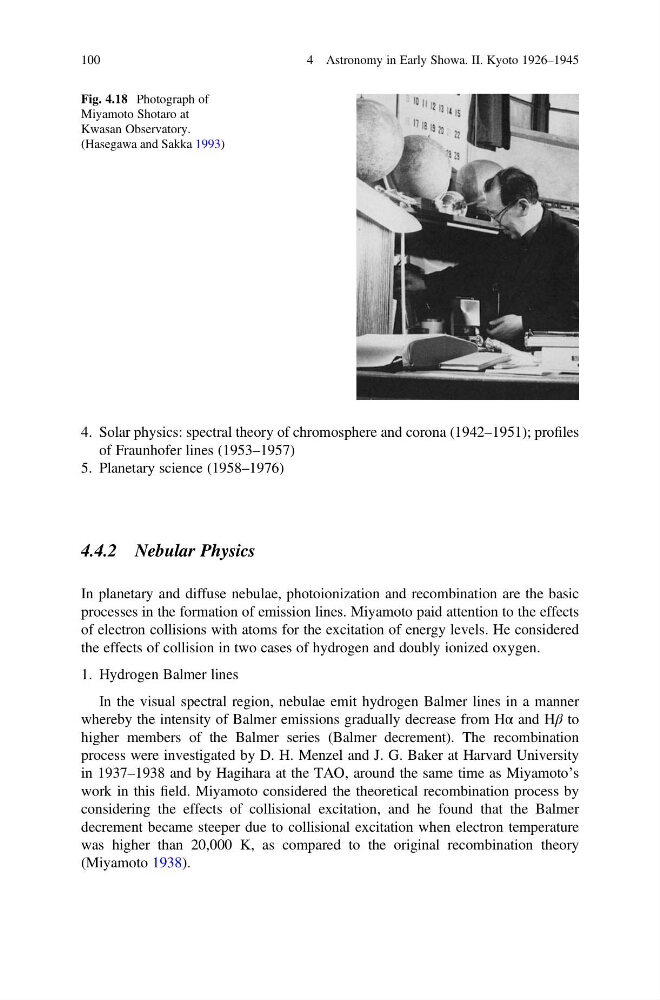
Fig. 4.18 Photograph of
Miyamoto Shotaro at
Kwasan Observatory.
(Hasegawa and Sakka 1993)
100
4 Astronomy in Early Showa. II. Kyoto 1926–1945
of Fraunhofer lines (1953–1957)
5. Planetary science (1958–1976)
4.4.2 Nebular Physics
In planetary and diffuse nebulae, photoionization and recombination are the basic
processes in the formation of emission lines. Miyamoto paid attention to the effects
of electron collisions with atoms for the excitation of energy levels. He considered
the effects of collision in two cases of hydrogen and doubly ionized oxygen.
1. Hydrogen Balmer lines
In the visual spectral region, nebulae emit hydrogen Balmer lines in a manner
whereby the intensity of Balmer emissions gradually decrease from Hα and Hβ to
higher members of the Balmer series (Balmer decrement). The recombination
process were investigated by D. H. Menzel and J. G. Baker at Harvard University
in 1937–1938 and by Hagihara at the TAO, around the same time as Miyamoto’s
work in this field. Miyamoto considered the theoretical recombination process by
considering the effects of collisional excitation, and he found that the Balmer
decrement became steeper due to collisional excitation when electron temperature
was higher than 20,000 K, as compared to the original recombination theory
(Miyamoto 1938).
Fig. 4.18 Photograph of
Miyamoto Shotaro at
Kwasan Observatory.
(Hasegawa and Sakka 1993)
100
4 Astronomy in Early Showa. II. Kyoto 1926–1945