

4.1 Optimization Strategies for Micromixers
49
were linearly combined using a weighting factor to yield a single-objective function. The other approach to multi-objective optimization uses multi-objective evolutionary algorithms (MOEAs), where multiple trade-off solutions for the objectives are
determined. The latest MOEAs include Pareto evolutionary algorithms [27], Pareto
archived evolutionary strategies [28] and an elitist non-dominated sorting genetic
algorithm [29].
Multi-objective problems yield many solutions, which are known as Paretooptimal solutions. These solutions can be used to analyze the trade-offs among
designs. A multi-objective genetic algorithm (MOGA) was used by Hossain et al.
[13] and Cortes-Quiroz et al. [26] for the shape optimizations of SHMs. The degree of
mixing and the pressure drop were used as the objective functions. A Pareto-optimal
front was established with an optimized trade-off between the maximum mixing
index and the minimum pressure loss. In another study, Cortes-Quiroz et al. [11]
carried out a multi-objective optimization of a passive micromixer with fin-shaped
baffles in a T-channel to obtain Pareto-optimal designs.
Afzal and Kim carried out multi-objective optimizations of a Sigma micromixer
[30], an SAR micromixer with convergent-divergent sinusoidal walls [31] and a
SHM [32]. Surrogate models, viz. RSA and RBNN were used to approximate the
objective functions: mixing index and non-dimensional pressure drop. The surrogate
models for the objectives were supplied as fitness functions to MOGA to obtain the
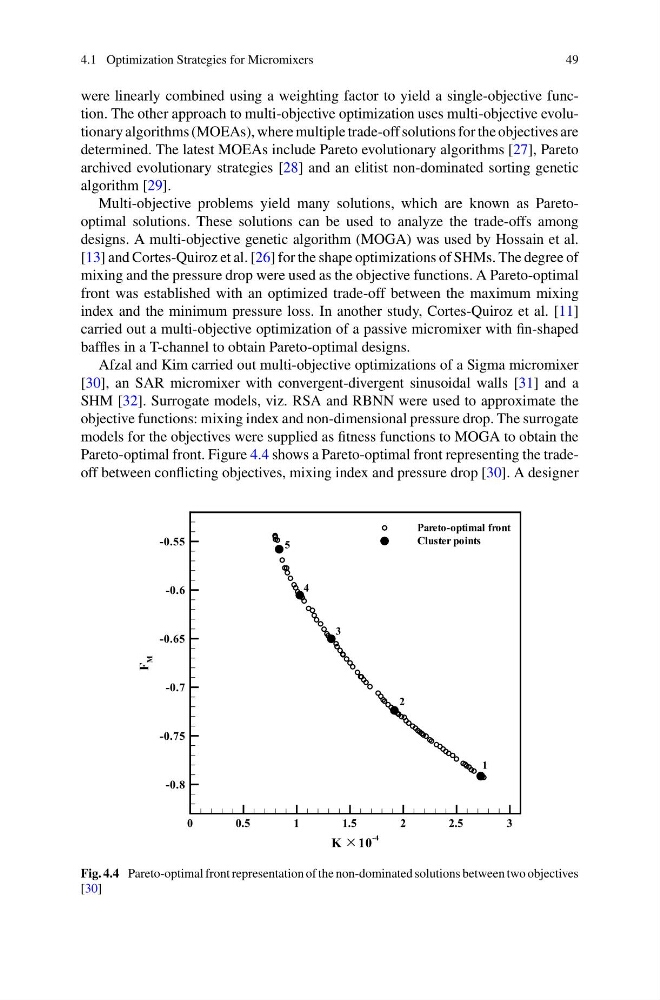
Pareto-optimal front. Figure 4.4 shows a Pareto-optimal front representing the tradeoff between conflicting objectives, mixing index and pressure drop [30]. A designer
K 10
-4
F
M
0
0.5
1
1.5
2
2.5
3
-0.8
-0.75
-0.7
-0.65
-0.6
-0.55
Pareto-optimal front
Cluster points
×
1
2
3
4
5
Fig. 4.4 Pareto-optimal front representation of the non-dominated solutions between two objectives
[30]
49
were linearly combined using a weighting factor to yield a single-objective function. The other approach to multi-objective optimization uses multi-objective evolutionary algorithms (MOEAs), where multiple trade-off solutions for the objectives are
determined. The latest MOEAs include Pareto evolutionary algorithms [27], Pareto
archived evolutionary strategies [28] and an elitist non-dominated sorting genetic
algorithm [29].
Multi-objective problems yield many solutions, which are known as Paretooptimal solutions. These solutions can be used to analyze the trade-offs among
designs. A multi-objective genetic algorithm (MOGA) was used by Hossain et al.
[13] and Cortes-Quiroz et al. [26] for the shape optimizations of SHMs. The degree of
mixing and the pressure drop were used as the objective functions. A Pareto-optimal
front was established with an optimized trade-off between the maximum mixing
index and the minimum pressure loss. In another study, Cortes-Quiroz et al. [11]
carried out a multi-objective optimization of a passive micromixer with fin-shaped
baffles in a T-channel to obtain Pareto-optimal designs.
Afzal and Kim carried out multi-objective optimizations of a Sigma micromixer
[30], an SAR micromixer with convergent-divergent sinusoidal walls [31] and a
SHM [32]. Surrogate models, viz. RSA and RBNN were used to approximate the
objective functions: mixing index and non-dimensional pressure drop. The surrogate
models for the objectives were supplied as fitness functions to MOGA to obtain the
Pareto-optimal front. Figure 4.4 shows a Pareto-optimal front representing the tradeoff between conflicting objectives, mixing index and pressure drop [30]. A designer
K 10
-4
F
M
0
0.5
1
1.5
2
2.5
3
-0.8
-0.75
-0.7
-0.65
-0.6
-0.55
Pareto-optimal front
Cluster points
×
1
2
3
4
5
Fig. 4.4 Pareto-optimal front representation of the non-dominated solutions between two objectives
[30]