

48
4 Design Optimization of Micromixers
The SHM developed by Stroock et al. [25] has been used by many researchers
to form a well-posed design optimization problem [9, 10, 13, 26]. As explained
earlier in various studies [3, 4], the groove shape can significantly affect the mixing
performance of SHMs. Ansari and Kim [9, 10] used radial basis neural network
(RBNN) and response surface approximation (RSA) models for surrogate modeling
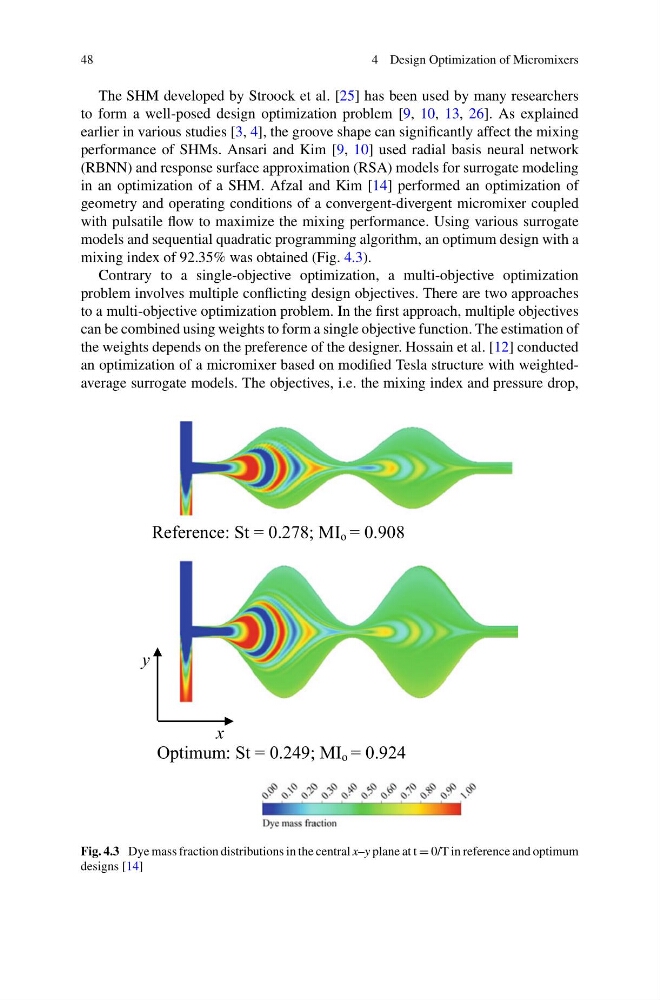
in an optimization of a SHM. Afzal and Kim [14] performed an optimization of
geometry and operating conditions of a convergent-divergent micromixer coupled
with pulsatile flow to maximize the mixing performance. Using various surrogate
models and sequential quadratic programming algorithm, an optimum design with a
mixing index of 92.35% was obtained (Fig. 4.3).
Contrary to a single-objective optimization, a multi-objective optimization
problem involves multiple conflicting design objectives. There are two approaches
to a multi-objective optimization problem. In the first approach, multiple objectives
can be combined using weights to form a single objective function. The estimation of
the weights depends on the preference of the designer. Hossain et al. [12] conducted
an optimization of a micromixer based on modified Tesla structure with weightedaverage surrogate models. The objectives, i.e. the mixing index and pressure drop,
Optimum: St = 0.249; MI o = 0.924
Reference: St = 0.278; MI o = 0.908
y
x
Fig. 4.3 Dye mass fraction distributions in the central x–y plane at t = 0/T in reference and optimum
designs [14]
4 Design Optimization of Micromixers
The SHM developed by Stroock et al. [25] has been used by many researchers
to form a well-posed design optimization problem [9, 10, 13, 26]. As explained
earlier in various studies [3, 4], the groove shape can significantly affect the mixing
performance of SHMs. Ansari and Kim [9, 10] used radial basis neural network
(RBNN) and response surface approximation (RSA) models for surrogate modeling
in an optimization of a SHM. Afzal and Kim [14] performed an optimization of
geometry and operating conditions of a convergent-divergent micromixer coupled
with pulsatile flow to maximize the mixing performance. Using various surrogate
models and sequential quadratic programming algorithm, an optimum design with a
mixing index of 92.35% was obtained (Fig. 4.3).
Contrary to a single-objective optimization, a multi-objective optimization
problem involves multiple conflicting design objectives. There are two approaches
to a multi-objective optimization problem. In the first approach, multiple objectives
can be combined using weights to form a single objective function. The estimation of
the weights depends on the preference of the designer. Hossain et al. [12] conducted
an optimization of a micromixer based on modified Tesla structure with weightedaverage surrogate models. The objectives, i.e. the mixing index and pressure drop,
Optimum: St = 0.249; MI o = 0.924
Reference: St = 0.278; MI o = 0.908
y
x
Fig. 4.3 Dye mass fraction distributions in the central x–y plane at t = 0/T in reference and optimum
designs [14]