

2.2 Passive Micromixers
23
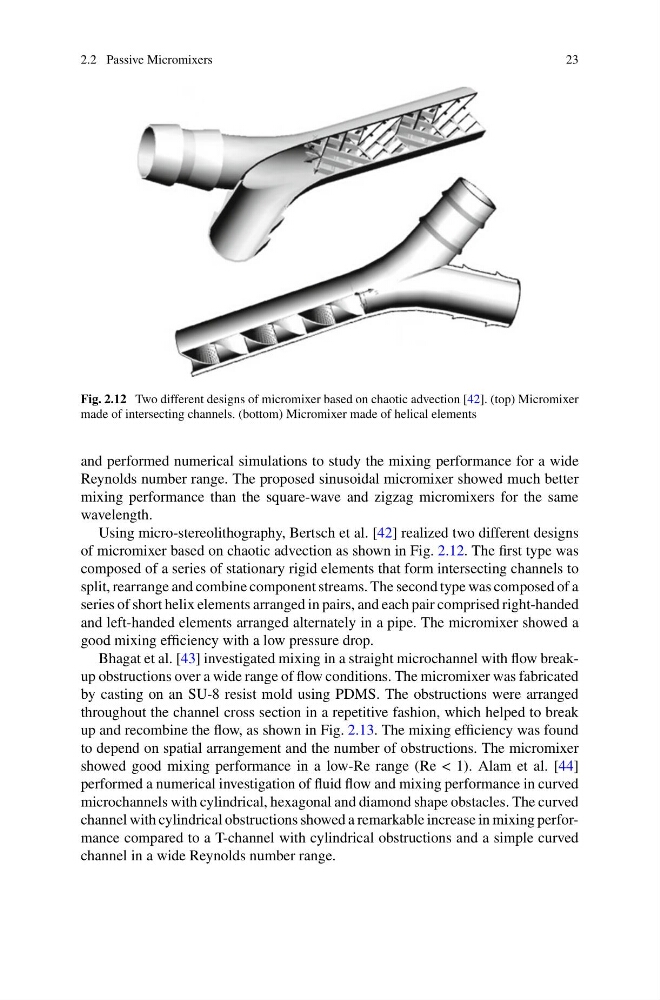
Fig. 2.12 Two different designs of micromixer based on chaotic advection [42]. (top) Micromixer
made of intersecting channels. (bottom) Micromixer made of helical elements
and performed numerical simulations to study the mixing performance for a wide
Reynolds number range. The proposed sinusoidal micromixer showed much better
mixing performance than the square-wave and zigzag micromixers for the same
wavelength.
Using micro-stereolithography, Bertsch et al. [42] realized two different designs
of micromixer based on chaotic advection as shown in Fig. 2.12. The first type was
composed of a series of stationary rigid elements that form intersecting channels to
split, rearrange and combine component streams. The second type was composed of a
series of short helix elements arranged in pairs, and each pair comprised right-handed
and left-handed elements arranged alternately in a pipe. The micromixer showed a
good mixing efficiency with a low pressure drop.
Bhagat et al. [43] investigated mixing in a straight microchannel with flow breakup obstructions over a wide range of flow conditions. The micromixer was fabricated
by casting on an SU-8 resist mold using PDMS. The obstructions were arranged
throughout the channel cross section in a repetitive fashion, which helped to break
up and recombine the flow, as shown in Fig. 2.13. The mixing efficiency was found
to depend on spatial arrangement and the number of obstructions. The micromixer
showed good mixing performance in a low-Re range (Re < 1). Alam et al. [44]
performed a numerical investigation of fluid flow and mixing performance in curved
microchannels with cylindrical, hexagonal and diamond shape obstacles. The curved
channel with cylindrical obstructions showed a remarkable increase in mixing performance compared to a T-channel with cylindrical obstructions and a simple curved
channel in a wide Reynolds number range.
23
Fig. 2.12 Two different designs of micromixer based on chaotic advection [42]. (top) Micromixer
made of intersecting channels. (bottom) Micromixer made of helical elements
and performed numerical simulations to study the mixing performance for a wide
Reynolds number range. The proposed sinusoidal micromixer showed much better
mixing performance than the square-wave and zigzag micromixers for the same
wavelength.
Using micro-stereolithography, Bertsch et al. [42] realized two different designs
of micromixer based on chaotic advection as shown in Fig. 2.12. The first type was
composed of a series of stationary rigid elements that form intersecting channels to
split, rearrange and combine component streams. The second type was composed of a
series of short helix elements arranged in pairs, and each pair comprised right-handed
and left-handed elements arranged alternately in a pipe. The micromixer showed a
good mixing efficiency with a low pressure drop.
Bhagat et al. [43] investigated mixing in a straight microchannel with flow breakup obstructions over a wide range of flow conditions. The micromixer was fabricated
by casting on an SU-8 resist mold using PDMS. The obstructions were arranged
throughout the channel cross section in a repetitive fashion, which helped to break
up and recombine the flow, as shown in Fig. 2.13. The mixing efficiency was found
to depend on spatial arrangement and the number of obstructions. The micromixer
showed good mixing performance in a low-Re range (Re < 1). Alam et al. [44]
performed a numerical investigation of fluid flow and mixing performance in curved
microchannels with cylindrical, hexagonal and diamond shape obstacles. The curved
channel with cylindrical obstructions showed a remarkable increase in mixing performance compared to a T-channel with cylindrical obstructions and a simple curved
channel in a wide Reynolds number range.