

22
2 Active and Passive Micromixers
= 3, the dye, which was introduced in the inner half of the channel, moves to the outer
half by the process of diffusion. On the other hand, a very rapid mixing was achieved
at Re = 30 due to strong Dean vortices developed in the channel. Jiang et al. [37]
used such secondary flows to induce chaotic mixing in the flows through meandering
channels. The secondary motions were characterized using Dean number. For low
values of Dean number, the secondary flow consisted of two counter-rotating vortices.
Above a critical value of Dean number, two additional counter-rotating vortices
appeared near the outer wall. The four-vortex pattern resulted in a rapid development
of mixing in the microchannel. However, the operating Reynolds number should be
sufficiently high (Re ~ 300) in order to utilize the full potential of the micromixer.
Liu et al. [38] studied experimentally the mixing in a 3D serpentine microchannel
with C-shaped repeating units in a Reynolds number range, 6 ≤ Re ≤ 70.
Using a double-sided KOH (Potassium Hydroxide) wet-etching technique, the 3D
micromixer was fabricated in a silicon wafer. The mixing capability of the micromixer
was found to increase with Reynolds number, and nearly complete mixing was
observed at Re = 70 with the occurrence of chaotic advection. The mixing performance of the 3D serpentine channel was found to be superior to that of a planar
serpentine channel.
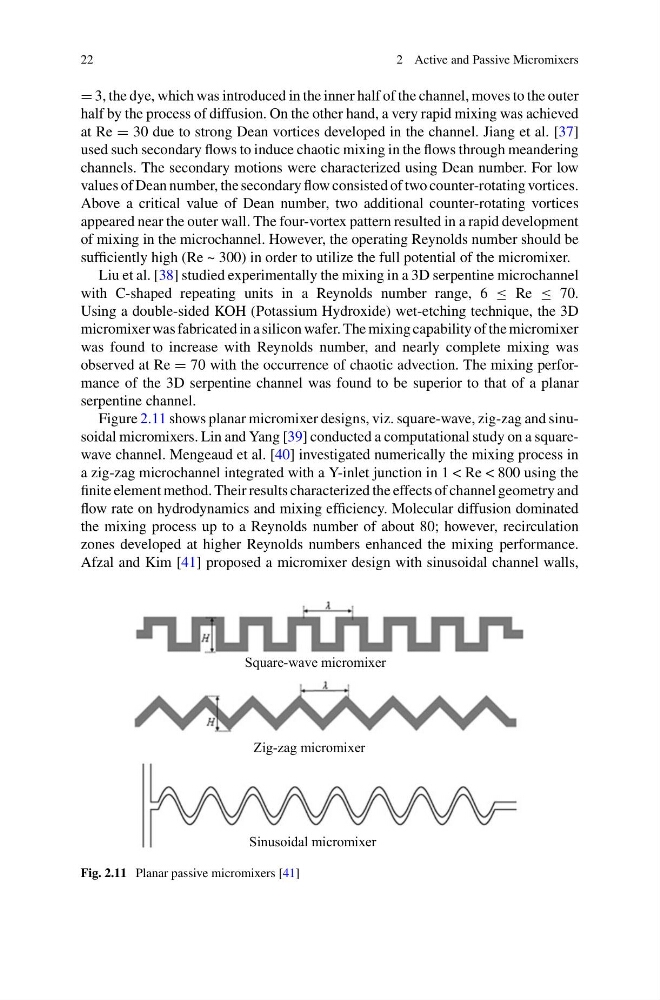
Figure 2.11 shows planar micromixer designs, viz. square-wave, zig-zag and sinusoidal micromixers. Lin and Yang [39] conducted a computational study on a squarewave channel. Mengeaud et al. [40] investigated numerically the mixing process in
a zig-zag microchannel integrated with a Y-inlet junction in 1 < Re < 800 using the
finite element method. Their results characterized the effects of channel geometry and
flow rate on hydrodynamics and mixing efficiency. Molecular diffusion dominated
the mixing process up to a Reynolds number of about 80; however, recirculation
zones developed at higher Reynolds numbers enhanced the mixing performance.
Afzal and Kim [41] proposed a micromixer design with sinusoidal channel walls,
Square-wave micromixer
Zig-zag micromixer
Sinusoidal micromixer
Fig. 2.11 Planar passive micromixers [41]
2 Active and Passive Micromixers
= 3, the dye, which was introduced in the inner half of the channel, moves to the outer
half by the process of diffusion. On the other hand, a very rapid mixing was achieved
at Re = 30 due to strong Dean vortices developed in the channel. Jiang et al. [37]
used such secondary flows to induce chaotic mixing in the flows through meandering
channels. The secondary motions were characterized using Dean number. For low
values of Dean number, the secondary flow consisted of two counter-rotating vortices.
Above a critical value of Dean number, two additional counter-rotating vortices
appeared near the outer wall. The four-vortex pattern resulted in a rapid development
of mixing in the microchannel. However, the operating Reynolds number should be
sufficiently high (Re ~ 300) in order to utilize the full potential of the micromixer.
Liu et al. [38] studied experimentally the mixing in a 3D serpentine microchannel
with C-shaped repeating units in a Reynolds number range, 6 ≤ Re ≤ 70.
Using a double-sided KOH (Potassium Hydroxide) wet-etching technique, the 3D
micromixer was fabricated in a silicon wafer. The mixing capability of the micromixer
was found to increase with Reynolds number, and nearly complete mixing was
observed at Re = 70 with the occurrence of chaotic advection. The mixing performance of the 3D serpentine channel was found to be superior to that of a planar
serpentine channel.
Figure 2.11 shows planar micromixer designs, viz. square-wave, zig-zag and sinusoidal micromixers. Lin and Yang [39] conducted a computational study on a squarewave channel. Mengeaud et al. [40] investigated numerically the mixing process in
a zig-zag microchannel integrated with a Y-inlet junction in 1 < Re < 800 using the
finite element method. Their results characterized the effects of channel geometry and
flow rate on hydrodynamics and mixing efficiency. Molecular diffusion dominated
the mixing process up to a Reynolds number of about 80; however, recirculation
zones developed at higher Reynolds numbers enhanced the mixing performance.
Afzal and Kim [41] proposed a micromixer design with sinusoidal channel walls,
Square-wave micromixer
Zig-zag micromixer
Sinusoidal micromixer
Fig. 2.11 Planar passive micromixers [41]