

2.2 Passive Micromixers
17
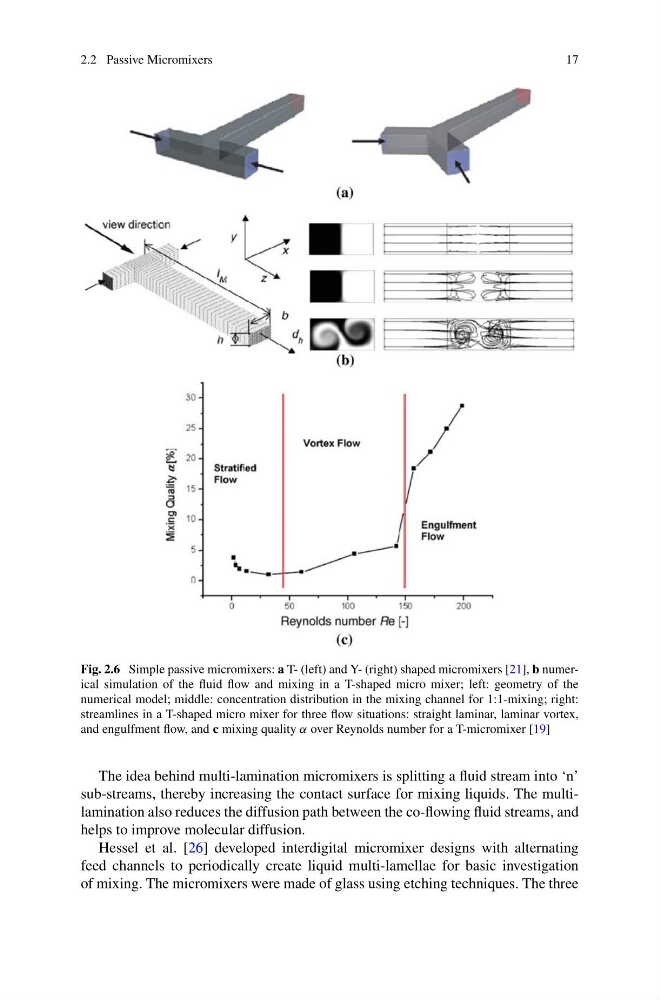
Fig. 2.6 Simple passive micromixers: a T- (left) and Y- (right) shaped micromixers [21], b numerical simulation of the fluid flow and mixing in a T-shaped micro mixer; left: geometry of the
numerical model; middle: concentration distribution in the mixing channel for 1:1-mixing; right:
streamlines in a T-shaped micro mixer for three flow situations: straight laminar, laminar vortex,
and engulfment flow, and c mixing quality α over Reynolds number for a T-micromixer [19]
The idea behind multi-lamination micromixers is splitting a fluid stream into ‘n’
sub-streams, thereby increasing the contact surface for mixing liquids. The multilamination also reduces the diffusion path between the co-flowing fluid streams, and
helps to improve molecular diffusion.
Hessel et al. [26] developed interdigital micromixer designs with alternating
feed channels to periodically create liquid multi-lamellae for basic investigation
of mixing. The micromixers were made of glass using etching techniques. The three
17
Fig. 2.6 Simple passive micromixers: a T- (left) and Y- (right) shaped micromixers [21], b numerical simulation of the fluid flow and mixing in a T-shaped micro mixer; left: geometry of the
numerical model; middle: concentration distribution in the mixing channel for 1:1-mixing; right:
streamlines in a T-shaped micro mixer for three flow situations: straight laminar, laminar vortex,
and engulfment flow, and c mixing quality α over Reynolds number for a T-micromixer [19]
The idea behind multi-lamination micromixers is splitting a fluid stream into ‘n’
sub-streams, thereby increasing the contact surface for mixing liquids. The multilamination also reduces the diffusion path between the co-flowing fluid streams, and
helps to improve molecular diffusion.
Hessel et al. [26] developed interdigital micromixer designs with alternating
feed channels to periodically create liquid multi-lamellae for basic investigation
of mixing. The micromixers were made of glass using etching techniques. The three