

16
2 Active and Passive Micromixers
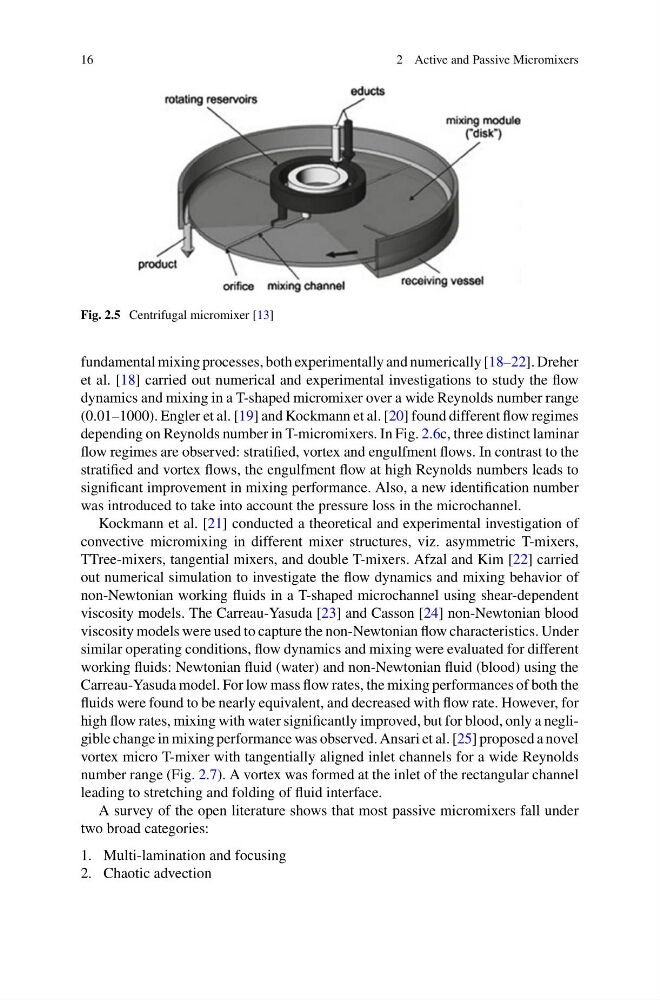
Fig. 2.5 Centrifugal micromixer [13]
fundamental mixing processes, both experimentally and numerically [18–22]. Dreher
et al. [18] carried out numerical and experimental investigations to study the flow
dynamics and mixing in a T-shaped micromixer over a wide Reynolds number range
(0.01–1000). Engler et al. [19] and Kockmann et al. [20] found different flow regimes
depending on Reynolds number in T-micromixers. In Fig. 2.6c, three distinct laminar
flow regimes are observed: stratified, vortex and engulfment flows. In contrast to the
stratified and vortex flows, the engulfment flow at high Reynolds numbers leads to
significant improvement in mixing performance. Also, a new identification number
was introduced to take into account the pressure loss in the microchannel.
Kockmann et al. [21] conducted a theoretical and experimental investigation of
convective micromixing in different mixer structures, viz. asymmetric T-mixers,
TTree-mixers, tangential mixers, and double T-mixers. Afzal and Kim [22] carried
out numerical simulation to investigate the flow dynamics and mixing behavior of
non-Newtonian working fluids in a T-shaped microchannel using shear-dependent
viscosity models. The Carreau-Yasuda [23] and Casson [24] non-Newtonian blood
viscosity models were used to capture the non-Newtonian flow characteristics. Under
similar operating conditions, flow dynamics and mixing were evaluated for different
working fluids: Newtonian fluid (water) and non-Newtonian fluid (blood) using the
Carreau-Yasuda model. For low mass flow rates, the mixing performances of both the
fluids were found to be nearly equivalent, and decreased with flow rate. However, for
high flow rates, mixing with water significantly improved, but for blood, only a negligible change in mixing performance was observed. Ansari et al. [25] proposed a novel
vortex micro T-mixer with tangentially aligned inlet channels for a wide Reynolds
number range (Fig. 2.7). A vortex was formed at the inlet of the rectangular channel
leading to stretching and folding of fluid interface.
A survey of the open literature shows that most passive micromixers fall under
two broad categories:
1. Multi-lamination and focusing
2. Chaotic advection
2 Active and Passive Micromixers
Fig. 2.5 Centrifugal micromixer [13]
fundamental mixing processes, both experimentally and numerically [18–22]. Dreher
et al. [18] carried out numerical and experimental investigations to study the flow
dynamics and mixing in a T-shaped micromixer over a wide Reynolds number range
(0.01–1000). Engler et al. [19] and Kockmann et al. [20] found different flow regimes
depending on Reynolds number in T-micromixers. In Fig. 2.6c, three distinct laminar
flow regimes are observed: stratified, vortex and engulfment flows. In contrast to the
stratified and vortex flows, the engulfment flow at high Reynolds numbers leads to
significant improvement in mixing performance. Also, a new identification number
was introduced to take into account the pressure loss in the microchannel.
Kockmann et al. [21] conducted a theoretical and experimental investigation of
convective micromixing in different mixer structures, viz. asymmetric T-mixers,
TTree-mixers, tangential mixers, and double T-mixers. Afzal and Kim [22] carried
out numerical simulation to investigate the flow dynamics and mixing behavior of
non-Newtonian working fluids in a T-shaped microchannel using shear-dependent
viscosity models. The Carreau-Yasuda [23] and Casson [24] non-Newtonian blood
viscosity models were used to capture the non-Newtonian flow characteristics. Under
similar operating conditions, flow dynamics and mixing were evaluated for different
working fluids: Newtonian fluid (water) and non-Newtonian fluid (blood) using the
Carreau-Yasuda model. For low mass flow rates, the mixing performances of both the
fluids were found to be nearly equivalent, and decreased with flow rate. However, for
high flow rates, mixing with water significantly improved, but for blood, only a negligible change in mixing performance was observed. Ansari et al. [25] proposed a novel
vortex micro T-mixer with tangentially aligned inlet channels for a wide Reynolds
number range (Fig. 2.7). A vortex was formed at the inlet of the rectangular channel
leading to stretching and folding of fluid interface.
A survey of the open literature shows that most passive micromixers fall under
two broad categories:
1. Multi-lamination and focusing
2. Chaotic advection