

18
2 Active and Passive Micromixers
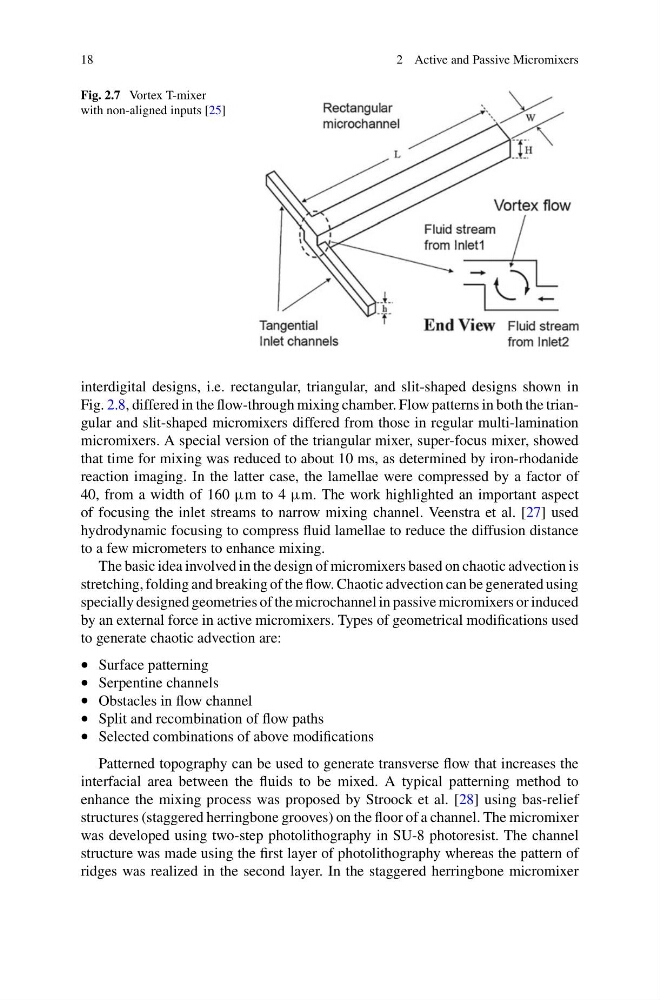
Fig. 2.7 Vortex T-mixer
with non-aligned inputs [25]
interdigital designs, i.e. rectangular, triangular, and slit-shaped designs shown in
Fig. 2.8, differed in the flow-through mixing chamber. Flow patterns in both the triangular and slit-shaped micromixers differed from those in regular multi-lamination
micromixers. A special version of the triangular mixer, super-focus mixer, showed
that time for mixing was reduced to about 10 ms, as determined by iron-rhodanide
reaction imaging. In the latter case, the lamellae were compressed by a factor of
40, from a width of 160 μm to 4 μm. The work highlighted an important aspect
of focusing the inlet streams to narrow mixing channel. Veenstra et al. [27] used
hydrodynamic focusing to compress fluid lamellae to reduce the diffusion distance
to a few micrometers to enhance mixing.
The basic idea involved in the design of micromixers based on chaotic advection is
stretching, folding and breaking of the flow. Chaotic advection can be generated using
specially designed geometries of the microchannel in passive micromixers or induced
by an external force in active micromixers. Types of geometrical modifications used
to generate chaotic advection are:
• Surface patterning
• Serpentine channels
• Obstacles in flow channel
• Split and recombination of flow paths
• Selected combinations of above modifications
Patterned topography can be used to generate transverse flow that increases the
interfacial area between the fluids to be mixed. A typical patterning method to
enhance the mixing process was proposed by Stroock et al. [28] using bas-relief
structures (staggered herringbone grooves) on the floor of a channel. The micromixer
was developed using two-step photolithography in SU-8 photoresist. The channel
structure was made using the first layer of photolithography whereas the pattern of
ridges was realized in the second layer. In the staggered herringbone micromixer
2 Active and Passive Micromixers
Fig. 2.7 Vortex T-mixer
with non-aligned inputs [25]
interdigital designs, i.e. rectangular, triangular, and slit-shaped designs shown in
Fig. 2.8, differed in the flow-through mixing chamber. Flow patterns in both the triangular and slit-shaped micromixers differed from those in regular multi-lamination
micromixers. A special version of the triangular mixer, super-focus mixer, showed
that time for mixing was reduced to about 10 ms, as determined by iron-rhodanide
reaction imaging. In the latter case, the lamellae were compressed by a factor of
40, from a width of 160 μm to 4 μm. The work highlighted an important aspect
of focusing the inlet streams to narrow mixing channel. Veenstra et al. [27] used
hydrodynamic focusing to compress fluid lamellae to reduce the diffusion distance
to a few micrometers to enhance mixing.
The basic idea involved in the design of micromixers based on chaotic advection is
stretching, folding and breaking of the flow. Chaotic advection can be generated using
specially designed geometries of the microchannel in passive micromixers or induced
by an external force in active micromixers. Types of geometrical modifications used
to generate chaotic advection are:
• Surface patterning
• Serpentine channels
• Obstacles in flow channel
• Split and recombination of flow paths
• Selected combinations of above modifications
Patterned topography can be used to generate transverse flow that increases the
interfacial area between the fluids to be mixed. A typical patterning method to
enhance the mixing process was proposed by Stroock et al. [28] using bas-relief
structures (staggered herringbone grooves) on the floor of a channel. The micromixer
was developed using two-step photolithography in SU-8 photoresist. The channel
structure was made using the first layer of photolithography whereas the pattern of
ridges was realized in the second layer. In the staggered herringbone micromixer