

3.3 Scenario Analysis
Scenario analysis is a method, where boundary conditions (i.e. type of process and
associated quantity) of some of the key process parameters are modified in the
inventory, in order to analyse the variation induced on LCIA results. Scenario
analysis can be a powerful method to identify different potential strategies supporting the optimisation of product’s environmental performance.
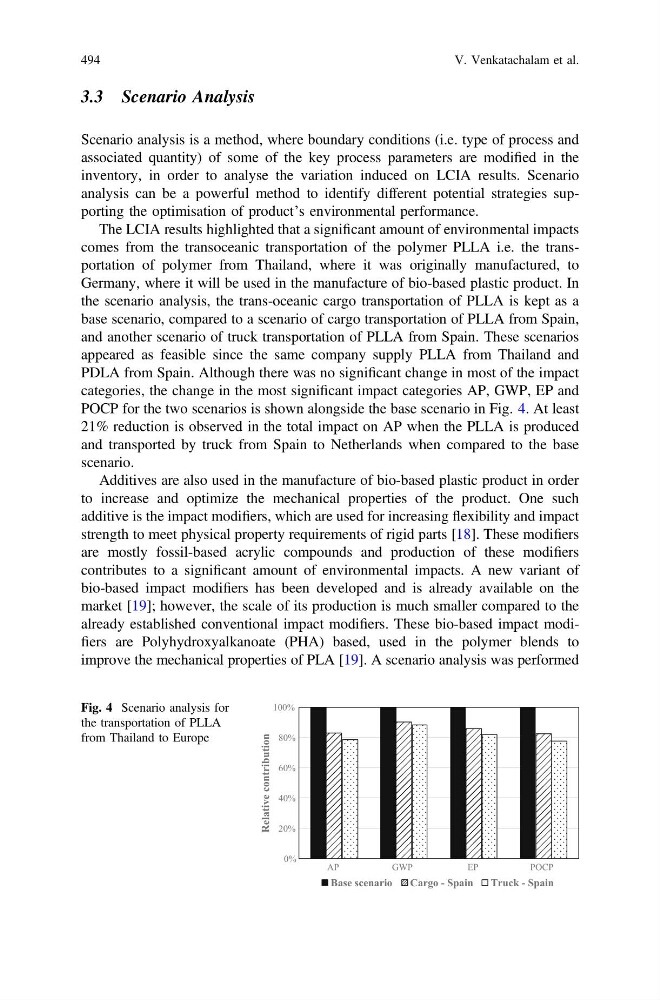
The LCIA results highlighted that a significant amount of environmental impacts
comes from the transoceanic transportation of the polymer PLLA i.e. the transportation of polymer from Thailand, where it was originally manufactured, to
Germany, where it will be used in the manufacture of bio-based plastic product. In
the scenario analysis, the trans-oceanic cargo transportation of PLLA is kept as a
base scenario, compared to a scenario of cargo transportation of PLLA from Spain,
and another scenario of truck transportation of PLLA from Spain. These scenarios
appeared as feasible since the same company supply PLLA from Thailand and
PDLA from Spain. Although there was no significant change in most of the impact
categories, the change in the most significant impact categories AP, GWP, EP and
POCP for the two scenarios is shown alongside the base scenario in Fig. 4. At least
21% reduction is observed in the total impact on AP when the PLLA is produced
and transported by truck from Spain to Netherlands when compared to the base
scenario.
Additives are also used in the manufacture of bio-based plastic product in order
to increase and optimize the mechanical properties of the product. One such
additive is the impact modifiers, which are used for increasing flexibility and impact
strength to meet physical property requirements of rigid parts [18]. These modifiers
are mostly fossil-based acrylic compounds and production of these modifiers
contributes to a significant amount of environmental impacts. A new variant of
bio-based impact modifiers has been developed and is already available on the
market [19]; however, the scale of its production is much smaller compared to the
already established conventional impact modifiers. These bio-based impact modifiers are Polyhydroxyalkanoate (PHA) based, used in the polymer blends to
improve the mechanical properties of PLA [19]. A scenario analysis was performed
0%
20%
40%
60%
80%
100%
AP
GWP
EP
POCP
Relative contribution
Base scenario
Cargo - Spain
Truck - Spain
Fig. 4 Scenario analysis for
the transportation of PLLA
from Thailand to Europe
494
V. Venkatachalam et al.
Scenario analysis is a method, where boundary conditions (i.e. type of process and
associated quantity) of some of the key process parameters are modified in the
inventory, in order to analyse the variation induced on LCIA results. Scenario
analysis can be a powerful method to identify different potential strategies supporting the optimisation of product’s environmental performance.
The LCIA results highlighted that a significant amount of environmental impacts
comes from the transoceanic transportation of the polymer PLLA i.e. the transportation of polymer from Thailand, where it was originally manufactured, to
Germany, where it will be used in the manufacture of bio-based plastic product. In
the scenario analysis, the trans-oceanic cargo transportation of PLLA is kept as a
base scenario, compared to a scenario of cargo transportation of PLLA from Spain,
and another scenario of truck transportation of PLLA from Spain. These scenarios
appeared as feasible since the same company supply PLLA from Thailand and
PDLA from Spain. Although there was no significant change in most of the impact
categories, the change in the most significant impact categories AP, GWP, EP and
POCP for the two scenarios is shown alongside the base scenario in Fig. 4. At least
21% reduction is observed in the total impact on AP when the PLLA is produced
and transported by truck from Spain to Netherlands when compared to the base
scenario.
Additives are also used in the manufacture of bio-based plastic product in order
to increase and optimize the mechanical properties of the product. One such
additive is the impact modifiers, which are used for increasing flexibility and impact
strength to meet physical property requirements of rigid parts [18]. These modifiers
are mostly fossil-based acrylic compounds and production of these modifiers
contributes to a significant amount of environmental impacts. A new variant of
bio-based impact modifiers has been developed and is already available on the
market [19]; however, the scale of its production is much smaller compared to the
already established conventional impact modifiers. These bio-based impact modifiers are Polyhydroxyalkanoate (PHA) based, used in the polymer blends to
improve the mechanical properties of PLA [19]. A scenario analysis was performed
0%
20%
40%
60%
80%
100%
AP
GWP
EP
POCP
Relative contribution
Base scenario
Cargo - Spain
Truck - Spain
Fig. 4 Scenario analysis for
the transportation of PLLA
from Thailand to Europe
494
V. Venkatachalam et al.