

with the replacement of the fossil-based impact modifiers by PHA based additives.
Eco-design strategies were identified based on these scenario analyses.
4 Identification of Eco-design Strategies
From the LCIA results and scenario analysis, considered together with costs and
materials properties, eco-design strategies have been proposed and some of the
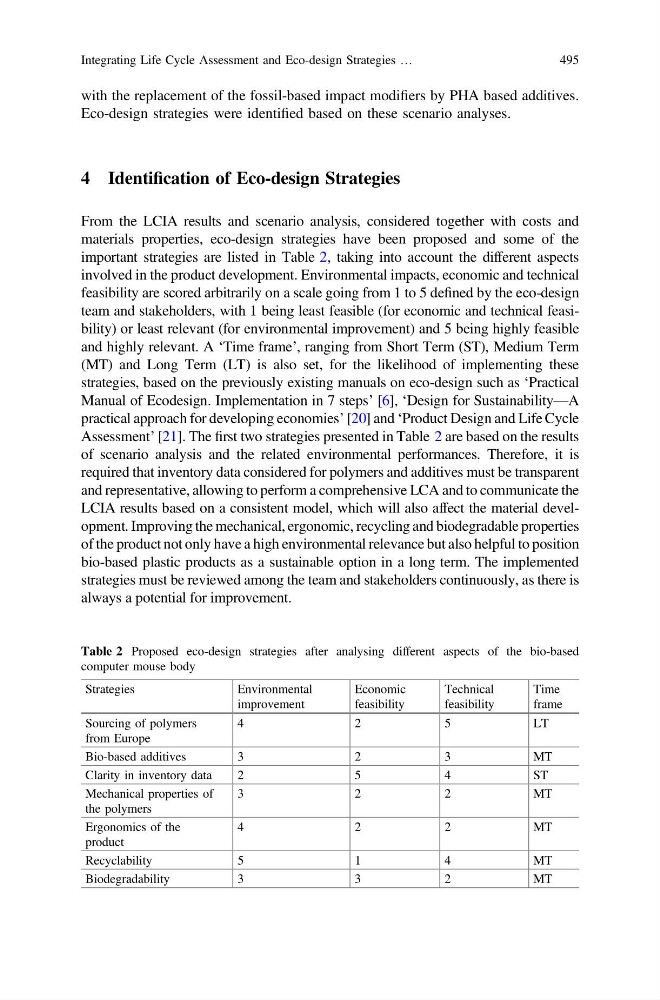
important strategies are listed in Table 2, taking into account the different aspects
involved in the product development. Environmental impacts, economic and technical
feasibility are scored arbitrarily on a scale going from 1 to 5 defined by the eco-design
team and stakeholders, with 1 being least feasible (for economic and technical feasibility) or least relevant (for environmental improvement) and 5 being highly feasible
and highly relevant. A ‘Time frame’, ranging from Short Term (ST), Medium Term
(MT) and Long Term (LT) is also set, for the likelihood of implementing these
strategies, based on the previously existing manuals on eco-design such as ‘Practical
Manual of Ecodesign. Implementation in 7 steps’ [6], ‘Design for Sustainability—A
practical approach for developing economies’ [20] and ‘Product Design and Life Cycle
Assessment’ [21]. The first two strategies presented in Table 2 are based on the results
of scenario analysis and the related environmental performances. Therefore, it is
required that inventory data considered for polymers and additives must be transparent
and representative, allowing to perform a comprehensive LCA and to communicate the
LCIA results based on a consistent model, which will also affect the material development. Improving the mechanical, ergonomic, recycling and biodegradable properties
of the product not only have a high environmental relevance but also helpful to position
bio-based plastic products as a sustainable option in a long term. The implemented
strategies must be reviewed among the team and stakeholders continuously, as there is
always a potential for improvement.
Table 2 Proposed eco-design strategies after analysing different aspects of the bio-based
computer mouse body
Strategies
Environmental
improvement
Economic
feasibility
Technical
feasibility
Time
frame
Sourcing of polymers
from Europe
4
2
5
L T
Bio-based additives
3
2
3
MT
Clarity in inventory data
2
5
4
ST
Mechanical properties of
the polymers
3
2
2
M T
Ergonomics of the
product
4
2
2
M T
Recyclability
5
1
4
MT
Biodegradability
3
3
2
MT
Integrating Life Cycle Assessment and Eco-design Strategies …
495
Eco-design strategies were identified based on these scenario analyses.
4 Identification of Eco-design Strategies
From the LCIA results and scenario analysis, considered together with costs and
materials properties, eco-design strategies have been proposed and some of the
important strategies are listed in Table 2, taking into account the different aspects
involved in the product development. Environmental impacts, economic and technical
feasibility are scored arbitrarily on a scale going from 1 to 5 defined by the eco-design
team and stakeholders, with 1 being least feasible (for economic and technical feasibility) or least relevant (for environmental improvement) and 5 being highly feasible
and highly relevant. A ‘Time frame’, ranging from Short Term (ST), Medium Term
(MT) and Long Term (LT) is also set, for the likelihood of implementing these
strategies, based on the previously existing manuals on eco-design such as ‘Practical
Manual of Ecodesign. Implementation in 7 steps’ [6], ‘Design for Sustainability—A
practical approach for developing economies’ [20] and ‘Product Design and Life Cycle
Assessment’ [21]. The first two strategies presented in Table 2 are based on the results
of scenario analysis and the related environmental performances. Therefore, it is
required that inventory data considered for polymers and additives must be transparent
and representative, allowing to perform a comprehensive LCA and to communicate the
LCIA results based on a consistent model, which will also affect the material development. Improving the mechanical, ergonomic, recycling and biodegradable properties
of the product not only have a high environmental relevance but also helpful to position
bio-based plastic products as a sustainable option in a long term. The implemented
strategies must be reviewed among the team and stakeholders continuously, as there is
always a potential for improvement.
Table 2 Proposed eco-design strategies after analysing different aspects of the bio-based
computer mouse body
Strategies
Environmental
improvement
Economic
feasibility
Technical
feasibility
Time
frame
Sourcing of polymers
from Europe
4
2
5
L T
Bio-based additives
3
2
3
MT
Clarity in inventory data
2
5
4
ST
Mechanical properties of
the polymers
3
2
2
M T
Ergonomics of the
product
4
2
2
M T
Recyclability
5
1
4
MT
Biodegradability
3
3
2
MT
Integrating Life Cycle Assessment and Eco-design Strategies …
495