

Let’s assume a static state of the economy and disregard any consideration about
the dynamic of economic activity over time. If we consider CE assessment to be
bidimensional—related to the 2 subsets of use of the environment—then we
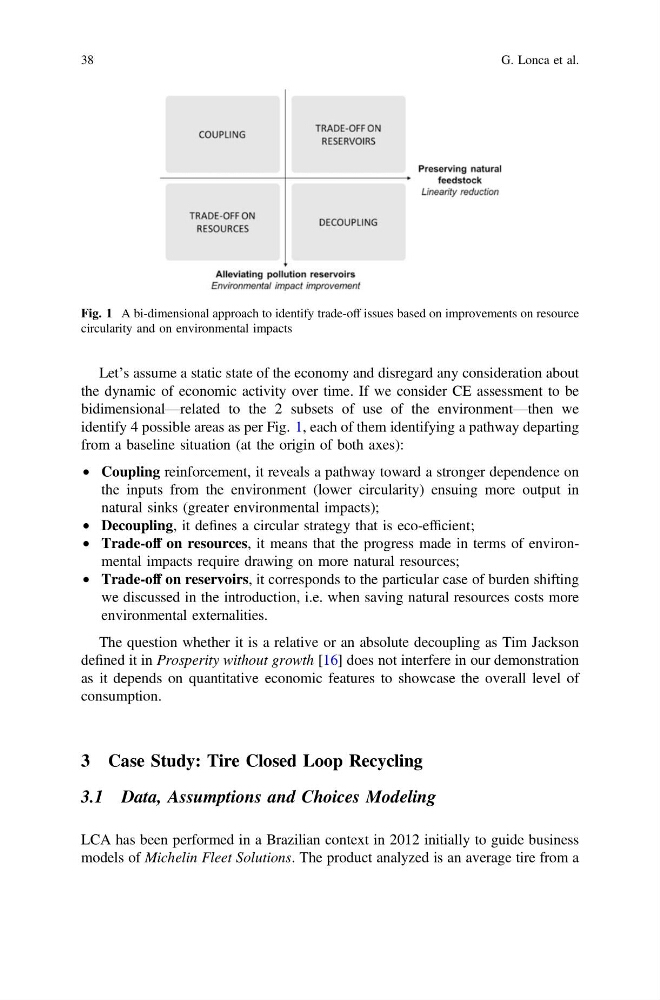
identify 4 possible areas as per Fig. 1, each of them identifying a pathway departing
from a baseline situation (at the origin of both axes):
• Coupling reinforcement, it reveals a pathway toward a stronger dependence on
the inputs from the environment (lower circularity) ensuing more output in
natural sinks (greater environmental impacts);
• Decoupling, it defines a circular strategy that is eco-efficient;
• Trade-off on resources, it means that the progress made in terms of environmental impacts require drawing on more natural resources;
• Trade-off on reservoirs, it corresponds to the particular case of burden shifting
we discussed in the introduction, i.e. when saving natural resources costs more
environmental externalities.
The question whether it is a relative or an absolute decoupling as Tim Jackson
defined it in Prosperity without growth [16] does not interfere in our demonstration
as it depends on quantitative economic features to showcase the overall level of
consumption.
3 Case Study: Tire Closed Loop Recycling
3.1 Data, Assumptions and Choices Modeling
LCA has been performed in a Brazilian context in 2012 initially to guide business
models of Michelin Fleet Solutions. The product analyzed is an average tire from a
Fig. 1 A bi-dimensional approach to identify trade-off issues based on improvements on resource
circularity and on environmental impacts
38
G. Lonca et al.
the dynamic of economic activity over time. If we consider CE assessment to be
bidimensional—related to the 2 subsets of use of the environment—then we
identify 4 possible areas as per Fig. 1, each of them identifying a pathway departing
from a baseline situation (at the origin of both axes):
• Coupling reinforcement, it reveals a pathway toward a stronger dependence on
the inputs from the environment (lower circularity) ensuing more output in
natural sinks (greater environmental impacts);
• Decoupling, it defines a circular strategy that is eco-efficient;
• Trade-off on resources, it means that the progress made in terms of environmental impacts require drawing on more natural resources;
• Trade-off on reservoirs, it corresponds to the particular case of burden shifting
we discussed in the introduction, i.e. when saving natural resources costs more
environmental externalities.
The question whether it is a relative or an absolute decoupling as Tim Jackson
defined it in Prosperity without growth [16] does not interfere in our demonstration
as it depends on quantitative economic features to showcase the overall level of
consumption.
3 Case Study: Tire Closed Loop Recycling
3.1 Data, Assumptions and Choices Modeling
LCA has been performed in a Brazilian context in 2012 initially to guide business
models of Michelin Fleet Solutions. The product analyzed is an average tire from a
Fig. 1 A bi-dimensional approach to identify trade-off issues based on improvements on resource
circularity and on environmental impacts
38
G. Lonca et al.