

haulage truck with 32 tons’ average load which usual lifetime is 600,000 km. Data
come from the Research Center of Michelin in Clermont-Ferrand (France) and the
EcoInvent 2.2 database.
Hereafter is some relevant features to interpret the results. 63.5% of end-of-life
tires go to energy recovery in cement clink processes and 36.5% go to material
recovery (data initially retrieved from the organization responsible for collecting
end-of-life tires in Brazil, Reciclanip, in 2012). For every multifunctional process of
different recovery route but cast iron and extended boundaries have been considered
and the co-products issued from soy esterification were considered through economic allocation. The method ReCiPe (Hierarchical perspective) Endpoint has been
used to perform LCA results. For the MCI, the weighting approach for the
re-treading case has been used, as per Eq. 11.
It has been assumed that tires are re-treaded 1.5 times on average after their
first use. A 13.90 kg re-treaded rubber band (on average) replaces a tread one
weighting 20.78 kg on average. Tire lifetime after being re-treaded is assumed to be
equal to its original lifetime. However, fuel consumption increases 6.8%, i.e. from
12.04 l/100 to 12.87 l/100 km attributable to the re-treaded tire due to an increasing
rolling resistance. In Brazil, haulage trucks consume Biofuel B5 from soy esterification. Re-grooving increases tire lifetime 30.46% on average and decreases the
fuel consumption to 11.39 l/100 km (−5.4%).
3.2 Results
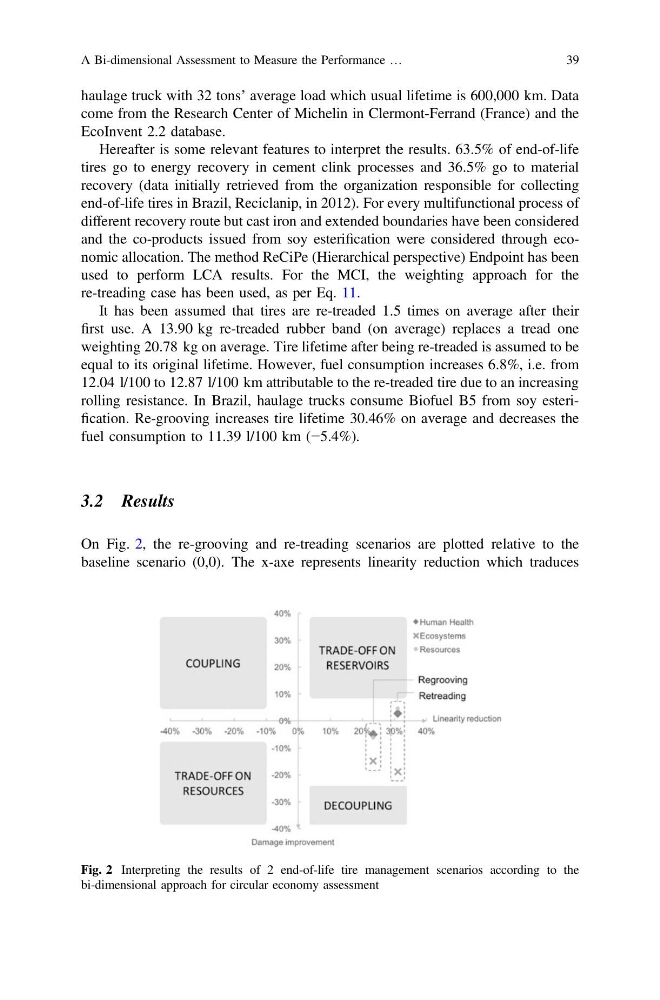
On Fig. 2, the re-grooving and re-treading scenarios are plotted relative to the
baseline scenario (0,0). The x-axe represents linearity reduction which traduces
Fig. 2 Interpreting the results of 2 end-of-life tire management scenarios according to the
bi-dimensional approach for circular economy assessment
A Bi-dimensional Assessment to Measure the Performance …
39
come from the Research Center of Michelin in Clermont-Ferrand (France) and the
EcoInvent 2.2 database.
Hereafter is some relevant features to interpret the results. 63.5% of end-of-life
tires go to energy recovery in cement clink processes and 36.5% go to material
recovery (data initially retrieved from the organization responsible for collecting
end-of-life tires in Brazil, Reciclanip, in 2012). For every multifunctional process of
different recovery route but cast iron and extended boundaries have been considered
and the co-products issued from soy esterification were considered through economic allocation. The method ReCiPe (Hierarchical perspective) Endpoint has been
used to perform LCA results. For the MCI, the weighting approach for the
re-treading case has been used, as per Eq. 11.
It has been assumed that tires are re-treaded 1.5 times on average after their
first use. A 13.90 kg re-treaded rubber band (on average) replaces a tread one
weighting 20.78 kg on average. Tire lifetime after being re-treaded is assumed to be
equal to its original lifetime. However, fuel consumption increases 6.8%, i.e. from
12.04 l/100 to 12.87 l/100 km attributable to the re-treaded tire due to an increasing
rolling resistance. In Brazil, haulage trucks consume Biofuel B5 from soy esterification. Re-grooving increases tire lifetime 30.46% on average and decreases the
fuel consumption to 11.39 l/100 km (−5.4%).
3.2 Results
On Fig. 2, the re-grooving and re-treading scenarios are plotted relative to the
baseline scenario (0,0). The x-axe represents linearity reduction which traduces
Fig. 2 Interpreting the results of 2 end-of-life tire management scenarios according to the
bi-dimensional approach for circular economy assessment
A Bi-dimensional Assessment to Measure the Performance …
39