

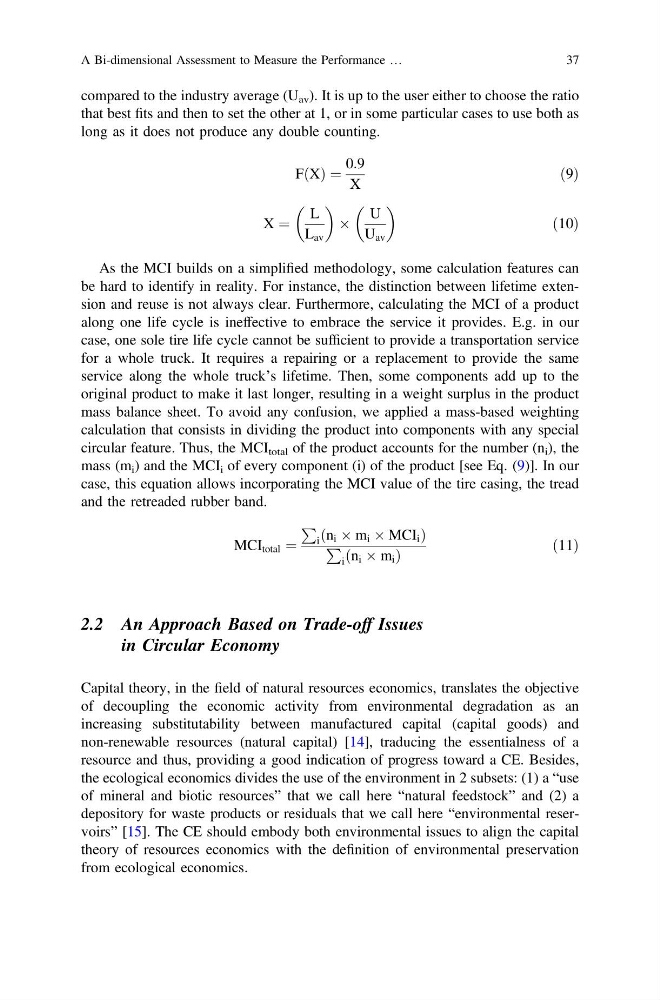
compared to the industry average (U av ). It is up to the user either to choose the ratio
that best fits and then to set the other at 1, or in some particular cases to use both as
long as it does not produce any double counting.
F X
ð Þ ¼
0:9
X
ð9Þ
X ¼
L
L av
Â
U
U av
ð10Þ
As the MCI builds on a simplified methodology, some calculation features can
be hard to identify in reality. For instance, the distinction between lifetime extension and reuse is not always clear. Furthermore, calculating the MCI of a product
along one life cycle is ineffective to embrace the service it provides. E.g. in our
case, one sole tire life cycle cannot be sufficient to provide a transportation service
for a whole truck. It requires a repairing or a replacement to provide the same
service along the whole truck’s lifetime. Then, some components add up to the
original product to make it last longer, resulting in a weight surplus in the product
mass balance sheet. To avoid any confusion, we applied a mass-based weighting
calculation that consists in dividing the product into components with any special
circular feature. Thus, the MCI total of the product accounts for the number (n i ), the
mass (m i ) and the MCI i of every component (i) of the product [see Eq. (9)]. In our
case, this equation allows incorporating the MCI value of the tire casing, the tread
and the retreaded rubber band.
MCI total ¼
P
i n i  m i  MCI i
ð
Þ
P
i ðn i  m i Þ
ð11Þ
2.2 An Approach Based on Trade-off Issues
in Circular Economy
Capital theory, in the field of natural resources economics, translates the objective
of decoupling the economic activity from environmental degradation as an
increasing substitutability between manufactured capital (capital goods) and
non-renewable resources (natural capital) [14], traducing the essentialness of a
resource and thus, providing a good indication of progress toward a CE. Besides,
the ecological economics divides the use of the environment in 2 subsets: (1) a “use
of mineral and biotic resources” that we call here “natural feedstock” and (2) a
depository for waste products or residuals that we call here “environmental reservoirs” [15]. The CE should embody both environmental issues to align the capital
theory of resources economics with the definition of environmental preservation
from ecological economics.
A Bi-dimensional Assessment to Measure the Performance …
37
that best fits and then to set the other at 1, or in some particular cases to use both as
long as it does not produce any double counting.
F X
ð Þ ¼
0:9
X
ð9Þ
X ¼
L
L av
Â
U
U av
ð10Þ
As the MCI builds on a simplified methodology, some calculation features can
be hard to identify in reality. For instance, the distinction between lifetime extension and reuse is not always clear. Furthermore, calculating the MCI of a product
along one life cycle is ineffective to embrace the service it provides. E.g. in our
case, one sole tire life cycle cannot be sufficient to provide a transportation service
for a whole truck. It requires a repairing or a replacement to provide the same
service along the whole truck’s lifetime. Then, some components add up to the
original product to make it last longer, resulting in a weight surplus in the product
mass balance sheet. To avoid any confusion, we applied a mass-based weighting
calculation that consists in dividing the product into components with any special
circular feature. Thus, the MCI total of the product accounts for the number (n i ), the
mass (m i ) and the MCI i of every component (i) of the product [see Eq. (9)]. In our
case, this equation allows incorporating the MCI value of the tire casing, the tread
and the retreaded rubber band.
MCI total ¼
P
i n i  m i  MCI i
ð
Þ
P
i ðn i  m i Þ
ð11Þ
2.2 An Approach Based on Trade-off Issues
in Circular Economy
Capital theory, in the field of natural resources economics, translates the objective
of decoupling the economic activity from environmental degradation as an
increasing substitutability between manufactured capital (capital goods) and
non-renewable resources (natural capital) [14], traducing the essentialness of a
resource and thus, providing a good indication of progress toward a CE. Besides,
the ecological economics divides the use of the environment in 2 subsets: (1) a “use
of mineral and biotic resources” that we call here “natural feedstock” and (2) a
depository for waste products or residuals that we call here “environmental reservoirs” [15]. The CE should embody both environmental issues to align the capital
theory of resources economics with the definition of environmental preservation
from ecological economics.
A Bi-dimensional Assessment to Measure the Performance …
37