

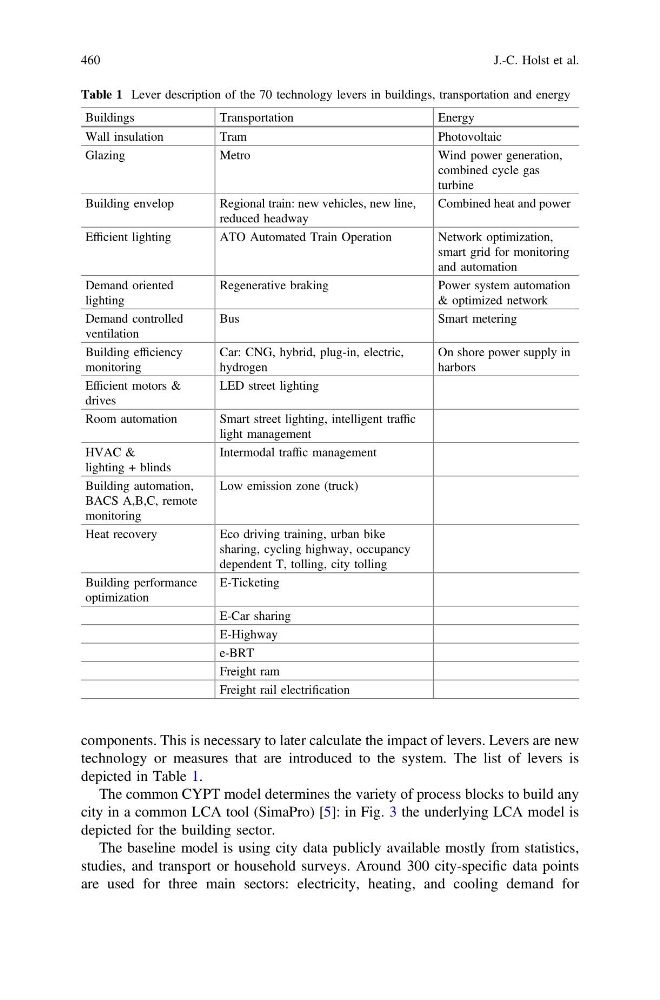
components. This is necessary to later calculate the impact of levers. Levers are new
technology or measures that are introduced to the system. The list of levers is
depicted in Table 1.
The common CYPT model determines the variety of process blocks to build any
city in a common LCA tool (SimaPro) [5]: in Fig. 3 the underlying LCA model is
depicted for the building sector.
The baseline model is using city data publicly available mostly from statistics,
studies, and transport or household surveys. Around 300 city-specific data points
are used for three main sectors: electricity, heating, and cooling demand for
Table 1 Lever description of the 70 technology levers in buildings, transportation and energy
Buildings
Transportation
Energy
Wall insulation
Tram
Photovoltaic
Glazing
Metro
Wind power generation,
combined cycle gas
turbine
Building envelop
Regional train: new vehicles, new line,
reduced headway
Combined heat and power
Efficient lighting
ATO Automated Train Operation
Network optimization,
smart grid for monitoring
and automation
Demand oriented
lighting
Regenerative braking
Power system automation
& optimized network
Demand controlled
ventilation
Bus
Smart metering
Building efficiency
monitoring
Car: CNG, hybrid, plug-in, electric,
hydrogen
On shore power supply in
harbors
Efficient motors &
drives
LED street lighting
Room automation
Smart street lighting, intelligent traffic
light management
HVAC &
lighting + blinds
Intermodal traffic management
Building automation,
BACS A,B,C, remote
monitoring
Low emission zone (truck)
Heat recovery
Eco driving training, urban bike
sharing, cycling highway, occupancy
dependent T, tolling, city tolling
Building performance
optimization
E-Ticketing
E-Car sharing
E-Highway
e-BRT
Freight ram
Freight rail electrification
460
J.-C. Holst et al.
technology or measures that are introduced to the system. The list of levers is
depicted in Table 1.
The common CYPT model determines the variety of process blocks to build any
city in a common LCA tool (SimaPro) [5]: in Fig. 3 the underlying LCA model is
depicted for the building sector.
The baseline model is using city data publicly available mostly from statistics,
studies, and transport or household surveys. Around 300 city-specific data points
are used for three main sectors: electricity, heating, and cooling demand for
Table 1 Lever description of the 70 technology levers in buildings, transportation and energy
Buildings
Transportation
Energy
Wall insulation
Tram
Photovoltaic
Glazing
Metro
Wind power generation,
combined cycle gas
turbine
Building envelop
Regional train: new vehicles, new line,
reduced headway
Combined heat and power
Efficient lighting
ATO Automated Train Operation
Network optimization,
smart grid for monitoring
and automation
Demand oriented
lighting
Regenerative braking
Power system automation
& optimized network
Demand controlled
ventilation
Bus
Smart metering
Building efficiency
monitoring
Car: CNG, hybrid, plug-in, electric,
hydrogen
On shore power supply in
harbors
Efficient motors &
drives
LED street lighting
Room automation
Smart street lighting, intelligent traffic
light management
HVAC &
lighting + blinds
Intermodal traffic management
Building automation,
BACS A,B,C, remote
monitoring
Low emission zone (truck)
Heat recovery
Eco driving training, urban bike
sharing, cycling highway, occupancy
dependent T, tolling, city tolling
Building performance
optimization
E-Ticketing
E-Car sharing
E-Highway
e-BRT
Freight ram
Freight rail electrification
460
J.-C. Holst et al.