

2.2 EVALEAU: The DWPP Simulator
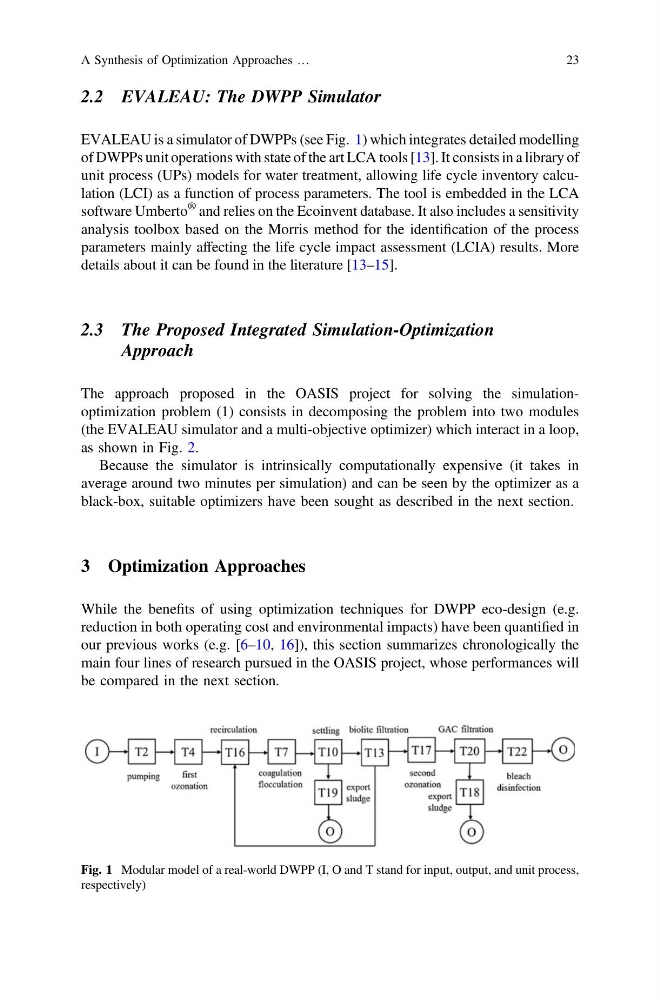
EVALEAU is a simulator of DWPPs (see Fig. 1) which integrates detailed modelling
of DWPPs unit operations with state of the art LCA tools [13]. It consists in a library of
unit process (UPs) models for water treatment, allowing life cycle inventory calculation (LCI) as a function of process parameters. The tool is embedded in the LCA
software Umberto
® and relies on the Ecoinvent database. It also includes a sensitivity
analysis toolbox based on the Morris method for the identification of the process
parameters mainly affecting the life cycle impact assessment (LCIA) results. More
details about it can be found in the literature [13–15].
2.3 The Proposed Integrated Simulation-Optimization
Approach
The approach proposed in the OASIS project for solving the simulationoptimization problem (1) consists in decomposing the problem into two modules
(the EVALEAU simulator and a multi-objective optimizer) which interact in a loop,
as shown in Fig. 2.
Because the simulator is intrinsically computationally expensive (it takes in
average around two minutes per simulation) and can be seen by the optimizer as a
black-box, suitable optimizers have been sought as described in the next section.
3 Optimization Approaches
While the benefits of using optimization techniques for DWPP eco-design (e.g.
reduction in both operating cost and environmental impacts) have been quantified in
our previous works (e.g. [6–10, 16]), this section summarizes chronologically the
main four lines of research pursued in the OASIS project, whose performances will
be compared in the next section.
Fig. 1 Modular model of a real-world DWPP (I, O and T stand for input, output, and unit process,
respectively)
A Synthesis of Optimization Approaches …
23
EVALEAU is a simulator of DWPPs (see Fig. 1) which integrates detailed modelling
of DWPPs unit operations with state of the art LCA tools [13]. It consists in a library of
unit process (UPs) models for water treatment, allowing life cycle inventory calculation (LCI) as a function of process parameters. The tool is embedded in the LCA
software Umberto
® and relies on the Ecoinvent database. It also includes a sensitivity
analysis toolbox based on the Morris method for the identification of the process
parameters mainly affecting the life cycle impact assessment (LCIA) results. More
details about it can be found in the literature [13–15].
2.3 The Proposed Integrated Simulation-Optimization
Approach
The approach proposed in the OASIS project for solving the simulationoptimization problem (1) consists in decomposing the problem into two modules
(the EVALEAU simulator and a multi-objective optimizer) which interact in a loop,
as shown in Fig. 2.
Because the simulator is intrinsically computationally expensive (it takes in
average around two minutes per simulation) and can be seen by the optimizer as a
black-box, suitable optimizers have been sought as described in the next section.
3 Optimization Approaches
While the benefits of using optimization techniques for DWPP eco-design (e.g.
reduction in both operating cost and environmental impacts) have been quantified in
our previous works (e.g. [6–10, 16]), this section summarizes chronologically the
main four lines of research pursued in the OASIS project, whose performances will
be compared in the next section.
Fig. 1 Modular model of a real-world DWPP (I, O and T stand for input, output, and unit process,
respectively)
A Synthesis of Optimization Approaches …
23