

The outline of the remaining of the paper is as follows. Section 2 presents the
statement of the problem and the tool components. Section 3 briefly describes the
main optimization algorithms employed in the four research streams. Section 4
provides optimization results with these algorithms for a realistic model of a
real-world DWPP. Section 5 concludes and provides directions for future work.
2 Statement of the Optimization-Process Modelling-LCA
Problem
2.1 Problem Formulation
The multi-objective optimization (MOO) problem corresponding to a DWPP can be
compactly expressed, assuming a single relevant aggregated operating scenario, as
follows:
min
x
f 1 x
ð Þ; f 2 x
ð Þ
f
g
subject to:
g x
ð Þ ¼ 0
h x
ð Þ ! h
x x x
ð1Þ
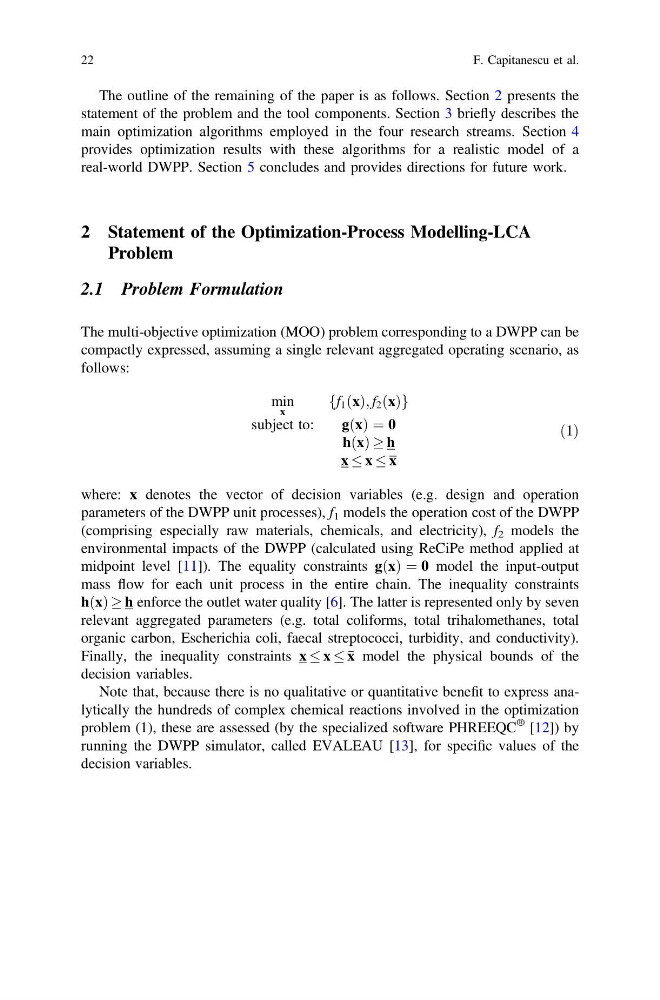
where: x denotes the vector of decision variables (e.g. design and operation
parameters of the DWPP unit processes), f 1 models the operation cost of the DWPP
(comprising especially raw materials, chemicals, and electricity), f 2 models the
environmental impacts of the DWPP (calculated using ReCiPe method applied at
midpoint level [11]). The equality constraints g x
ð Þ ¼ 0 model the input-output
mass flow for each unit process in the entire chain. The inequality constraints
h x
ð Þ ! h enforce the outlet water quality [6]. The latter is represented only by seven
relevant aggregated parameters (e.g. total coliforms, total trihalomethanes, total
organic carbon, Escherichia coli, faecal streptococci, turbidity, and conductivity).
Finally, the inequality constraints x x x model the physical bounds of the
decision variables.
Note that, because there is no qualitative or quantitative benefit to express analytically the hundreds of complex chemical reactions involved in the optimization
problem (1), these are assessed (by the specialized software PHREEQC
® [12]) by
running the DWPP simulator, called EVALEAU [13], for specific values of the
decision variables.
22
F. Capitanescu et al.
statement of the problem and the tool components. Section 3 briefly describes the
main optimization algorithms employed in the four research streams. Section 4
provides optimization results with these algorithms for a realistic model of a
real-world DWPP. Section 5 concludes and provides directions for future work.
2 Statement of the Optimization-Process Modelling-LCA
Problem
2.1 Problem Formulation
The multi-objective optimization (MOO) problem corresponding to a DWPP can be
compactly expressed, assuming a single relevant aggregated operating scenario, as
follows:
min
x
f 1 x
ð Þ; f 2 x
ð Þ
f
g
subject to:
g x
ð Þ ¼ 0
h x
ð Þ ! h
x x x
ð1Þ
where: x denotes the vector of decision variables (e.g. design and operation
parameters of the DWPP unit processes), f 1 models the operation cost of the DWPP
(comprising especially raw materials, chemicals, and electricity), f 2 models the
environmental impacts of the DWPP (calculated using ReCiPe method applied at
midpoint level [11]). The equality constraints g x
ð Þ ¼ 0 model the input-output
mass flow for each unit process in the entire chain. The inequality constraints
h x
ð Þ ! h enforce the outlet water quality [6]. The latter is represented only by seven
relevant aggregated parameters (e.g. total coliforms, total trihalomethanes, total
organic carbon, Escherichia coli, faecal streptococci, turbidity, and conductivity).
Finally, the inequality constraints x x x model the physical bounds of the
decision variables.
Note that, because there is no qualitative or quantitative benefit to express analytically the hundreds of complex chemical reactions involved in the optimization
problem (1), these are assessed (by the specialized software PHREEQC
® [12]) by
running the DWPP simulator, called EVALEAU [13], for specific values of the
decision variables.
22
F. Capitanescu et al.