

environmental and social impacts; together with life cycle costs of used tire management scenarios associated with different life extension options.
As such, this case study aims to analyse environmental, social and cost performances obtained through life cycle assessment approach in order to support the
choice between two scenarios:
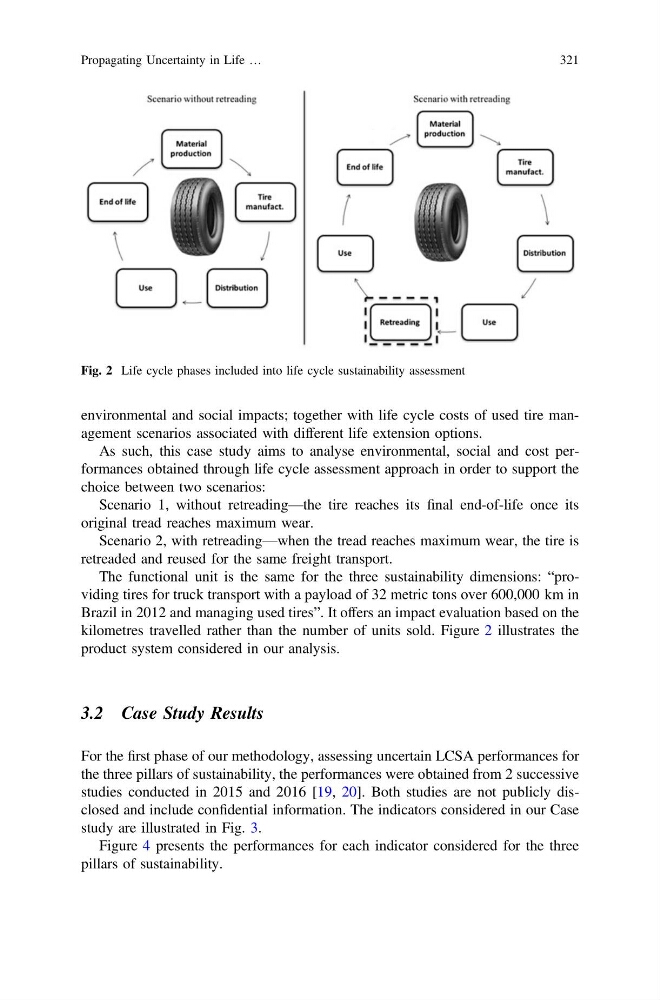
Scenario 1, without retreading—the tire reaches its final end-of-life once its
original tread reaches maximum wear.
Scenario 2, with retreading—when the tread reaches maximum wear, the tire is
retreaded and reused for the same freight transport.
The functional unit is the same for the three sustainability dimensions: “providing tires for truck transport with a payload of 32 metric tons over 600,000 km in
Brazil in 2012 and managing used tires”. It offers an impact evaluation based on the
kilometres travelled rather than the number of units sold. Figure 2 illustrates the
product system considered in our analysis.
3.2 Case Study Results
For the first phase of our methodology, assessing uncertain LCSA performances for
the three pillars of sustainability, the performances were obtained from 2 successive
studies conducted in 2015 and 2016 [19, 20]. Both studies are not publicly disclosed and include confidential information. The indicators considered in our Case
study are illustrated in Fig. 3.
Figure 4 presents the performances for each indicator considered for the three
pillars of sustainability.
Fig. 2 Life cycle phases included into life cycle sustainability assessment
Propagating Uncertainty in Life …
321
As such, this case study aims to analyse environmental, social and cost performances obtained through life cycle assessment approach in order to support the
choice between two scenarios:
Scenario 1, without retreading—the tire reaches its final end-of-life once its
original tread reaches maximum wear.
Scenario 2, with retreading—when the tread reaches maximum wear, the tire is
retreaded and reused for the same freight transport.
The functional unit is the same for the three sustainability dimensions: “providing tires for truck transport with a payload of 32 metric tons over 600,000 km in
Brazil in 2012 and managing used tires”. It offers an impact evaluation based on the
kilometres travelled rather than the number of units sold. Figure 2 illustrates the
product system considered in our analysis.
3.2 Case Study Results
For the first phase of our methodology, assessing uncertain LCSA performances for
the three pillars of sustainability, the performances were obtained from 2 successive
studies conducted in 2015 and 2016 [19, 20]. Both studies are not publicly disclosed and include confidential information. The indicators considered in our Case
study are illustrated in Fig. 3.
Figure 4 presents the performances for each indicator considered for the three
pillars of sustainability.
Fig. 2 Life cycle phases included into life cycle sustainability assessment
Propagating Uncertainty in Life …
321