

makers (parameters needed must be easy to be understood by decision makers
through direct elicitation process).
Each method requires different parameters, for example the weights of each
criterion (all methods) and the equivalence, weak preference and strict preference
zones (for the Prométhée II method), as remarked by Carmo et al. [18]. These
parameters were defined from an interview (elicitation process) with decision
makers (three company’s truck tire development experts). We run each model 1000
times, equivalent to the amount of Monte Carlo simulations we have carried out to
generate the overall environmental, social and economic performances. As such, we
got 1000 comparisons between product systems, each of which gives an order of
preference.
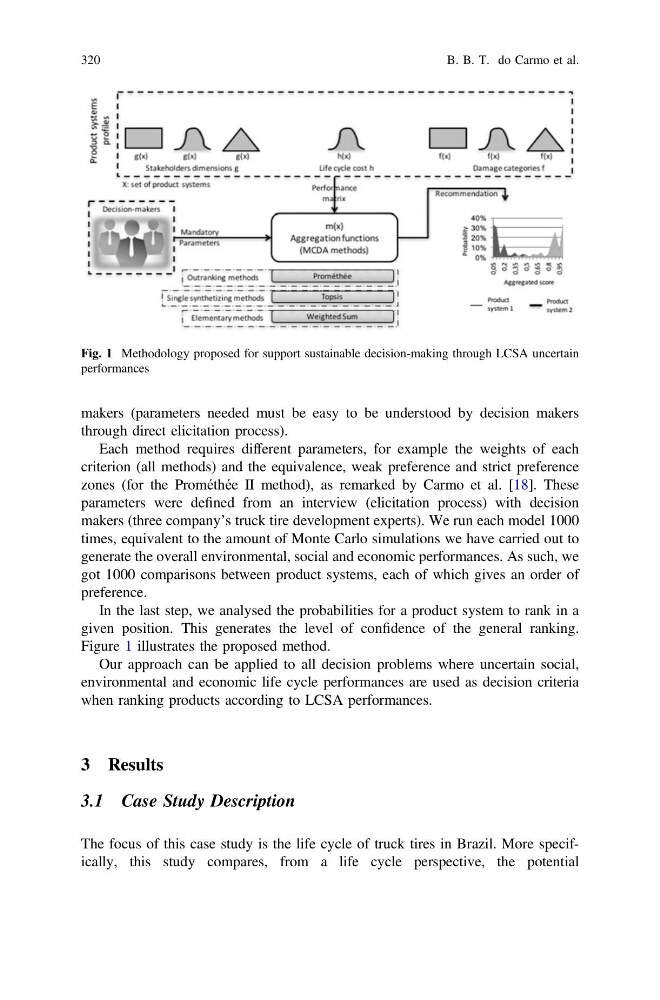
In the last step, we analysed the probabilities for a product system to rank in a
given position. This generates the level of confidence of the general ranking.
Figure 1 illustrates the proposed method.
Our approach can be applied to all decision problems where uncertain social,
environmental and economic life cycle performances are used as decision criteria
when ranking products according to LCSA performances.
3 Results
3.1 Case Study Description
The focus of this case study is the life cycle of truck tires in Brazil. More specifically, this study compares, from a life cycle perspective, the potential
Fig. 1 Methodology proposed for support sustainable decision-making through LCSA uncertain
performances
320
B. B. T. do Carmo et al.
through direct elicitation process).
Each method requires different parameters, for example the weights of each
criterion (all methods) and the equivalence, weak preference and strict preference
zones (for the Prométhée II method), as remarked by Carmo et al. [18]. These
parameters were defined from an interview (elicitation process) with decision
makers (three company’s truck tire development experts). We run each model 1000
times, equivalent to the amount of Monte Carlo simulations we have carried out to
generate the overall environmental, social and economic performances. As such, we
got 1000 comparisons between product systems, each of which gives an order of
preference.
In the last step, we analysed the probabilities for a product system to rank in a
given position. This generates the level of confidence of the general ranking.
Figure 1 illustrates the proposed method.
Our approach can be applied to all decision problems where uncertain social,
environmental and economic life cycle performances are used as decision criteria
when ranking products according to LCSA performances.
3 Results
3.1 Case Study Description
The focus of this case study is the life cycle of truck tires in Brazil. More specifically, this study compares, from a life cycle perspective, the potential
Fig. 1 Methodology proposed for support sustainable decision-making through LCSA uncertain
performances
320
B. B. T. do Carmo et al.