

294
deployed with its Brand teams to help them understand the sustainability impacts
and issues of their brands and to identify sustainability marketing opportunities in
the late 2000s (Gowland 2009 ).
The most recent and signifi cant example of the use of the LCA approach to guide
sustainability strategy has been the use of product footprinting as an integral element of Unilever’s Sustainable Living Plan (USLP) (Rigarlsford et al. 2010 ; UNEP
2015 ). The USLP footprint, which is an example of an organizational LCA (UNEP
2015 ) is based on a streamlined process that involves the defi nition of representative
countries and products. Fourteen countries were selected on the basis of business
parameters (e.g. annual sales and consumer habits) and environmental ones (e.g.
carbon intensity of the electricity grid, waste management infrastructure and water
scarcity). The business and sales in each country are then described by a series of
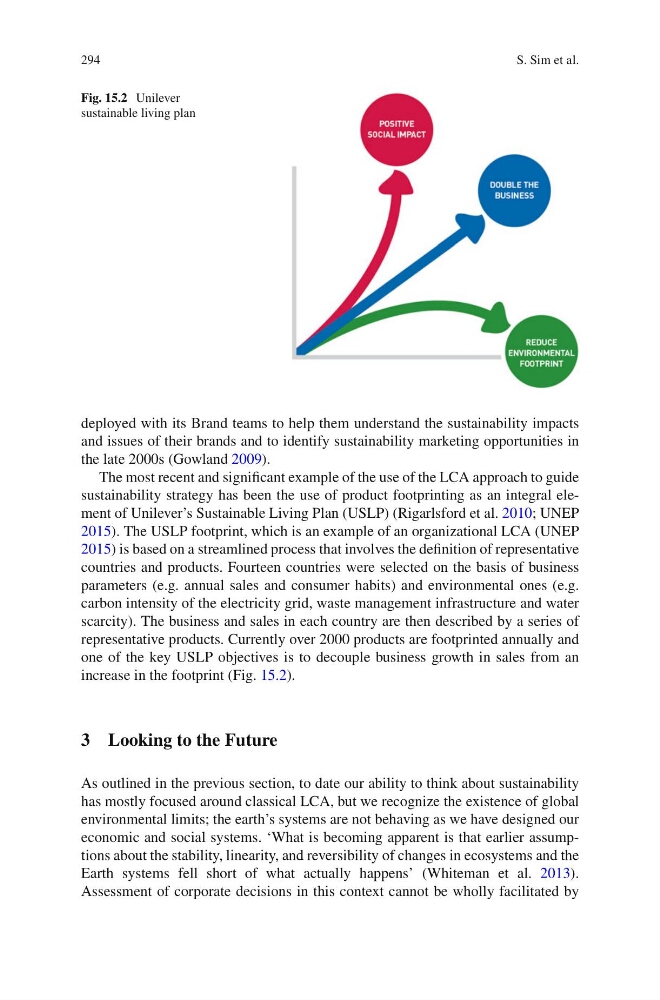
representative products. Currently over 2000 products are footprinted annually and
one of the key USLP objectives is to decouple business growth in sales from an
increase in the footprint (Fig. 15.2 ).
3 Looking to the Future
As outlined in the previous section, to date our ability to think about sustainability
has mostly focused around classical LCA, but we recognize the existence of global
environmental limits; the earth’s systems are not behaving as we have designed our
economic and social systems. ‘What is becoming apparent is that earlier assumptions about the stability, linearity, and reversibility of changes in ecosystems and the
Earth systems fell short of what actually happens’ (Whiteman et al. 2013 ).
Assessment of corporate decisions in this context cannot be wholly facilitated by
Fig. 15.2 Unilever
sustainable living plan
S. Sim et al.
deployed with its Brand teams to help them understand the sustainability impacts
and issues of their brands and to identify sustainability marketing opportunities in
the late 2000s (Gowland 2009 ).
The most recent and signifi cant example of the use of the LCA approach to guide
sustainability strategy has been the use of product footprinting as an integral element of Unilever’s Sustainable Living Plan (USLP) (Rigarlsford et al. 2010 ; UNEP
2015 ). The USLP footprint, which is an example of an organizational LCA (UNEP
2015 ) is based on a streamlined process that involves the defi nition of representative
countries and products. Fourteen countries were selected on the basis of business
parameters (e.g. annual sales and consumer habits) and environmental ones (e.g.
carbon intensity of the electricity grid, waste management infrastructure and water
scarcity). The business and sales in each country are then described by a series of
representative products. Currently over 2000 products are footprinted annually and
one of the key USLP objectives is to decouple business growth in sales from an
increase in the footprint (Fig. 15.2 ).
3 Looking to the Future
As outlined in the previous section, to date our ability to think about sustainability
has mostly focused around classical LCA, but we recognize the existence of global
environmental limits; the earth’s systems are not behaving as we have designed our
economic and social systems. ‘What is becoming apparent is that earlier assumptions about the stability, linearity, and reversibility of changes in ecosystems and the
Earth systems fell short of what actually happens’ (Whiteman et al. 2013 ).
Assessment of corporate decisions in this context cannot be wholly facilitated by
Fig. 15.2 Unilever
sustainable living plan
S. Sim et al.