

295
traditional LCA approaches. Though these remain important, their focus on ecoeffi ciency and relative sustainability will not be suffi cient.
The refresh of Unilever’s Sustainable Living Plan (USLP) in 2014 (Unilever
2014 ) articulates a desire to drive transformational change. There are three particular aspects to this: (1) helping to eliminate deforestation; (2) championing sustainable agriculture and smallholder farmers and (3) improving water, sanitation and
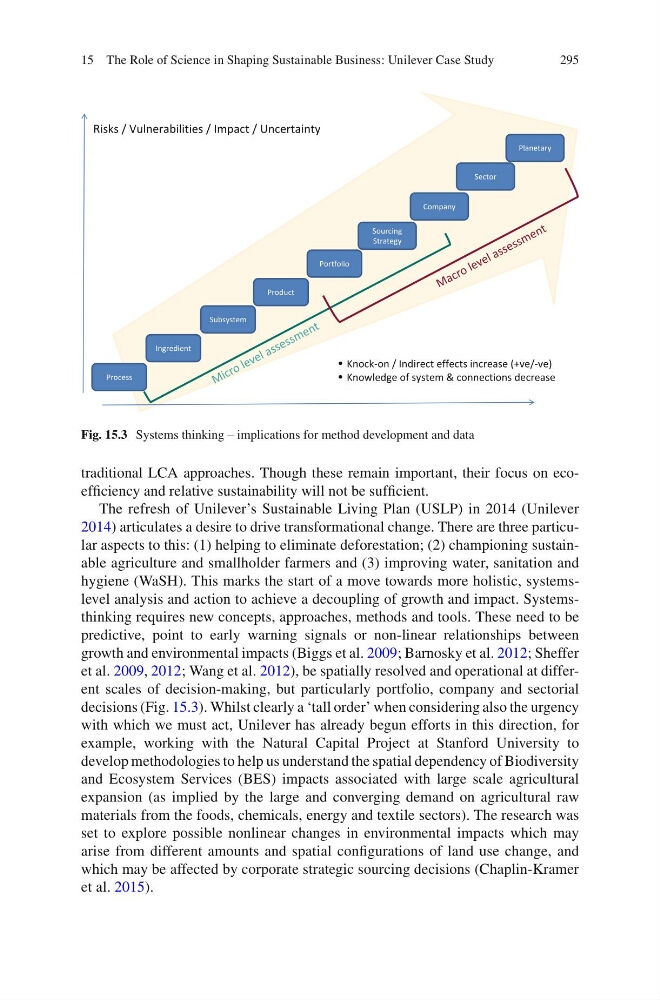
hygiene (WaSH). This marks the start of a move towards more holistic, systemslevel analysis and action to achieve a decoupling of growth and impact. Systemsthinking requires new concepts, approaches, methods and tools. These need to be
predictive, point to early warning signals or non-linear relationships between
growth and environmental impacts (Biggs et al. 2009 ; Barnosky et al. 2012 ; Sheffer
et al. 2009 , 2012 ; Wang et al. 2012 ), be spatially resolved and operational at different scales of decision-making, but particularly portfolio, company and sectorial
decisions (Fig. 15.3 ). Whilst clearly a ‘tall order’ when considering also the urgency
with which we must act, Unilever has already begun efforts in this direction, for
example, working with the Natural Capital Project at Stanford University to
develop methodologies to help us understand the spatial dependency of Biodiversity
and Ecosystem Services (BES) impacts associated with large scale agricultural
expansion (as implied by the large and converging demand on agricultural raw
materials from the foods, chemicals, energy and textile sectors). The research was
set to explore possible nonlinear changes in environmental impacts which may
arise from different amounts and spatial confi gurations of land use change, and
which may be affected by corporate strategic sourcing decisions (Chaplin-Kramer
et al. 2015 ).
Ingredient
Subsystem
Product
Portfolio
Company
Sector
Sourcing
Strategy
Planetary
Risks / Vulnerabilities / Impact / Uncertainty
Process
• Knock-on / Indirect effects increase (+ve/-ve)
• Knowledge of system & connections decrease
Fig. 15.3 Systems thinking – implications for method development and data
15 The Role of Science in Shaping Sustainable Business: Unilever Case Study
traditional LCA approaches. Though these remain important, their focus on ecoeffi ciency and relative sustainability will not be suffi cient.
The refresh of Unilever’s Sustainable Living Plan (USLP) in 2014 (Unilever
2014 ) articulates a desire to drive transformational change. There are three particular aspects to this: (1) helping to eliminate deforestation; (2) championing sustainable agriculture and smallholder farmers and (3) improving water, sanitation and
hygiene (WaSH). This marks the start of a move towards more holistic, systemslevel analysis and action to achieve a decoupling of growth and impact. Systemsthinking requires new concepts, approaches, methods and tools. These need to be
predictive, point to early warning signals or non-linear relationships between
growth and environmental impacts (Biggs et al. 2009 ; Barnosky et al. 2012 ; Sheffer
et al. 2009 , 2012 ; Wang et al. 2012 ), be spatially resolved and operational at different scales of decision-making, but particularly portfolio, company and sectorial
decisions (Fig. 15.3 ). Whilst clearly a ‘tall order’ when considering also the urgency
with which we must act, Unilever has already begun efforts in this direction, for
example, working with the Natural Capital Project at Stanford University to
develop methodologies to help us understand the spatial dependency of Biodiversity
and Ecosystem Services (BES) impacts associated with large scale agricultural
expansion (as implied by the large and converging demand on agricultural raw
materials from the foods, chemicals, energy and textile sectors). The research was
set to explore possible nonlinear changes in environmental impacts which may
arise from different amounts and spatial confi gurations of land use change, and
which may be affected by corporate strategic sourcing decisions (Chaplin-Kramer
et al. 2015 ).
Ingredient
Subsystem
Product
Portfolio
Company
Sector
Sourcing
Strategy
Planetary
Risks / Vulnerabilities / Impact / Uncertainty
Process
• Knock-on / Indirect effects increase (+ve/-ve)
• Knowledge of system & connections decrease
Fig. 15.3 Systems thinking – implications for method development and data
15 The Role of Science in Shaping Sustainable Business: Unilever Case Study