

236
(NCPC) programme included the CNCPC and established NCPCs in Brazil, India,
Mexico, Tanzania, Tunisia and Zimbabwe (Nishikawa 2009 ). Since then the programme has expanded to include 47 developing and transition countries (UNIDO/
UNEP 2010 ). In each of these countries, training programmes on CP have been
conducted and in-plant CP assessments have been completed (UNIDO/UNEP
2010 ). In the 1990s, the World Bank sponsored a project focused on “Environmental
Management Capacity Building” that resulted in CP promotion efforts in India
(Rathi 2003 ).
In 2002, CP was included in policy in the Cleaner Production Promotion Law
that was passed by the Chinese government in 2002. This law defi nes and sets goals
and targets for clean industry, clearly specifi es implementation responsibilities and
outlines ways to measure successful implementation of CP in industries (Mol and
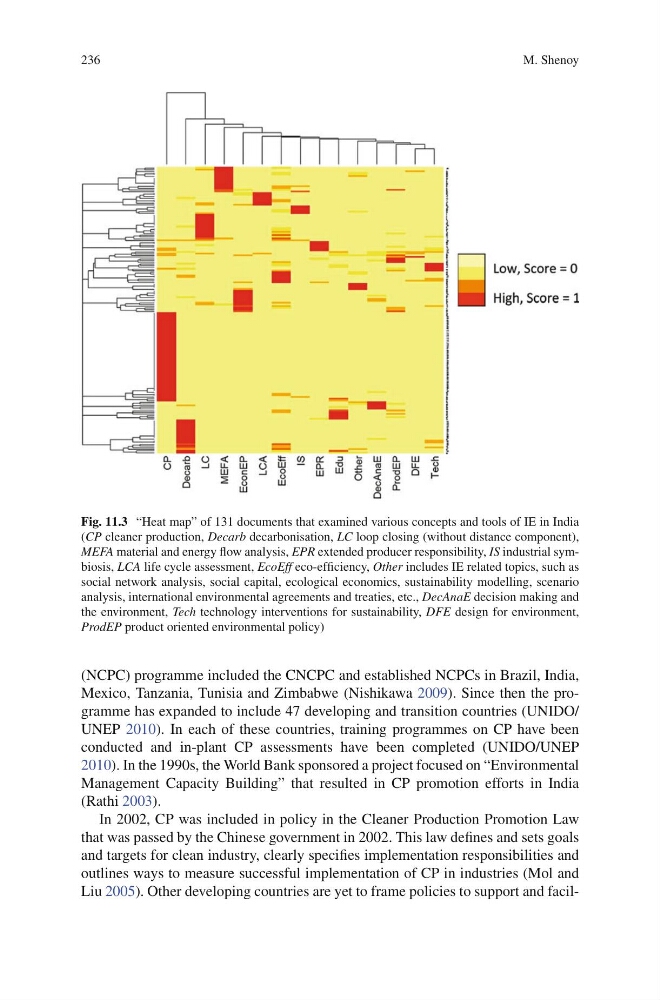
Liu 2005 ). Other developing countries are yet to frame policies to support and facilFig. 11.3 “Heat map” of 131 documents that examined various concepts and tools of IE in India
( CP cleaner production, Decarb decarbonisation, LC loop closing (without distance component),
MEFA material and energy fl ow analysis, EPR extended producer responsibility , IS industrial symbiosis, LCA life cycle assessment, EcoEff eco-effi ciency, Other includes IE related topics, such as
social network analysis, social capital, ecological economics, sustainability modelling, scenario
analysis, international environmental agreements and treaties, etc., DecAnaE decision making and
the environment, Tech technology interventions for sustainability, DFE design for environment,
ProdEP product oriented environmental policy)
M. Shenoy
(NCPC) programme included the CNCPC and established NCPCs in Brazil, India,
Mexico, Tanzania, Tunisia and Zimbabwe (Nishikawa 2009 ). Since then the programme has expanded to include 47 developing and transition countries (UNIDO/
UNEP 2010 ). In each of these countries, training programmes on CP have been
conducted and in-plant CP assessments have been completed (UNIDO/UNEP
2010 ). In the 1990s, the World Bank sponsored a project focused on “Environmental
Management Capacity Building” that resulted in CP promotion efforts in India
(Rathi 2003 ).
In 2002, CP was included in policy in the Cleaner Production Promotion Law
that was passed by the Chinese government in 2002. This law defi nes and sets goals
and targets for clean industry, clearly specifi es implementation responsibilities and
outlines ways to measure successful implementation of CP in industries (Mol and
Liu 2005 ). Other developing countries are yet to frame policies to support and facilFig. 11.3 “Heat map” of 131 documents that examined various concepts and tools of IE in India
( CP cleaner production, Decarb decarbonisation, LC loop closing (without distance component),
MEFA material and energy fl ow analysis, EPR extended producer responsibility , IS industrial symbiosis, LCA life cycle assessment, EcoEff eco-effi ciency, Other includes IE related topics, such as
social network analysis, social capital, ecological economics, sustainability modelling, scenario
analysis, international environmental agreements and treaties, etc., DecAnaE decision making and
the environment, Tech technology interventions for sustainability, DFE design for environment,
ProdEP product oriented environmental policy)
M. Shenoy