

235
2.1 Hotspots of IE in the Global South
Available research papers and reports highlight the main streams of IE that have
been researched and implemented in developing countries. Analysing 131 documents (comprising 83 peer-reviewed journal articles, 27 books and book chapters
and 21 reports from development organizations, institutions and companies) that
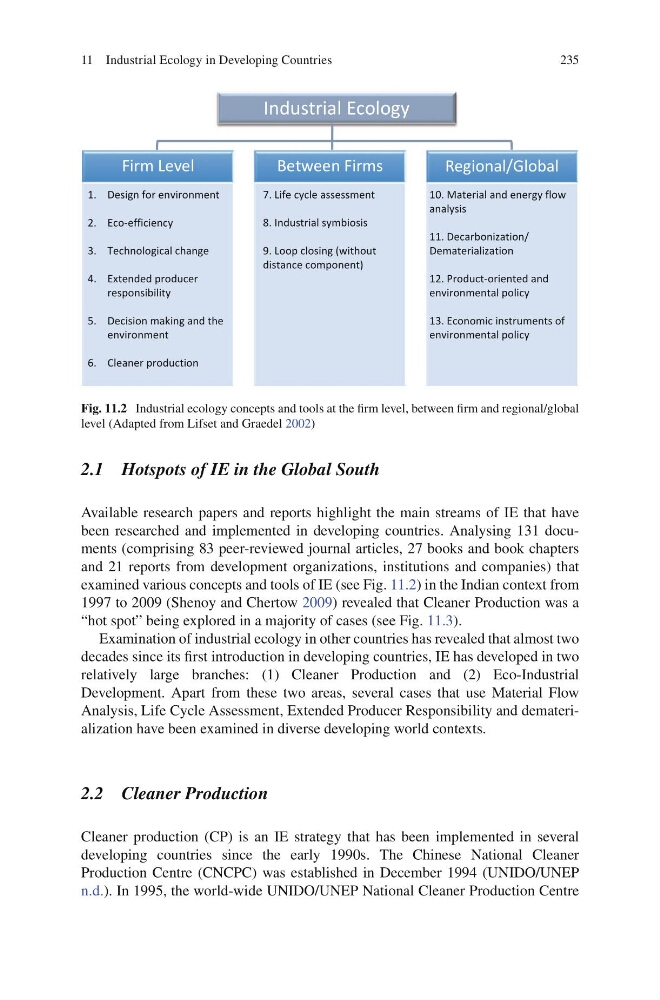
examined various concepts and tools of IE (see Fig. 11.2 ) in the Indian context from
1997 to 2009 (Shenoy and Chertow 2009 ) revealed that Cleaner Production was a
“hot spot” being explored in a majority of cases (see Fig. 11.3 ).
Examination of industrial ecology in other countries has revealed that almost two
decades since its fi rst introduction in developing countries, IE has developed in two
relatively large branches: (1) Cleaner Production and (2) Eco-Industrial
Development. Apart from these two areas, several cases that use Material Flow
Analysis, Life Cycle Assessment, Extended Producer Responsibility and dematerialization have been examined in diverse developing world contexts.
2.2 Cleaner Production
Cleaner production (CP) is an IE strategy that has been implemented in several
developing countries since the early 1990s. The Chinese National Cleaner
Production Centre (CNCPC) was established in December 1994 (UNIDO/UNEP
n.d. ). In 1995, the world-wide UNIDO/UNEP National Cleaner Production Centre
Firm Level
Between Firms
Regional/Global
Industrial Ecology
1. Design for environment
2. Eco-efficiency
3. Technological change
4. Extended producer
responsibility
5. Decision making and the
environment
6. Cleaner production
7. Life cycle assessment
8. Industrial symbiosis
9. Loop closing (without
distance component)
10. Material and energy flow
analysis
11. Decarbonization/
Dematerialization
12. Product-oriented and
environmental policy
13. Economic instruments of
environmental policy
Fig. 11.2 Industrial ecology concepts and tools at the fi rm level, between fi rm and regional/global
level (Adapted from Lifset and Graedel 2002 )
11 Industrial Ecology in Developing Countries
2.1 Hotspots of IE in the Global South
Available research papers and reports highlight the main streams of IE that have
been researched and implemented in developing countries. Analysing 131 documents (comprising 83 peer-reviewed journal articles, 27 books and book chapters
and 21 reports from development organizations, institutions and companies) that
examined various concepts and tools of IE (see Fig. 11.2 ) in the Indian context from
1997 to 2009 (Shenoy and Chertow 2009 ) revealed that Cleaner Production was a
“hot spot” being explored in a majority of cases (see Fig. 11.3 ).
Examination of industrial ecology in other countries has revealed that almost two
decades since its fi rst introduction in developing countries, IE has developed in two
relatively large branches: (1) Cleaner Production and (2) Eco-Industrial
Development. Apart from these two areas, several cases that use Material Flow
Analysis, Life Cycle Assessment, Extended Producer Responsibility and dematerialization have been examined in diverse developing world contexts.
2.2 Cleaner Production
Cleaner production (CP) is an IE strategy that has been implemented in several
developing countries since the early 1990s. The Chinese National Cleaner
Production Centre (CNCPC) was established in December 1994 (UNIDO/UNEP
n.d. ). In 1995, the world-wide UNIDO/UNEP National Cleaner Production Centre
Firm Level
Between Firms
Regional/Global
Industrial Ecology
1. Design for environment
2. Eco-efficiency
3. Technological change
4. Extended producer
responsibility
5. Decision making and the
environment
6. Cleaner production
7. Life cycle assessment
8. Industrial symbiosis
9. Loop closing (without
distance component)
10. Material and energy flow
analysis
11. Decarbonization/
Dematerialization
12. Product-oriented and
environmental policy
13. Economic instruments of
environmental policy
Fig. 11.2 Industrial ecology concepts and tools at the fi rm level, between fi rm and regional/global
level (Adapted from Lifset and Graedel 2002 )
11 Industrial Ecology in Developing Countries