

232
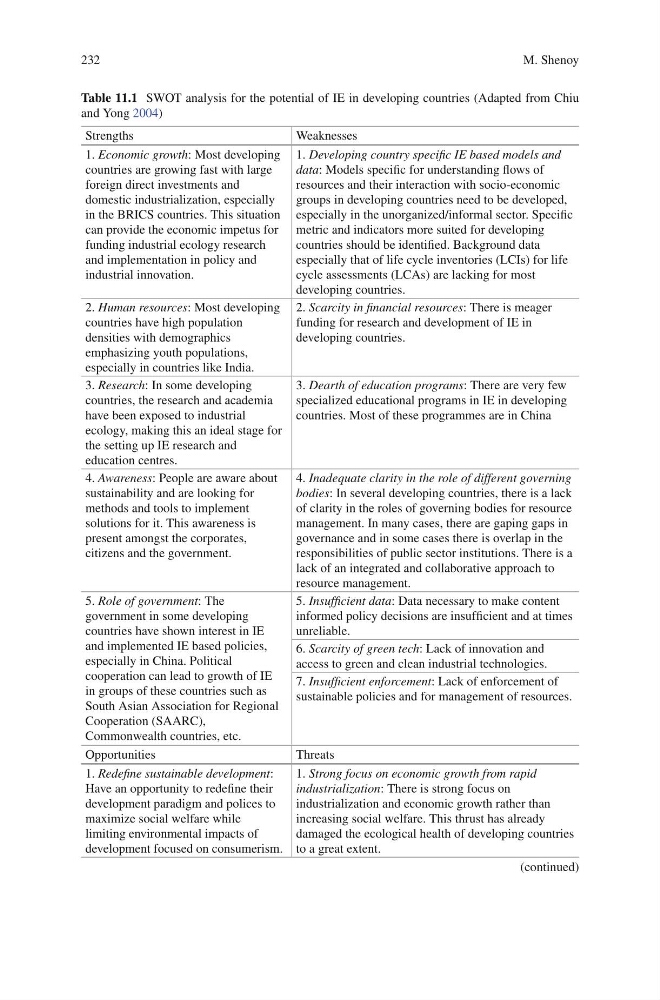
Table 11.1 SWOT analysis for the potential of IE in developing countries (Adapted from Chiu
and Yong 2004 )
Strengths
Weaknesses
1. Economic growth : Most developing
countries are growing fast with large
foreign direct investments and
domestic industrialization, especially
in the BRICS countries. This situation
can provide the economic impetus for
funding industrial ecology research
and implementation in policy and
industrial innovation.
1. Developing country specifi c IE based models and
data : Models specifi c for understanding fl ows of
resources and their interaction with socio-economic
groups in developing countries need to be developed,
especially in the unorganized/informal sector. Specifi c
metric and indicators more suited for developing
countries should be identifi ed. Background data
especially that of life cycle inventories (LCIs) for life
cycle assessments (LCAs) are lacking for most
developing countries.
2. Human resources : Most developing
countries have high population
densities with demographics
emphasizing youth populations,
especially in countries like India.
2. Scarcity in fi nancial resources : There is meager
funding for research and development of IE in
developing countries.
3. Research : In some developing
countries, the research and academia
have been exposed to industrial
ecology, making this an ideal stage for
the setting up IE research and
education centres.
3. Dearth of education programs : There are very few
specialized educational programs in IE in developing
countries. Most of these programmes are in China
4. Awareness : People are aware about
sustainability and are looking for
methods and tools to implement
solutions for it. This awareness is
present amongst the corporates,
citizens and the government.
4. Inadequate clarity in the role of different governing
bodies : In several developing countries, there is a lack
of clarity in the roles of governing bodies for resource
management. In many cases, there are gaping gaps in
governance and in some cases there is overlap in the
responsibilities of public sector institutions. There is a
lack of an integrated and collaborative approach to
resource management.
5. Role of government : The
government in some developing
countries have shown interest in IE
and implemented IE based policies,
especially in China. Political
cooperation can lead to growth of IE
in groups of these countries such as
South Asian Association for Regional
Cooperation (SAARC),
Commonwealth countries, etc.
5. Insuffi cient data : Data necessary to make content
informed policy decisions are insuffi cient and at times
unreliable.
6. Scarcity of green tech : Lack of innovation and
access to green and clean industrial technologies.
7. Insuffi cient enforcement : Lack of enforcement of
sustainable policies and for management of resources.
Opportunities
Threats
1. Redefi ne sustainable development :
Have an opportunity to redefi ne their
development paradigm and polices to
maximize social welfare while
limiting environmental impacts of
development focused on consumerism.
1. Strong focus on economic growth from rapid
industrialization : There is strong focus on
industrialization and economic growth rather than
increasing social welfare. This thrust has already
damaged the ecological health of developing countries
to a great extent.
(continued)
M. Shenoy
Table 11.1 SWOT analysis for the potential of IE in developing countries (Adapted from Chiu
and Yong 2004 )
Strengths
Weaknesses
1. Economic growth : Most developing
countries are growing fast with large
foreign direct investments and
domestic industrialization, especially
in the BRICS countries. This situation
can provide the economic impetus for
funding industrial ecology research
and implementation in policy and
industrial innovation.
1. Developing country specifi c IE based models and
data : Models specifi c for understanding fl ows of
resources and their interaction with socio-economic
groups in developing countries need to be developed,
especially in the unorganized/informal sector. Specifi c
metric and indicators more suited for developing
countries should be identifi ed. Background data
especially that of life cycle inventories (LCIs) for life
cycle assessments (LCAs) are lacking for most
developing countries.
2. Human resources : Most developing
countries have high population
densities with demographics
emphasizing youth populations,
especially in countries like India.
2. Scarcity in fi nancial resources : There is meager
funding for research and development of IE in
developing countries.
3. Research : In some developing
countries, the research and academia
have been exposed to industrial
ecology, making this an ideal stage for
the setting up IE research and
education centres.
3. Dearth of education programs : There are very few
specialized educational programs in IE in developing
countries. Most of these programmes are in China
4. Awareness : People are aware about
sustainability and are looking for
methods and tools to implement
solutions for it. This awareness is
present amongst the corporates,
citizens and the government.
4. Inadequate clarity in the role of different governing
bodies : In several developing countries, there is a lack
of clarity in the roles of governing bodies for resource
management. In many cases, there are gaping gaps in
governance and in some cases there is overlap in the
responsibilities of public sector institutions. There is a
lack of an integrated and collaborative approach to
resource management.
5. Role of government : The
government in some developing
countries have shown interest in IE
and implemented IE based policies,
especially in China. Political
cooperation can lead to growth of IE
in groups of these countries such as
South Asian Association for Regional
Cooperation (SAARC),
Commonwealth countries, etc.
5. Insuffi cient data : Data necessary to make content
informed policy decisions are insuffi cient and at times
unreliable.
6. Scarcity of green tech : Lack of innovation and
access to green and clean industrial technologies.
7. Insuffi cient enforcement : Lack of enforcement of
sustainable policies and for management of resources.
Opportunities
Threats
1. Redefi ne sustainable development :
Have an opportunity to redefi ne their
development paradigm and polices to
maximize social welfare while
limiting environmental impacts of
development focused on consumerism.
1. Strong focus on economic growth from rapid
industrialization : There is strong focus on
industrialization and economic growth rather than
increasing social welfare. This thrust has already
damaged the ecological health of developing countries
to a great extent.
(continued)
M. Shenoy