

233
the absence of an overarching sustainable development paradigm, industrial residues
that are expensive for industries to recycle will be disposed of in the cheapest and
most often not the cleanest of ways. Moreover, polluting industries such as coal fi red
power plants in EIPs may be further locked-in in industrial networks, making it diffi cult to replace them with cleaner technologies such as plants based on renewable
resources. On the policy front, it is important for developing countries to be aware of
these interlinked complications and think of ways to avoid net long-term damage to
their ecological, social and economic health, as explored in Chap. 6 .
1.4 IE in the Policy Context
Around the world, national policies for environmental protection have evolved from
a perception of industrial processes as linear chains, rather than viewing them as
cyclic ones. These policies, therefore, are aimed at cleaning up pollution at the end
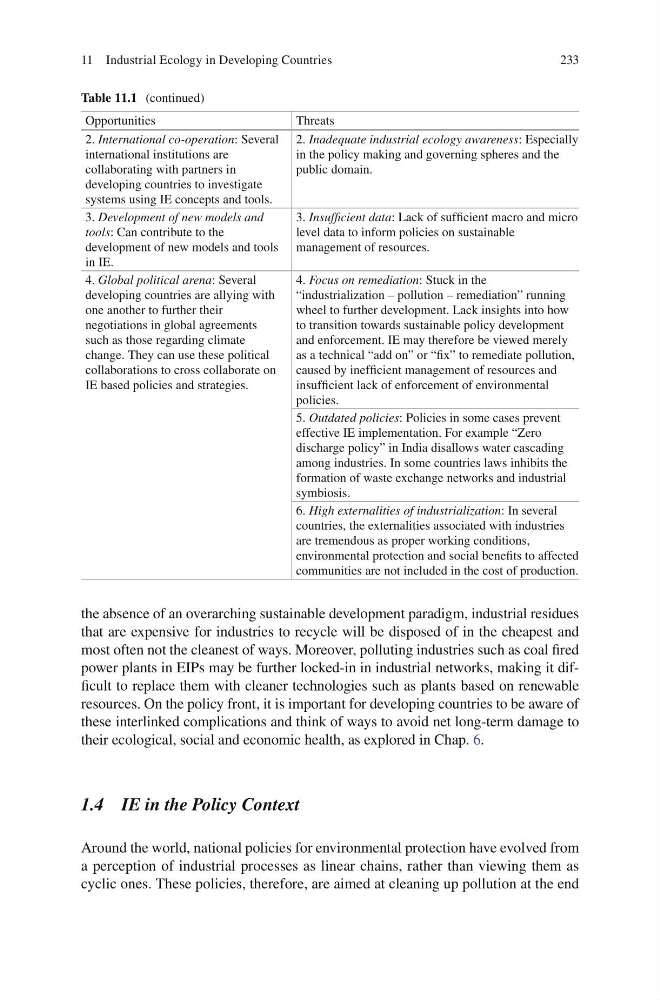
Table 11.1 (continued)
Opportunities
Threats
2. International co-operation : Several
international institutions are
collaborating with partners in
developing countries to investigate
systems using IE concepts and tools.
2. Inadequate industrial ecology awareness : Especially
in the policy making and governing spheres and the
public domain.
3. Development of new models and
tools : Can contribute to the
development of new models and tools
in IE.
3. Insuffi cient data : Lack of suffi cient macro and micro
level data to inform policies on sustainable
management of resources.
4. Global political arena : Several
developing countries are allying with
one another to further their
negotiations in global agreements
such as those regarding climate
change. They can use these political
collaborations to cross collaborate on
IE based policies and strategies.
4. Focus on remediation : Stuck in the
“industrialization – pollution – remediation” running
wheel to further development. Lack insights into how
to transition towards sustainable policy development
and enforcement. IE may therefore be viewed merely
as a technical “add on” or “fi x” to remediate pollution,
caused by ineffi cient management of resources and
insuffi cient lack of enforcement of environmental
policies.
5. Outdated policies : Policies in some cases prevent
effective IE implementation. For example “Zero
discharge policy” in India disallows water cascading
among industries. In some countries laws inhibits the
formation of waste exchange networks and industrial
symbiosis.
6. High externalities of industrialization : In several
countries, the externalities associated with industries
are tremendous as proper working conditions,
environmental protection and social benefi ts to affected
communities are not included in the cost of production.
11 Industrial Ecology in Developing Countries
the absence of an overarching sustainable development paradigm, industrial residues
that are expensive for industries to recycle will be disposed of in the cheapest and
most often not the cleanest of ways. Moreover, polluting industries such as coal fi red
power plants in EIPs may be further locked-in in industrial networks, making it diffi cult to replace them with cleaner technologies such as plants based on renewable
resources. On the policy front, it is important for developing countries to be aware of
these interlinked complications and think of ways to avoid net long-term damage to
their ecological, social and economic health, as explored in Chap. 6 .
1.4 IE in the Policy Context
Around the world, national policies for environmental protection have evolved from
a perception of industrial processes as linear chains, rather than viewing them as
cyclic ones. These policies, therefore, are aimed at cleaning up pollution at the end
Table 11.1 (continued)
Opportunities
Threats
2. International co-operation : Several
international institutions are
collaborating with partners in
developing countries to investigate
systems using IE concepts and tools.
2. Inadequate industrial ecology awareness : Especially
in the policy making and governing spheres and the
public domain.
3. Development of new models and
tools : Can contribute to the
development of new models and tools
in IE.
3. Insuffi cient data : Lack of suffi cient macro and micro
level data to inform policies on sustainable
management of resources.
4. Global political arena : Several
developing countries are allying with
one another to further their
negotiations in global agreements
such as those regarding climate
change. They can use these political
collaborations to cross collaborate on
IE based policies and strategies.
4. Focus on remediation : Stuck in the
“industrialization – pollution – remediation” running
wheel to further development. Lack insights into how
to transition towards sustainable policy development
and enforcement. IE may therefore be viewed merely
as a technical “add on” or “fi x” to remediate pollution,
caused by ineffi cient management of resources and
insuffi cient lack of enforcement of environmental
policies.
5. Outdated policies : Policies in some cases prevent
effective IE implementation. For example “Zero
discharge policy” in India disallows water cascading
among industries. In some countries laws inhibits the
formation of waste exchange networks and industrial
symbiosis.
6. High externalities of industrialization : In several
countries, the externalities associated with industries
are tremendous as proper working conditions,
environmental protection and social benefi ts to affected
communities are not included in the cost of production.
11 Industrial Ecology in Developing Countries