

146
goods, the energy use and emissions are least for remanufacturing and greatest for
primary material production; i.e.
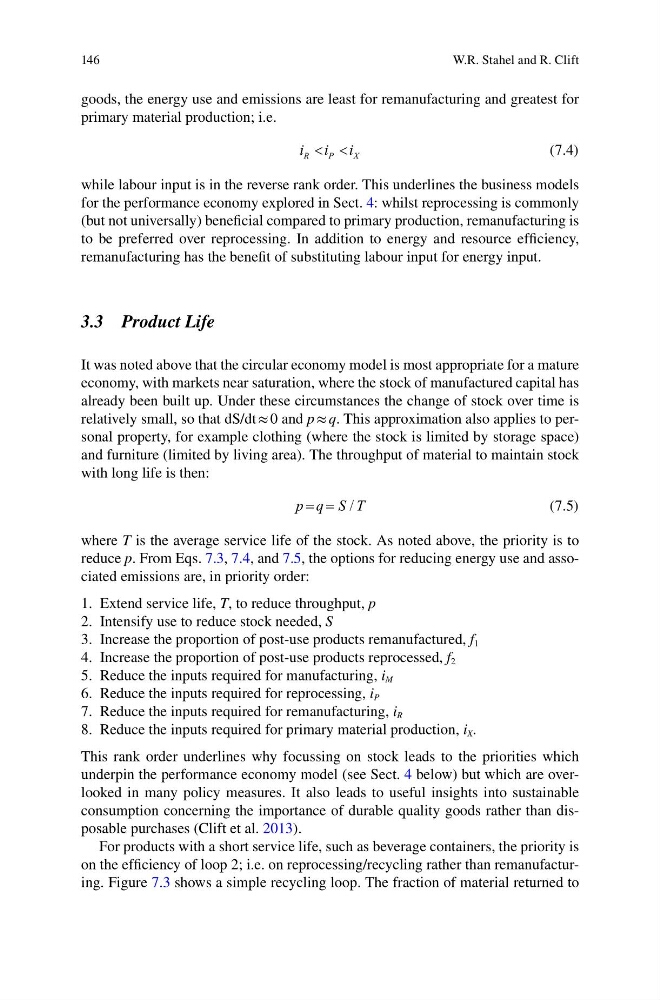
i i i
R
P
X
< <
(7.4)
while labour input is in the reverse rank order. This underlines the business models
for the performance economy explored in Sect. 4: whilst reprocessing is commonly
(but not universally) beneficial compared to primary production, remanufacturing is
to be preferred over reprocessing. In addition to energy and resource efficiency,
remanufacturing has the benefit of substituting labour input for energy input.
3.3 Product Life
It was noted above that the circular economy model is most appropriate for a mature
economy, with markets near saturation, where the stock of manufactured capital has
already been built up. Under these circumstances the change of stock over time is
relatively small, so that dS/dt ≈ 0 and p ≈ q. This approximation also applies to personal property, for example clothing (where the stock is limited by storage space)
and furniture (limited by living area). The throughput of material to maintain stock
with long life is then:
p q S T
= =
/
(7.5)
where T is the average service life of the stock. As noted above, the priority is to
reduce p. From Eqs. 7.3, 7.4, and 7.5, the options for reducing energy use and associated emissions are, in priority order:
1. Extend service life, T, to reduce throughput, p
2. Intensify use to reduce stock needed, S
3. Increase the proportion of post-use products remanufactured, f 1
4. Increase the proportion of post-use products reprocessed, f 2
5. Reduce the inputs required for manufacturing, i M
6. Reduce the inputs required for reprocessing, i P
7. Reduce the inputs required for remanufacturing, i R
8. Reduce the inputs required for primary material production, i X .
This rank order underlines why focussing on stock leads to the priorities which
underpin the performance economy model (see Sect. 4 below) but which are overlooked in many policy measures. It also leads to useful insights into sustainable
consumption concerning the importance of durable quality goods rather than disposable purchases (Clift et al. 2013).
For products with a short service life, such as beverage containers, the priority is
on the efficiency of loop 2; i.e. on reprocessing/recycling rather than remanufacturing. Figure 7.3 shows a simple recycling loop. The fraction of material returned to
W.R. Stahel and R. Clift
goods, the energy use and emissions are least for remanufacturing and greatest for
primary material production; i.e.
i i i
R
P
X
< <
(7.4)
while labour input is in the reverse rank order. This underlines the business models
for the performance economy explored in Sect. 4: whilst reprocessing is commonly
(but not universally) beneficial compared to primary production, remanufacturing is
to be preferred over reprocessing. In addition to energy and resource efficiency,
remanufacturing has the benefit of substituting labour input for energy input.
3.3 Product Life
It was noted above that the circular economy model is most appropriate for a mature
economy, with markets near saturation, where the stock of manufactured capital has
already been built up. Under these circumstances the change of stock over time is
relatively small, so that dS/dt ≈ 0 and p ≈ q. This approximation also applies to personal property, for example clothing (where the stock is limited by storage space)
and furniture (limited by living area). The throughput of material to maintain stock
with long life is then:
p q S T
= =
/
(7.5)
where T is the average service life of the stock. As noted above, the priority is to
reduce p. From Eqs. 7.3, 7.4, and 7.5, the options for reducing energy use and associated emissions are, in priority order:
1. Extend service life, T, to reduce throughput, p
2. Intensify use to reduce stock needed, S
3. Increase the proportion of post-use products remanufactured, f 1
4. Increase the proportion of post-use products reprocessed, f 2
5. Reduce the inputs required for manufacturing, i M
6. Reduce the inputs required for reprocessing, i P
7. Reduce the inputs required for remanufacturing, i R
8. Reduce the inputs required for primary material production, i X .
This rank order underlines why focussing on stock leads to the priorities which
underpin the performance economy model (see Sect. 4 below) but which are overlooked in many policy measures. It also leads to useful insights into sustainable
consumption concerning the importance of durable quality goods rather than disposable purchases (Clift et al. 2013).
For products with a short service life, such as beverage containers, the priority is
on the efficiency of loop 2; i.e. on reprocessing/recycling rather than remanufacturing. Figure 7.3 shows a simple recycling loop. The fraction of material returned to
W.R. Stahel and R. Clift