

147
use after each loop is r 2. After n loops, the fraction remaining in use is r 2
n
, which
reduces rapidly even when r 2 is relatively high. The average life of the material leaving use in terms of number of uses, ñ, is:
3
ñ =1 1 2
/ (
)
− r
(7.6)
For paper, recycling damages the fibres so that, to keep ñ from becoming too high,
r 2 is limited and a minimum introduction of new material is needed to maintain the
paper properties (Hart et al. 2005). Even for such a valuable material as nickel, used
in many alloys but also in items such as fashion jewellery, only 55 % returns around
the loop (i.e. r 2 = 0.55) so that 30 % remains after two loops and only 17 % after
three. In this particular case, about 2/3 of the losses arise from dissipative use
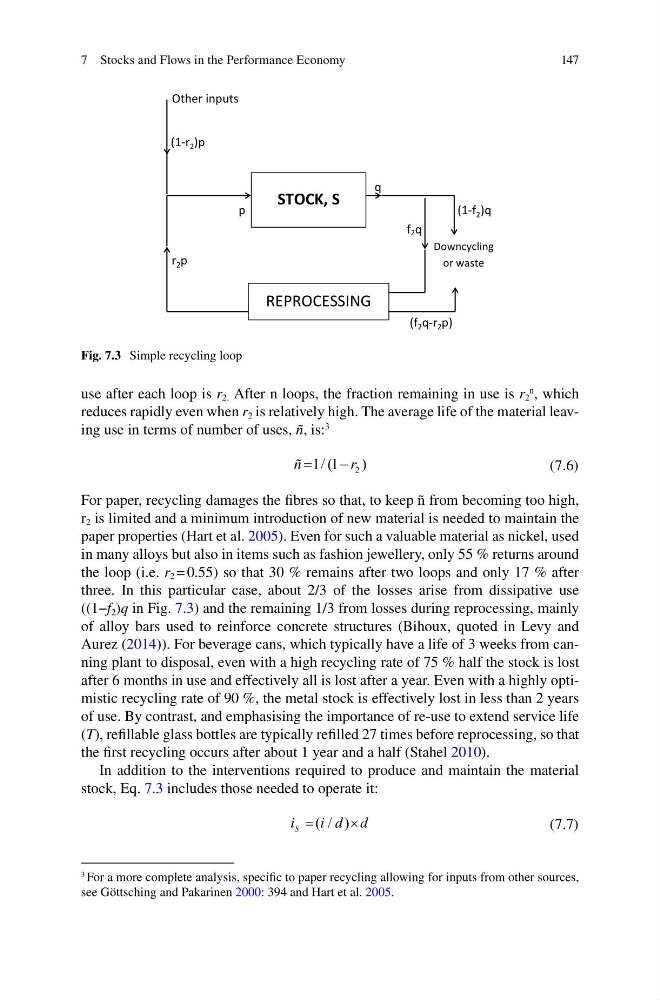
((1−f 2 )q in Fig. 7.3) and the remaining 1/3 from losses during reprocessing, mainly
of alloy bars used to reinforce concrete structures (Bihoux, quoted in Levy and
Aurez (2014)). For beverage cans, which typically have a life of 3 weeks from canning plant to disposal, even with a high recycling rate of 75 % half the stock is lost
after 6 months in use and effectively all is lost after a year. Even with a highly optimistic recycling rate of 90 %, the metal stock is effectively lost in less than 2 years
of use. By contrast, and emphasising the importance of re-use to extend service life
(T), refillable glass bottles are typically refilled 27 times before reprocessing, so that
the first recycling occurs after about 1 year and a half (Stahel 2010).
In addition to the interventions required to produce and maintain the material
stock, Eq. 7.3 includes those needed to operate it:
i
i d d
S = ( / )×
(7.7)
3 For a more complete analysis, specific to paper recycling allowing for inputs from other sources,
see Göttsching and Pakarinen 2000: 394 and Hart et al. 2005.
STOCK, S
REPROCESSING
Downcycling
or waste
Other inputs
(1-r 2 )p
p
r 2 p
q
f 2 q
(f 2 q-r 2 p)
(1-f 2 )q
Fig. 7.3 Simple recycling loop
7 Stocks and Flows in the Performance Economy
use after each loop is r 2. After n loops, the fraction remaining in use is r 2
n
, which
reduces rapidly even when r 2 is relatively high. The average life of the material leaving use in terms of number of uses, ñ, is:
3
ñ =1 1 2
/ (
)
− r
(7.6)
For paper, recycling damages the fibres so that, to keep ñ from becoming too high,
r 2 is limited and a minimum introduction of new material is needed to maintain the
paper properties (Hart et al. 2005). Even for such a valuable material as nickel, used
in many alloys but also in items such as fashion jewellery, only 55 % returns around
the loop (i.e. r 2 = 0.55) so that 30 % remains after two loops and only 17 % after
three. In this particular case, about 2/3 of the losses arise from dissipative use
((1−f 2 )q in Fig. 7.3) and the remaining 1/3 from losses during reprocessing, mainly
of alloy bars used to reinforce concrete structures (Bihoux, quoted in Levy and
Aurez (2014)). For beverage cans, which typically have a life of 3 weeks from canning plant to disposal, even with a high recycling rate of 75 % half the stock is lost
after 6 months in use and effectively all is lost after a year. Even with a highly optimistic recycling rate of 90 %, the metal stock is effectively lost in less than 2 years
of use. By contrast, and emphasising the importance of re-use to extend service life
(T), refillable glass bottles are typically refilled 27 times before reprocessing, so that
the first recycling occurs after about 1 year and a half (Stahel 2010).
In addition to the interventions required to produce and maintain the material
stock, Eq. 7.3 includes those needed to operate it:
i
i d d
S = ( / )×
(7.7)
3 For a more complete analysis, specific to paper recycling allowing for inputs from other sources,
see Göttsching and Pakarinen 2000: 394 and Hart et al. 2005.
STOCK, S
REPROCESSING
Downcycling
or waste
Other inputs
(1-r 2 )p
p
r 2 p
q
f 2 q
(f 2 q-r 2 p)
(1-f 2 )q
Fig. 7.3 Simple recycling loop
7 Stocks and Flows in the Performance Economy