

145
reprocessing. It follows that the economics of the circular economy depend on using
the shorter, more local and less dissipative loops (i.e. re-use and remanufacturing)
and keeping materials separate to minimise contamination.
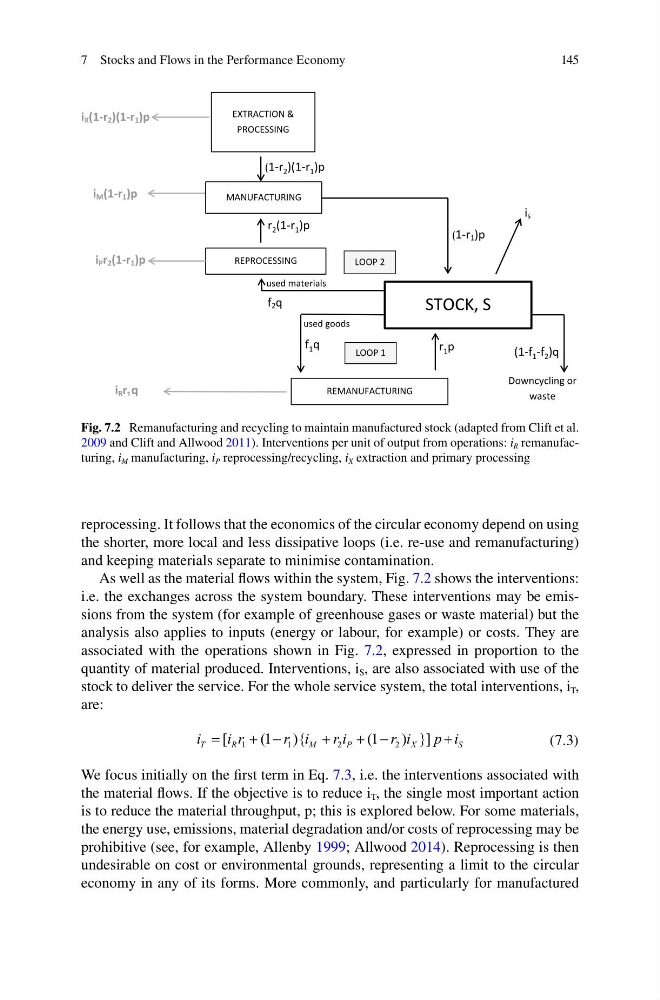
As well as the material flows within the system, Fig. 7.2 shows the interventions:
i.e. the exchanges across the system boundary. These interventions may be emissions from the system (for example of greenhouse gases or waste material) but the
analysis also applies to inputs (energy or labour, for example) or costs. They are
associated with the operations shown in Fig. 7.2, expressed in proportion to the
quantity of material produced. Interventions, i S , are also associated with use of the
stock to deliver the service. For the whole service system, the total interventions, i T ,
are:
i
i r
r i
ri
r i
p i
T
R
M
P
X
S
=
+
+
+
+
[
(
){
(
) }]
1
1
2
2
1
1
−
−
(7.3)
We focus initially on the first term in Eq. 7.3, i.e. the interventions associated with
the material flows. If the objective is to reduce i T , the single most important action
is to reduce the material throughput, p; this is explored below. For some materials,
the energy use, emissions, material degradation and/or costs of reprocessing may be
prohibitive (see, for example, Allenby 1999; Allwood 2014). Reprocessing is then
undesirable on cost or environmental grounds, representing a limit to the circular
economy in any of its forms. More commonly, and particularly for manufactured
used materials
EXTRACTION &
PROCESSING
REPROCESSING
STOCK, S
REMANUFACTURING
i X (ϭ-r Ϯ )(ϭ-r ϭ )p
i M (ϭ-r ϭ )p
i P r Ϯ (ϭ-r ϭ )p
Downcycling or
waste
(1-r 2 )(1-r 1 )p
r 2 (1-r 1 )p
(1-r 1 )p
r 1 p
f 1 q
(1-f 1 -f 2 )q
i R r 1 q
f 2 q
used goods
MANUFACTURING
i s
LOOP 1
LOOP 2
Fig. 7.2 Remanufacturing and recycling to maintain manufactured stock (adapted from Clift et al.
2009 and Clift and Allwood 2011). Interventions per unit of output from operations: i R remanufacturing, i M manufacturing, i P reprocessing/recycling, i X extraction and primary processing
7 Stocks and Flows in the Performance Economy
reprocessing. It follows that the economics of the circular economy depend on using
the shorter, more local and less dissipative loops (i.e. re-use and remanufacturing)
and keeping materials separate to minimise contamination.
As well as the material flows within the system, Fig. 7.2 shows the interventions:
i.e. the exchanges across the system boundary. These interventions may be emissions from the system (for example of greenhouse gases or waste material) but the
analysis also applies to inputs (energy or labour, for example) or costs. They are
associated with the operations shown in Fig. 7.2, expressed in proportion to the
quantity of material produced. Interventions, i S , are also associated with use of the
stock to deliver the service. For the whole service system, the total interventions, i T ,
are:
i
i r
r i
ri
r i
p i
T
R
M
P
X
S
=
+
+
+
+
[
(
){
(
) }]
1
1
2
2
1
1
−
−
(7.3)
We focus initially on the first term in Eq. 7.3, i.e. the interventions associated with
the material flows. If the objective is to reduce i T , the single most important action
is to reduce the material throughput, p; this is explored below. For some materials,
the energy use, emissions, material degradation and/or costs of reprocessing may be
prohibitive (see, for example, Allenby 1999; Allwood 2014). Reprocessing is then
undesirable on cost or environmental grounds, representing a limit to the circular
economy in any of its forms. More commonly, and particularly for manufactured
used materials
EXTRACTION &
PROCESSING
REPROCESSING
STOCK, S
REMANUFACTURING
i X (ϭ-r Ϯ )(ϭ-r ϭ )p
i M (ϭ-r ϭ )p
i P r Ϯ (ϭ-r ϭ )p
Downcycling or
waste
(1-r 2 )(1-r 1 )p
r 2 (1-r 1 )p
(1-r 1 )p
r 1 p
f 1 q
(1-f 1 -f 2 )q
i R r 1 q
f 2 q
used goods
MANUFACTURING
i s
LOOP 1
LOOP 2
Fig. 7.2 Remanufacturing and recycling to maintain manufactured stock (adapted from Clift et al.
2009 and Clift and Allwood 2011). Interventions per unit of output from operations: i R remanufacturing, i M manufacturing, i P reprocessing/recycling, i X extraction and primary processing
7 Stocks and Flows in the Performance Economy