

127
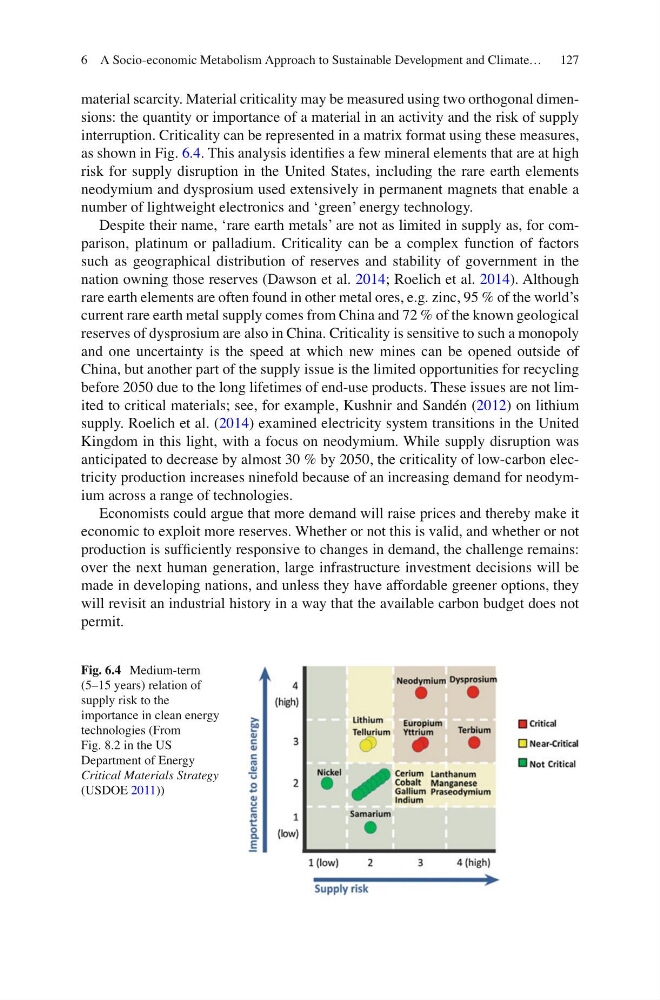
material scarcity. Material criticality may be measured using two orthogonal dimensions: the quantity or importance of a material in an activity and the risk of supply
interruption. Criticality can be represented in a matrix format using these measures,
as shown in Fig. 6.4 . This analysis identifi es a few mineral elements that are at high
risk for supply disruption in the United States, including the rare earth elements
neodymium and dysprosium used extensively in permanent magnets that enable a
number of lightweight electronics and ‘green’ energy technology.
Despite their name, ‘rare earth metals’ are not as limited in supply as, for comparison, platinum or palladium. Criticality can be a complex function of factors
such as geographical distribution of reserves and stability of government in the
nation owning those reserves (Dawson et al. 2014 ; Roelich et al. 2014 ). Although
rare earth elements are often found in other metal ores, e.g. zinc, 95 % of the world’s
current rare earth metal supply comes from China and 72 % of the known geological
reserves of dysprosium are also in China. Criticality is sensitive to such a monopoly
and one uncertainty is the speed at which new mines can be opened outside of
China, but another part of the supply issue is the limited opportunities for recycling
before 2050 due to the long lifetimes of end-use products. These issues are not limited to critical materials; see, for example, Kushnir and Sandén ( 2012 ) on lithium
supply. Roelich et al. ( 2014 ) examined electricity system transitions in the United
Kingdom in this light, with a focus on neodymium. While supply disruption was
anticipated to decrease by almost 30 % by 2050, the criticality of low-carbon electricity production increases ninefold because of an increasing demand for neodymium across a range of technologies.
Economists could argue that more demand will raise prices and thereby make it
economic to exploit more reserves. Whether or not this is valid, and whether or not
production is suffi ciently responsive to changes in demand, the challenge remains:
over the next human generation, large infrastructure investment decisions will be
made in developing nations, and unless they have affordable greener options, they
will revisit an industrial history in a way that the available carbon budget does not
permit.
Fig. 6.4 Medium-term
(5–15 years) relation of
supply risk to the
importance in clean energy
technologies (From
Fig. 8.2 in the US
Department of Energy
Critical Materials Strategy
(USDOE 2011 ))
6 A Socio-economic Metabolism Approach to Sustainable Development and Climate…
material scarcity. Material criticality may be measured using two orthogonal dimensions: the quantity or importance of a material in an activity and the risk of supply
interruption. Criticality can be represented in a matrix format using these measures,
as shown in Fig. 6.4 . This analysis identifi es a few mineral elements that are at high
risk for supply disruption in the United States, including the rare earth elements
neodymium and dysprosium used extensively in permanent magnets that enable a
number of lightweight electronics and ‘green’ energy technology.
Despite their name, ‘rare earth metals’ are not as limited in supply as, for comparison, platinum or palladium. Criticality can be a complex function of factors
such as geographical distribution of reserves and stability of government in the
nation owning those reserves (Dawson et al. 2014 ; Roelich et al. 2014 ). Although
rare earth elements are often found in other metal ores, e.g. zinc, 95 % of the world’s
current rare earth metal supply comes from China and 72 % of the known geological
reserves of dysprosium are also in China. Criticality is sensitive to such a monopoly
and one uncertainty is the speed at which new mines can be opened outside of
China, but another part of the supply issue is the limited opportunities for recycling
before 2050 due to the long lifetimes of end-use products. These issues are not limited to critical materials; see, for example, Kushnir and Sandén ( 2012 ) on lithium
supply. Roelich et al. ( 2014 ) examined electricity system transitions in the United
Kingdom in this light, with a focus on neodymium. While supply disruption was
anticipated to decrease by almost 30 % by 2050, the criticality of low-carbon electricity production increases ninefold because of an increasing demand for neodymium across a range of technologies.
Economists could argue that more demand will raise prices and thereby make it
economic to exploit more reserves. Whether or not this is valid, and whether or not
production is suffi ciently responsive to changes in demand, the challenge remains:
over the next human generation, large infrastructure investment decisions will be
made in developing nations, and unless they have affordable greener options, they
will revisit an industrial history in a way that the available carbon budget does not
permit.
Fig. 6.4 Medium-term
(5–15 years) relation of
supply risk to the
importance in clean energy
technologies (From
Fig. 8.2 in the US
Department of Energy
Critical Materials Strategy
(USDOE 2011 ))
6 A Socio-economic Metabolism Approach to Sustainable Development and Climate…