

4.1 Magnetic Monopole Generation and Recombination Noise
37
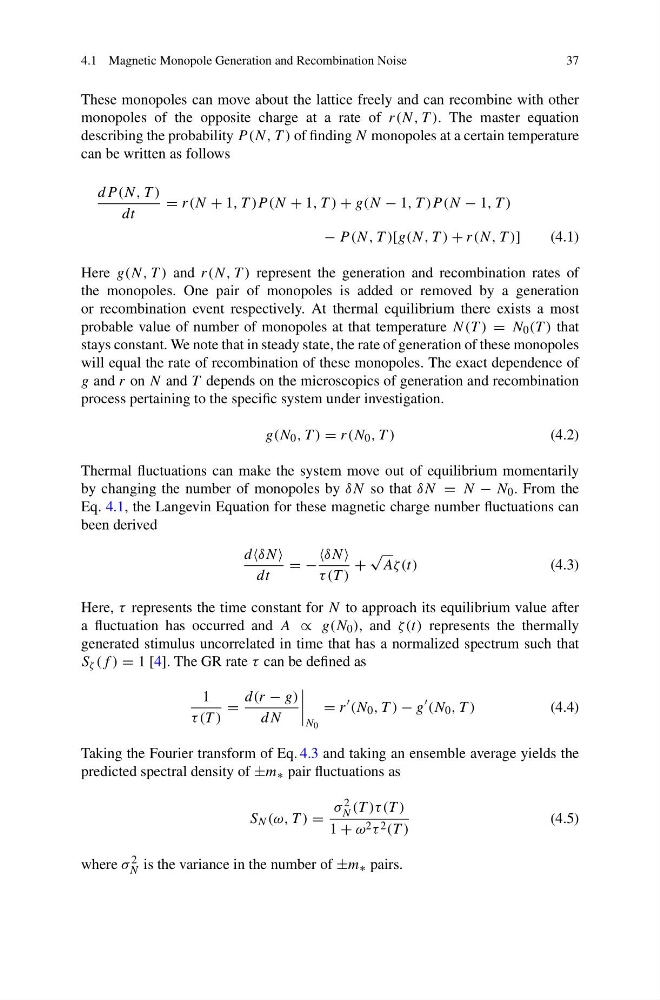
These monopoles can move about the lattice freely and can recombine with other
monopoles of the opposite charge at a rate of r(N, T ). The master equation
describing the probability P (N, T ) of finding N monopoles at a certain temperature
can be written as follows
dP (N, T )
dt
= r(N + 1, T )P (N + 1, T ) + g(N − 1, T )P (N − 1, T )
− P (N, T )[g(N, T ) + r(N, T )]
(4.1)
Here g(N, T ) and r(N, T ) represent the generation and recombination rates of
the monopoles. One pair of monopoles is added or removed by a generation
or recombination event respectively. At thermal equilibrium there exists a most
probable value of number of monopoles at that temperature N(T ) = N 0 (T ) that
stays constant. We note that in steady state, the rate of generation of these monopoles
will equal the rate of recombination of these monopoles. The exact dependence of
g and r on N and T depends on the microscopics of generation and recombination
process pertaining to the specific system under investigation.
g(N 0 , T ) = r(N 0 , T )
(4.2)
Thermal fluctuations can make the system move out of equilibrium momentarily
by changing the number of monopoles by δN so that δN = N − N 0 . From the
Eq. 4.1, the Langevin Equation for these magnetic charge number fluctuations can
been derived
dδN
dt
= −
δN
τ (T )
+
√
Aζ (t)
(4.3)
Here, τ represents the time constant for N to approach its equilibrium value after
a fluctuation has occurred and A ∝ g(N 0 ), and ζ(t) represents the thermally
generated stimulus uncorrelated in time that has a normalized spectrum such that
S ζ (f ) = 1 [4]. The GR rate τ can be defined as
1
τ (T )
=
d(r − g)
dN
N 0
= r
(N 0 , T ) − g
(N 0 , T )
(4.4)
Taking the Fourier transform of Eq. 4.3 and taking an ensemble average yields the
predicted spectral density of ±m ∗ pair fluctuations as
S N (ω, T ) =
σ 2
N (T )τ (T )
1 + ω 2 τ 2 (T )
(4.5)
where σ 2
N is the variance in the number of ±m ∗ pairs.
37
These monopoles can move about the lattice freely and can recombine with other
monopoles of the opposite charge at a rate of r(N, T ). The master equation
describing the probability P (N, T ) of finding N monopoles at a certain temperature
can be written as follows
dP (N, T )
dt
= r(N + 1, T )P (N + 1, T ) + g(N − 1, T )P (N − 1, T )
− P (N, T )[g(N, T ) + r(N, T )]
(4.1)
Here g(N, T ) and r(N, T ) represent the generation and recombination rates of
the monopoles. One pair of monopoles is added or removed by a generation
or recombination event respectively. At thermal equilibrium there exists a most
probable value of number of monopoles at that temperature N(T ) = N 0 (T ) that
stays constant. We note that in steady state, the rate of generation of these monopoles
will equal the rate of recombination of these monopoles. The exact dependence of
g and r on N and T depends on the microscopics of generation and recombination
process pertaining to the specific system under investigation.
g(N 0 , T ) = r(N 0 , T )
(4.2)
Thermal fluctuations can make the system move out of equilibrium momentarily
by changing the number of monopoles by δN so that δN = N − N 0 . From the
Eq. 4.1, the Langevin Equation for these magnetic charge number fluctuations can
been derived
dδN
dt
= −
δN
τ (T )
+
√
Aζ (t)
(4.3)
Here, τ represents the time constant for N to approach its equilibrium value after
a fluctuation has occurred and A ∝ g(N 0 ), and ζ(t) represents the thermally
generated stimulus uncorrelated in time that has a normalized spectrum such that
S ζ (f ) = 1 [4]. The GR rate τ can be defined as
1
τ (T )
=
d(r − g)
dN
N 0
= r
(N 0 , T ) − g
(N 0 , T )
(4.4)
Taking the Fourier transform of Eq. 4.3 and taking an ensemble average yields the
predicted spectral density of ±m ∗ pair fluctuations as
S N (ω, T ) =
σ 2
N (T )τ (T )
1 + ω 2 τ 2 (T )
(4.5)
where σ 2
N is the variance in the number of ±m ∗ pairs.