

58
4 Measuring Principles and Techniques …
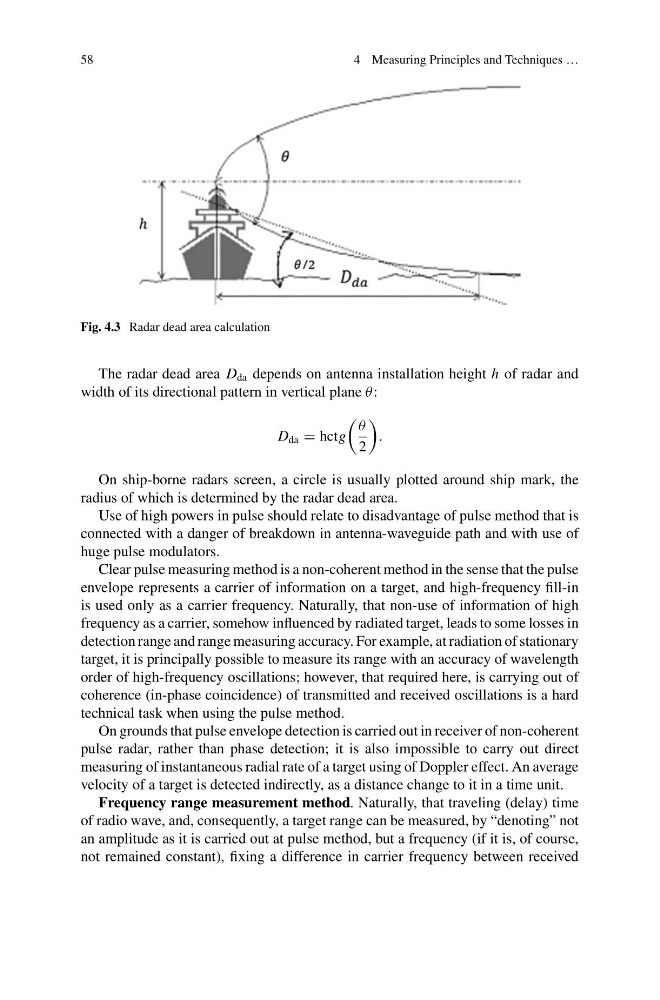
Fig. 4.3 Radar dead area calculation
The radar dead area D da depends on antenna installation height h of radar and
width of its directional pattern in vertical plane θ :
D da = hctg
θ
2
.
On ship-borne radars screen, a circle is usually plotted around ship mark, the
radius of which is determined by the radar dead area.
Use of high powers in pulse should relate to disadvantage of pulse method that is
connected with a danger of breakdown in antenna-waveguide path and with use of
huge pulse modulators.
Clear pulse measuring method is a non-coherent method in the sense that the pulse
envelope represents a carrier of information on a target, and high-frequency fill-in
is used only as a carrier frequency. Naturally, that non-use of information of high
frequency as a carrier, somehow influenced by radiated target, leads to some losses in
detection range and range measuring accuracy. For example, at radiation of stationary
target, it is principally possible to measure its range with an accuracy of wavelength
order of high-frequency oscillations; however, that required here, is carrying out of
coherence (in-phase coincidence) of transmitted and received oscillations is a hard
technical task when using the pulse method.
On grounds that pulse envelope detection is carried out in receiver of non-coherent
pulse radar, rather than phase detection; it is also impossible to carry out direct
measuring of instantaneous radial rate of a target using of Doppler effect. An average
velocity of a target is detected indirectly, as a distance change to it in a time unit.
Frequency range measurement method. Naturally, that traveling (delay) time
of radio wave, and, consequently, a target range can be measured, by “denoting” not
an amplitude as it is carried out at pulse method, but a frequency (if it is, of course,
not remained constant), fixing a difference in carrier frequency between received
4 Measuring Principles and Techniques …
Fig. 4.3 Radar dead area calculation
The radar dead area D da depends on antenna installation height h of radar and
width of its directional pattern in vertical plane θ :
D da = hctg
θ
2
.
On ship-borne radars screen, a circle is usually plotted around ship mark, the
radius of which is determined by the radar dead area.
Use of high powers in pulse should relate to disadvantage of pulse method that is
connected with a danger of breakdown in antenna-waveguide path and with use of
huge pulse modulators.
Clear pulse measuring method is a non-coherent method in the sense that the pulse
envelope represents a carrier of information on a target, and high-frequency fill-in
is used only as a carrier frequency. Naturally, that non-use of information of high
frequency as a carrier, somehow influenced by radiated target, leads to some losses in
detection range and range measuring accuracy. For example, at radiation of stationary
target, it is principally possible to measure its range with an accuracy of wavelength
order of high-frequency oscillations; however, that required here, is carrying out of
coherence (in-phase coincidence) of transmitted and received oscillations is a hard
technical task when using the pulse method.
On grounds that pulse envelope detection is carried out in receiver of non-coherent
pulse radar, rather than phase detection; it is also impossible to carry out direct
measuring of instantaneous radial rate of a target using of Doppler effect. An average
velocity of a target is detected indirectly, as a distance change to it in a time unit.
Frequency range measurement method. Naturally, that traveling (delay) time
of radio wave, and, consequently, a target range can be measured, by “denoting” not
an amplitude as it is carried out at pulse method, but a frequency (if it is, of course,
not remained constant), fixing a difference in carrier frequency between received