

4.1 Range Measurement Techniques
57
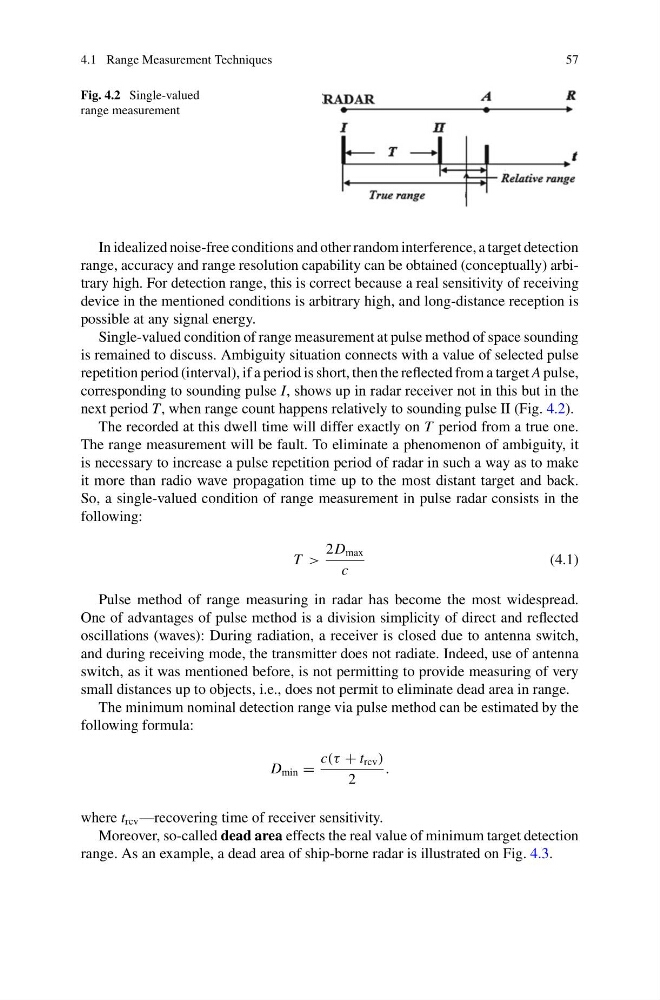
Fig. 4.2 Single-valued
range measurement
In idealized noise-free conditions and other random interference, a target detection
range, accuracy and range resolution capability can be obtained (conceptually) arbitrary high. For detection range, this is correct because a real sensitivity of receiving
device in the mentioned conditions is arbitrary high, and long-distance reception is
possible at any signal energy.
Single-valued condition of range measurement at pulse method of space sounding
is remained to discuss. Ambiguity situation connects with a value of selected pulse
repetition period (interval), if a period is short, then the reflected from a target A pulse,
corresponding to sounding pulse I, shows up in radar receiver not in this but in the
next period T, when range count happens relatively to sounding pulse II (Fig. 4.2).
The recorded at this dwell time will differ exactly on T period from a true one.
The range measurement will be fault. To eliminate a phenomenon of ambiguity, it
is necessary to increase a pulse repetition period of radar in such a way as to make
it more than radio wave propagation time up to the most distant target and back.
So, a single-valued condition of range measurement in pulse radar consists in the
following:
T >
2D max
c
(4.1)
Pulse method of range measuring in radar has become the most widespread.
One of advantages of pulse method is a division simplicity of direct and reflected
oscillations (waves): During radiation, a receiver is closed due to antenna switch,
and during receiving mode, the transmitter does not radiate. Indeed, use of antenna
switch, as it was mentioned before, is not permitting to provide measuring of very
small distances up to objects, i.e., does not permit to eliminate dead area in range.
The minimum nominal detection range via pulse method can be estimated by the
following formula:
D min =
c(τ + t rcv )
2
.
where t rcv —recovering time of receiver sensitivity.
Moreover, so-called dead area effects the real value of minimum target detection
range. As an example, a dead area of ship-borne radar is illustrated on Fig. 4.3.
57
Fig. 4.2 Single-valued
range measurement
In idealized noise-free conditions and other random interference, a target detection
range, accuracy and range resolution capability can be obtained (conceptually) arbitrary high. For detection range, this is correct because a real sensitivity of receiving
device in the mentioned conditions is arbitrary high, and long-distance reception is
possible at any signal energy.
Single-valued condition of range measurement at pulse method of space sounding
is remained to discuss. Ambiguity situation connects with a value of selected pulse
repetition period (interval), if a period is short, then the reflected from a target A pulse,
corresponding to sounding pulse I, shows up in radar receiver not in this but in the
next period T, when range count happens relatively to sounding pulse II (Fig. 4.2).
The recorded at this dwell time will differ exactly on T period from a true one.
The range measurement will be fault. To eliminate a phenomenon of ambiguity, it
is necessary to increase a pulse repetition period of radar in such a way as to make
it more than radio wave propagation time up to the most distant target and back.
So, a single-valued condition of range measurement in pulse radar consists in the
following:
T >
2D max
c
(4.1)
Pulse method of range measuring in radar has become the most widespread.
One of advantages of pulse method is a division simplicity of direct and reflected
oscillations (waves): During radiation, a receiver is closed due to antenna switch,
and during receiving mode, the transmitter does not radiate. Indeed, use of antenna
switch, as it was mentioned before, is not permitting to provide measuring of very
small distances up to objects, i.e., does not permit to eliminate dead area in range.
The minimum nominal detection range via pulse method can be estimated by the
following formula:
D min =
c(τ + t rcv )
2
.
where t rcv —recovering time of receiver sensitivity.
Moreover, so-called dead area effects the real value of minimum target detection
range. As an example, a dead area of ship-borne radar is illustrated on Fig. 4.3.