

4.1 Range Measurement Techniques
59
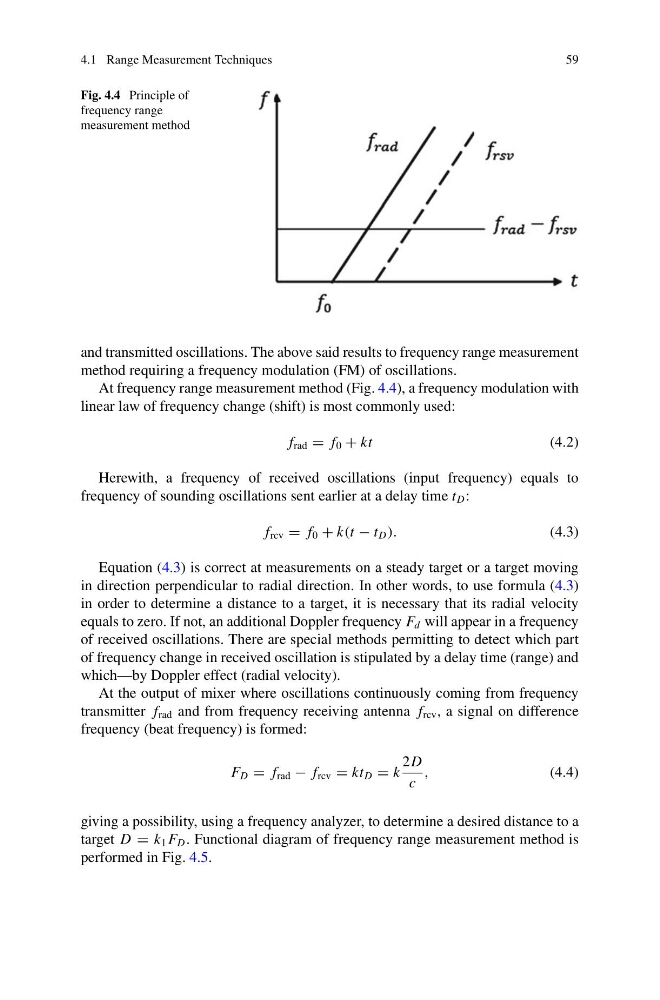
Fig. 4.4 Principle of
frequency range
measurement method
and transmitted oscillations. The above said results to frequency range measurement
method requiring a frequency modulation (FM) of oscillations.
At frequency range measurement method (Fig. 4.4), a frequency modulation with
linear law of frequency change (shift) is most commonly used:
f rad = f 0 + kt
(4.2)
Herewith, a frequency of received oscillations (input frequency) equals to
frequency of sounding oscillations sent earlier at a delay time t D :
f rcv = f 0 + k(t − t D ).
(4.3)
Equation (4.3) is correct at measurements on a steady target or a target moving
in direction perpendicular to radial direction. In other words, to use formula (4.3)
in order to determine a distance to a target, it is necessary that its radial velocity
equals to zero. If not, an additional Doppler frequency F d will appear in a frequency
of received oscillations. There are special methods permitting to detect which part
of frequency change in received oscillation is stipulated by a delay time (range) and
which—by Doppler effect (radial velocity).
At the output of mixer where oscillations continuously coming from frequency
transmitter f rad and from frequency receiving antenna f rcv , a signal on difference
frequency (beat frequency) is formed:
F D = f rad − f rcv = kt D = k
2D
c
,
(4.4)
giving a possibility, using a frequency analyzer, to determine a desired distance to a
target D = k 1 F D . Functional diagram of frequency range measurement method is
performed in Fig. 4.5.
59
Fig. 4.4 Principle of
frequency range
measurement method
and transmitted oscillations. The above said results to frequency range measurement
method requiring a frequency modulation (FM) of oscillations.
At frequency range measurement method (Fig. 4.4), a frequency modulation with
linear law of frequency change (shift) is most commonly used:
f rad = f 0 + kt
(4.2)
Herewith, a frequency of received oscillations (input frequency) equals to
frequency of sounding oscillations sent earlier at a delay time t D :
f rcv = f 0 + k(t − t D ).
(4.3)
Equation (4.3) is correct at measurements on a steady target or a target moving
in direction perpendicular to radial direction. In other words, to use formula (4.3)
in order to determine a distance to a target, it is necessary that its radial velocity
equals to zero. If not, an additional Doppler frequency F d will appear in a frequency
of received oscillations. There are special methods permitting to detect which part
of frequency change in received oscillation is stipulated by a delay time (range) and
which—by Doppler effect (radial velocity).
At the output of mixer where oscillations continuously coming from frequency
transmitter f rad and from frequency receiving antenna f rcv , a signal on difference
frequency (beat frequency) is formed:
F D = f rad − f rcv = kt D = k
2D
c
,
(4.4)
giving a possibility, using a frequency analyzer, to determine a desired distance to a
target D = k 1 F D . Functional diagram of frequency range measurement method is
performed in Fig. 4.5.