

3.7 Volume-Distributed Targets
53
ρ 6 =
1
√
2πσ
∞
0
ρ
6 e
− (ρ−ρ0)
2
2σ 2
dρ.
(3.66)
Since a dispersion σ is not too large as a rule, then ρ 6 = ρ
6
0 . Thus, (3.65) formula
will be written as:
a 0 =
60π
5
λ 4 Nρ
6
0 .
(3.67)
Expression Z =
N
i=1 ρ
6
i = Nρ
6
0 in meteorology bears a name of reflectivity
multiplier, which is connected with rain intensity rate I, i.e., with an amount precipitation mm/h, with Z = 200I
1,6 formula, and for real rain ranges from 150 to
500 mm
6 /m
3 . For hail Z = 3 · 10
6 mm
6 /m
3 , and for snow Z = 1000I
1,6 (I—now a
snowfall intensity rate in mm/h in terms of water, i.e., after thawing). Typical average
radius of rain droplets ρ 0 ∼ = 1 mm, and water droplets in a cloud—ρ 0 ∼ = 0.01 mm.
Amount of rain droplets in m
3 has a multiple of N ∼ = 10
3 , and in cloud—N ∼ = 10
9 . A
useful can be a Z multiplier representation via liquid water content (LWC) M(g/m
3
).
For average rain, it is given as Z = 0.03M
1,8 mm
6 /m
3 . The dependence of specific
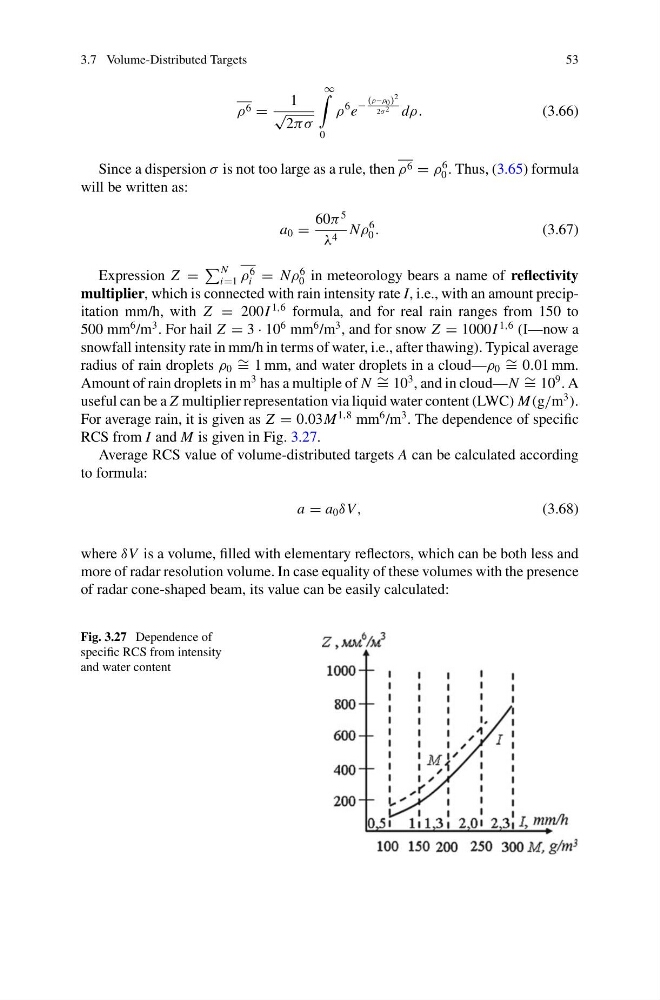
RCS from I and M is given in Fig. 3.27.
Average RCS value of volume-distributed targets A can be calculated according
to formula:
a = a 0 δV,
(3.68)
where δV is a volume, filled with elementary reflectors, which can be both less and
more of radar resolution volume. In case equality of these volumes with the presence
of radar cone-shaped beam, its value can be easily calculated:
Fig. 3.27 Dependence of
specific RCS from intensity
and water content
53
ρ 6 =
1
√
2πσ
∞
0
ρ
6 e
− (ρ−ρ0)
2
2σ 2
dρ.
(3.66)
Since a dispersion σ is not too large as a rule, then ρ 6 = ρ
6
0 . Thus, (3.65) formula
will be written as:
a 0 =
60π
5
λ 4 Nρ
6
0 .
(3.67)
Expression Z =
N
i=1 ρ
6
i = Nρ
6
0 in meteorology bears a name of reflectivity
multiplier, which is connected with rain intensity rate I, i.e., with an amount precipitation mm/h, with Z = 200I
1,6 formula, and for real rain ranges from 150 to
500 mm
6 /m
3 . For hail Z = 3 · 10
6 mm
6 /m
3 , and for snow Z = 1000I
1,6 (I—now a
snowfall intensity rate in mm/h in terms of water, i.e., after thawing). Typical average
radius of rain droplets ρ 0 ∼ = 1 mm, and water droplets in a cloud—ρ 0 ∼ = 0.01 mm.
Amount of rain droplets in m
3 has a multiple of N ∼ = 10
3 , and in cloud—N ∼ = 10
9 . A
useful can be a Z multiplier representation via liquid water content (LWC) M(g/m
3
).
For average rain, it is given as Z = 0.03M
1,8 mm
6 /m
3 . The dependence of specific
RCS from I and M is given in Fig. 3.27.
Average RCS value of volume-distributed targets A can be calculated according
to formula:
a = a 0 δV,
(3.68)
where δV is a volume, filled with elementary reflectors, which can be both less and
more of radar resolution volume. In case equality of these volumes with the presence
of radar cone-shaped beam, its value can be easily calculated:
Fig. 3.27 Dependence of
specific RCS from intensity
and water content