

52
3 Radar Targets and Its Reflecting Properties
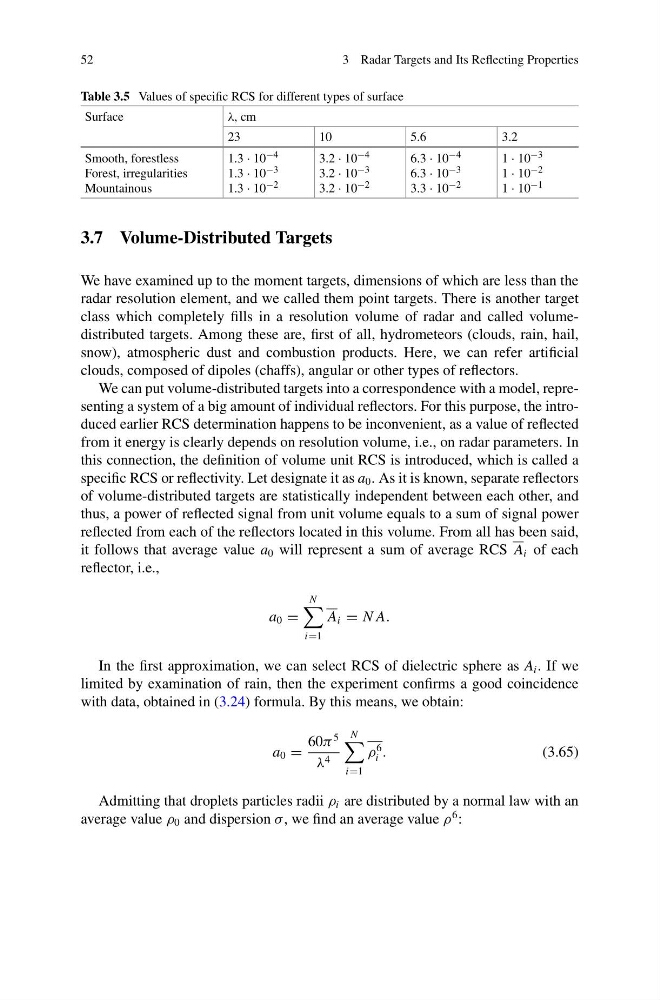
Table 3.5 Values of specific RCS for different types of surface
Surface
λ, cm
23
10
5.6
3.2
Smooth, forestless
Forest, irregularities
Mountainous
1.3 · 10 −4
1.3 · 10 −3
1.3 · 10 −2
3.2 · 10 −4
3.2 · 10 −3
3.2 · 10 −2
6.3 · 10 −4
6.3 · 10 −3
3.3 · 10 −2
1 · 10 −3
1 · 10 −2
1 · 10 −1
3.7 Volume-Distributed Targets
We have examined up to the moment targets, dimensions of which are less than the
radar resolution element, and we called them point targets. There is another target
class which completely fills in a resolution volume of radar and called volumedistributed targets. Among these are, first of all, hydrometeors (clouds, rain, hail,
snow), atmospheric dust and combustion products. Here, we can refer artificial
clouds, composed of dipoles (chaffs), angular or other types of reflectors.
We can put volume-distributed targets into a correspondence with a model, representing a system of a big amount of individual reflectors. For this purpose, the introduced earlier RCS determination happens to be inconvenient, as a value of reflected
from it energy is clearly depends on resolution volume, i.e., on radar parameters. In
this connection, the definition of volume unit RCS is introduced, which is called a
specific RCS or reflectivity. Let designate it as a 0 . As it is known, separate reflectors
of volume-distributed targets are statistically independent between each other, and
thus, a power of reflected signal from unit volume equals to a sum of signal power
reflected from each of the reflectors located in this volume. From all has been said,
it follows that average value a 0 will represent a sum of average RCS A i of each
reflector, i.e.,
a 0 =
N
i=1
A i = N A.
In the first approximation, we can select RCS of dielectric sphere as A i . If we
limited by examination of rain, then the experiment confirms a good coincidence
with data, obtained in (3.24) formula. By this means, we obtain:
a 0 =
60π
5
λ 4
N
i=1
ρ
6
i .
(3.65)
Admitting that droplets particles radii ρ i are distributed by a normal law with an
average value ρ 0 and dispersion σ, we find an average value ρ
6 :
3 Radar Targets and Its Reflecting Properties
Table 3.5 Values of specific RCS for different types of surface
Surface
λ, cm
23
10
5.6
3.2
Smooth, forestless
Forest, irregularities
Mountainous
1.3 · 10 −4
1.3 · 10 −3
1.3 · 10 −2
3.2 · 10 −4
3.2 · 10 −3
3.2 · 10 −2
6.3 · 10 −4
6.3 · 10 −3
3.3 · 10 −2
1 · 10 −3
1 · 10 −2
1 · 10 −1
3.7 Volume-Distributed Targets
We have examined up to the moment targets, dimensions of which are less than the
radar resolution element, and we called them point targets. There is another target
class which completely fills in a resolution volume of radar and called volumedistributed targets. Among these are, first of all, hydrometeors (clouds, rain, hail,
snow), atmospheric dust and combustion products. Here, we can refer artificial
clouds, composed of dipoles (chaffs), angular or other types of reflectors.
We can put volume-distributed targets into a correspondence with a model, representing a system of a big amount of individual reflectors. For this purpose, the introduced earlier RCS determination happens to be inconvenient, as a value of reflected
from it energy is clearly depends on resolution volume, i.e., on radar parameters. In
this connection, the definition of volume unit RCS is introduced, which is called a
specific RCS or reflectivity. Let designate it as a 0 . As it is known, separate reflectors
of volume-distributed targets are statistically independent between each other, and
thus, a power of reflected signal from unit volume equals to a sum of signal power
reflected from each of the reflectors located in this volume. From all has been said,
it follows that average value a 0 will represent a sum of average RCS A i of each
reflector, i.e.,
a 0 =
N
i=1
A i = N A.
In the first approximation, we can select RCS of dielectric sphere as A i . If we
limited by examination of rain, then the experiment confirms a good coincidence
with data, obtained in (3.24) formula. By this means, we obtain:
a 0 =
60π
5
λ 4
N
i=1
ρ
6
i .
(3.65)
Admitting that droplets particles radii ρ i are distributed by a normal law with an
average value ρ 0 and dispersion σ, we find an average value ρ
6 :