

54
3 Radar Targets and Its Reflecting Properties
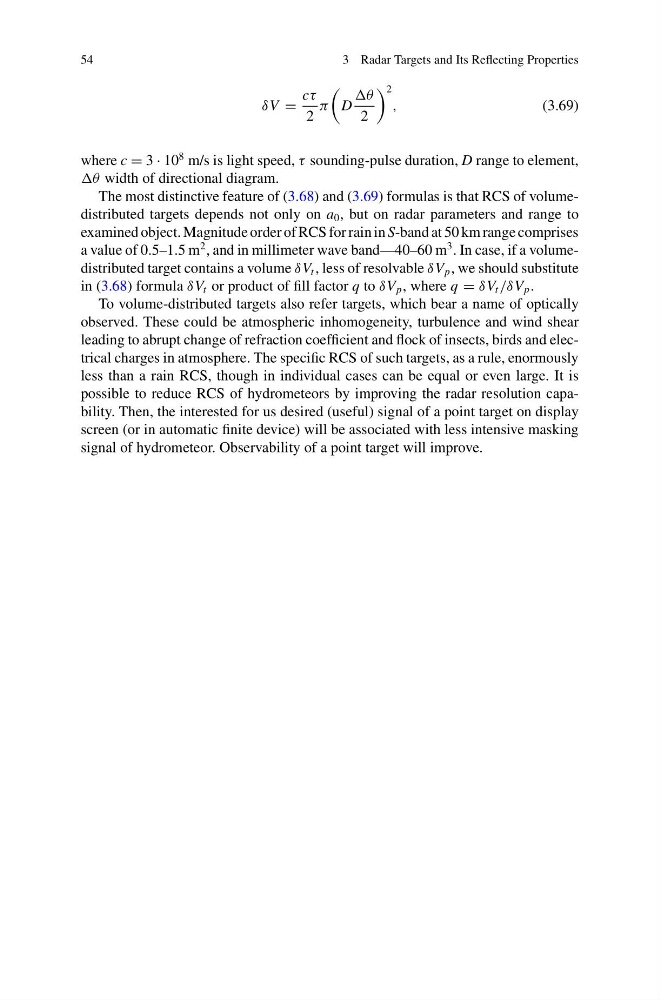
δV =
cτ
2
π
D
θ
2
2
,
(3.69)
where c = 3 · 10
8 m/s is light speed, τ sounding-pulse duration, D range to element,
θ width of directional diagram.
The most distinctive feature of (3.68) and (3.69) formulas is that RCS of volumedistributed targets depends not only on a 0 , but on radar parameters and range to
examined object. Magnitude order of RCS for rain in S-band at 50 km range comprises
a value of 0.5–1.5 m
2 , and in millimeter wave band—40–60 m
3 . In case, if a volumedistributed target contains a volume δV t , less of resolvable δV p , we should substitute
in (3.68) formula δV t or product of fill factor q to δV p , where q = δV t /δV p .
To volume-distributed targets also refer targets, which bear a name of optically
observed. These could be atmospheric inhomogeneity, turbulence and wind shear
leading to abrupt change of refraction coefficient and flock of insects, birds and electrical charges in atmosphere. The specific RCS of such targets, as a rule, enormously
less than a rain RCS, though in individual cases can be equal or even large. It is
possible to reduce RCS of hydrometeors by improving the radar resolution capability. Then, the interested for us desired (useful) signal of a point target on display
screen (or in automatic finite device) will be associated with less intensive masking
signal of hydrometeor. Observability of a point target will improve.
3 Radar Targets and Its Reflecting Properties
δV =
cτ
2
π
D
θ
2
2
,
(3.69)
where c = 3 · 10
8 m/s is light speed, τ sounding-pulse duration, D range to element,
θ width of directional diagram.
The most distinctive feature of (3.68) and (3.69) formulas is that RCS of volumedistributed targets depends not only on a 0 , but on radar parameters and range to
examined object. Magnitude order of RCS for rain in S-band at 50 km range comprises
a value of 0.5–1.5 m
2 , and in millimeter wave band—40–60 m
3 . In case, if a volumedistributed target contains a volume δV t , less of resolvable δV p , we should substitute
in (3.68) formula δV t or product of fill factor q to δV p , where q = δV t /δV p .
To volume-distributed targets also refer targets, which bear a name of optically
observed. These could be atmospheric inhomogeneity, turbulence and wind shear
leading to abrupt change of refraction coefficient and flock of insects, birds and electrical charges in atmosphere. The specific RCS of such targets, as a rule, enormously
less than a rain RCS, though in individual cases can be equal or even large. It is
possible to reduce RCS of hydrometeors by improving the radar resolution capability. Then, the interested for us desired (useful) signal of a point target on display
screen (or in automatic finite device) will be associated with less intensive masking
signal of hydrometeor. Observability of a point target will improve.