

3.4 Scattering Cross Section of Simple Point Targets
35
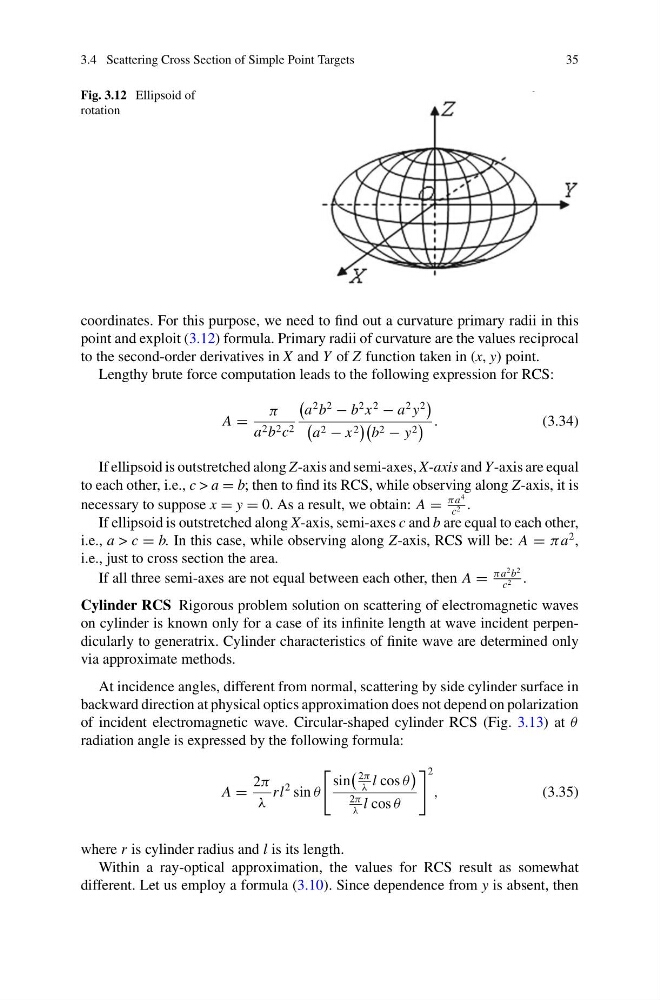
Fig. 3.12 Ellipsoid of
rotation
coordinates. For this purpose, we need to find out a curvature primary radii in this
point and exploit (3.12) formula. Primary radii of curvature are the values reciprocal
to the second-order derivatives in X and Y of Z function taken in (x, y) point.
Lengthy brute force computation leads to the following expression for RCS:
A =
π
a 2 b 2 c 2
a
2 b
2
− b
2 x
2
− a
2 y
2
a 2 − x 2
b 2 − y 2
.
(3.34)
If ellipsoid is outstretched along Z-axis and semi-axes, X-axis and Y-axis are equal
to each other, i.e., c > a = b; then to find its RCS, while observing along Z-axis, it is
necessary to suppose x = y = 0. As a result, we obtain: A =
πa
4
c 2 .
If ellipsoid is outstretched along X-axis, semi-axes c and b are equal to each other,
i.e., a > c = b. In this case, while observing along Z-axis, RCS will be: A = πa
2 ,
i.e., just to cross section the area.
If all three semi-axes are not equal between each other, then A =
πa
2 b
2
c 2 .
Cylinder RCS Rigorous problem solution on scattering of electromagnetic waves
on cylinder is known only for a case of its infinite length at wave incident perpendicularly to generatrix. Cylinder characteristics of finite wave are determined only
via approximate methods.
At incidence angles, different from normal, scattering by side cylinder surface in
backward direction at physical optics approximation does not depend on polarization
of incident electromagnetic wave. Circular-shaped cylinder RCS (Fig. 3.13) at θ
radiation angle is expressed by the following formula:
A =
2π
λ
rl
2 sin θ
sin
2π
λ
l cos θ
2π
λ
l cos θ
2
,
(3.35)
where r is cylinder radius and l is its length.
Within a ray-optical approximation, the values for RCS result as somewhat
different. Let us employ a formula (3.10). Since dependence from y is absent, then
35
Fig. 3.12 Ellipsoid of
rotation
coordinates. For this purpose, we need to find out a curvature primary radii in this
point and exploit (3.12) formula. Primary radii of curvature are the values reciprocal
to the second-order derivatives in X and Y of Z function taken in (x, y) point.
Lengthy brute force computation leads to the following expression for RCS:
A =
π
a 2 b 2 c 2
a
2 b
2
− b
2 x
2
− a
2 y
2
a 2 − x 2
b 2 − y 2
.
(3.34)
If ellipsoid is outstretched along Z-axis and semi-axes, X-axis and Y-axis are equal
to each other, i.e., c > a = b; then to find its RCS, while observing along Z-axis, it is
necessary to suppose x = y = 0. As a result, we obtain: A =
πa
4
c 2 .
If ellipsoid is outstretched along X-axis, semi-axes c and b are equal to each other,
i.e., a > c = b. In this case, while observing along Z-axis, RCS will be: A = πa
2 ,
i.e., just to cross section the area.
If all three semi-axes are not equal between each other, then A =
πa
2 b
2
c 2 .
Cylinder RCS Rigorous problem solution on scattering of electromagnetic waves
on cylinder is known only for a case of its infinite length at wave incident perpendicularly to generatrix. Cylinder characteristics of finite wave are determined only
via approximate methods.
At incidence angles, different from normal, scattering by side cylinder surface in
backward direction at physical optics approximation does not depend on polarization
of incident electromagnetic wave. Circular-shaped cylinder RCS (Fig. 3.13) at θ
radiation angle is expressed by the following formula:
A =
2π
λ
rl
2 sin θ
sin
2π
λ
l cos θ
2π
λ
l cos θ
2
,
(3.35)
where r is cylinder radius and l is its length.
Within a ray-optical approximation, the values for RCS result as somewhat
different. Let us employ a formula (3.10). Since dependence from y is absent, then