

34
3 Radar Targets and Its Reflecting Properties
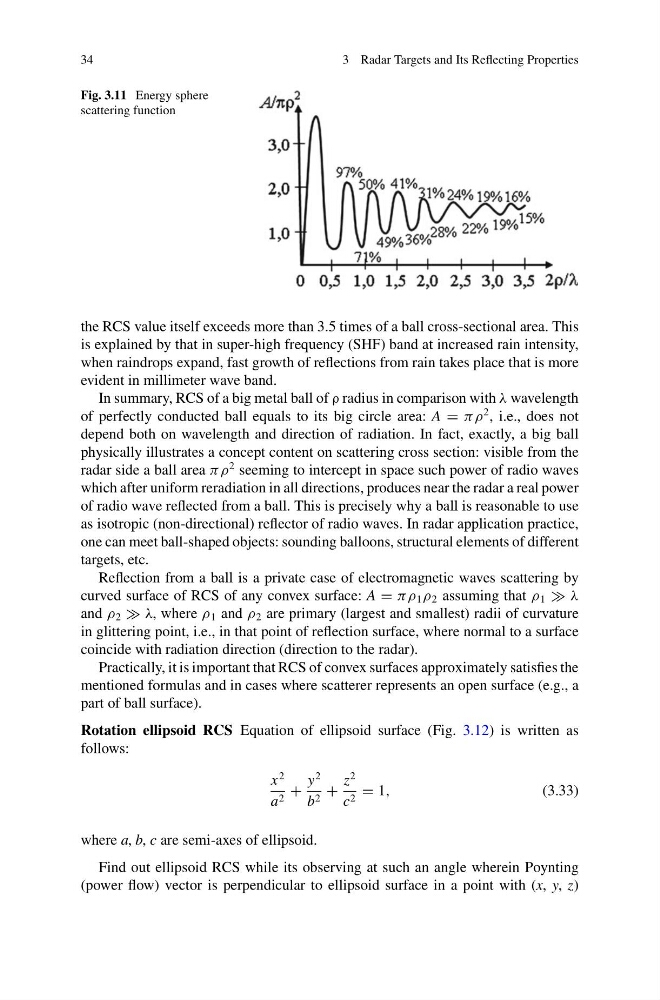
Fig. 3.11 Energy sphere
scattering function
the RCS value itself exceeds more than 3.5 times of a ball cross-sectional area. This
is explained by that in super-high frequency (SHF) band at increased rain intensity,
when raindrops expand, fast growth of reflections from rain takes place that is more
evident in millimeter wave band.
In summary, RCS of a big metal ball of ρ radius in comparison with λ wavelength
of perfectly conducted ball equals to its big circle area: A = πρ
2 , i.e., does not
depend both on wavelength and direction of radiation. In fact, exactly, a big ball
physically illustrates a concept content on scattering cross section: visible from the
radar side a ball area πρ
2 seeming to intercept in space such power of radio waves
which after uniform reradiation in all directions, produces near the radar a real power
of radio wave reflected from a ball. This is precisely why a ball is reasonable to use
as isotropic (non-directional) reflector of radio waves. In radar application practice,
one can meet ball-shaped objects: sounding balloons, structural elements of different
targets, etc.
Reflection from a ball is a private case of electromagnetic waves scattering by
curved surface of RCS of any convex surface: A = πρ 1 ρ 2 assuming that ρ 1 λ
and ρ 2 λ, where ρ 1 and ρ 2 are primary (largest and smallest) radii of curvature
in glittering point, i.e., in that point of reflection surface, where normal to a surface
coincide with radiation direction (direction to the radar).
Practically, it is important that RCS of convex surfaces approximately satisfies the
mentioned formulas and in cases where scatterer represents an open surface (e.g., a
part of ball surface).
Rotation ellipsoid RCS Equation of ellipsoid surface (Fig. 3.12) is written as
follows:
x
2
a 2 +
y
2
b 2 +
z
2
c 2 = 1,
(3.33)
where a, b, c are semi-axes of ellipsoid.
Find out ellipsoid RCS while its observing at such an angle wherein Poynting
(power flow) vector is perpendicular to ellipsoid surface in a point with (x, y, z)
3 Radar Targets and Its Reflecting Properties
Fig. 3.11 Energy sphere
scattering function
the RCS value itself exceeds more than 3.5 times of a ball cross-sectional area. This
is explained by that in super-high frequency (SHF) band at increased rain intensity,
when raindrops expand, fast growth of reflections from rain takes place that is more
evident in millimeter wave band.
In summary, RCS of a big metal ball of ρ radius in comparison with λ wavelength
of perfectly conducted ball equals to its big circle area: A = πρ
2 , i.e., does not
depend both on wavelength and direction of radiation. In fact, exactly, a big ball
physically illustrates a concept content on scattering cross section: visible from the
radar side a ball area πρ
2 seeming to intercept in space such power of radio waves
which after uniform reradiation in all directions, produces near the radar a real power
of radio wave reflected from a ball. This is precisely why a ball is reasonable to use
as isotropic (non-directional) reflector of radio waves. In radar application practice,
one can meet ball-shaped objects: sounding balloons, structural elements of different
targets, etc.
Reflection from a ball is a private case of electromagnetic waves scattering by
curved surface of RCS of any convex surface: A = πρ 1 ρ 2 assuming that ρ 1 λ
and ρ 2 λ, where ρ 1 and ρ 2 are primary (largest and smallest) radii of curvature
in glittering point, i.e., in that point of reflection surface, where normal to a surface
coincide with radiation direction (direction to the radar).
Practically, it is important that RCS of convex surfaces approximately satisfies the
mentioned formulas and in cases where scatterer represents an open surface (e.g., a
part of ball surface).
Rotation ellipsoid RCS Equation of ellipsoid surface (Fig. 3.12) is written as
follows:
x
2
a 2 +
y
2
b 2 +
z
2
c 2 = 1,
(3.33)
where a, b, c are semi-axes of ellipsoid.
Find out ellipsoid RCS while its observing at such an angle wherein Poynting
(power flow) vector is perpendicular to ellipsoid surface in a point with (x, y, z)