

3.4 Scattering Cross Section of Simple Point Targets
33
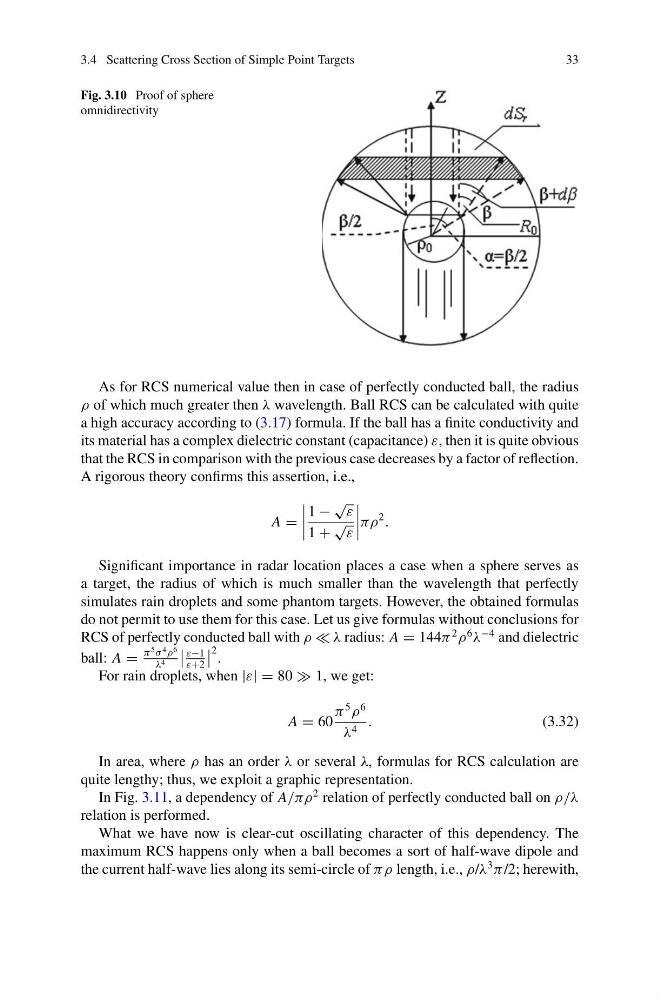
Fig. 3.10 Proof of sphere
omnidirectivity
As for RCS numerical value then in case of perfectly conducted ball, the radius
ρ of which much greater then λ wavelength. Ball RCS can be calculated with quite
a high accuracy according to (3.17) formula. If the ball has a finite conductivity and
its material has a complex dielectric constant (capacitance) ε, then it is quite obvious
that the RCS in comparison with the previous case decreases by a factor of reflection.
A rigorous theory confirms this assertion, i.e.,
A =
1 −
√ ε
1 +
√ ε
πρ
2
.
Significant importance in radar location places a case when a sphere serves as
a target, the radius of which is much smaller than the wavelength that perfectly
simulates rain droplets and some phantom targets. However, the obtained formulas
do not permit to use them for this case. Let us give formulas without conclusions for
RCS of perfectly conducted ball with ρ λ radius: A = 144π
2
ρ
6
λ
−4 and dielectric
ball: A =
π
5 σ
4 ρ
6
λ 4
ε−1
ε+2
2 .
For rain droplets, when |ε| = 80 1, we get:
A = 60
π
5
ρ
6
λ 4 .
(3.32)
In area, where ρ has an order λ or several λ, formulas for RCS calculation are
quite lengthy; thus, we exploit a graphic representation.
In Fig. 3.11, a dependency of A/πρ
2 relation of perfectly conducted ball on ρ/λ
relation is performed.
What we have now is clear-cut oscillating character of this dependency. The
maximum RCS happens only when a ball becomes a sort of half-wave dipole and
the current half-wave lies along its semi-circle of πρ length, i.e., ρ/λ
3
π /2; herewith,
33
Fig. 3.10 Proof of sphere
omnidirectivity
As for RCS numerical value then in case of perfectly conducted ball, the radius
ρ of which much greater then λ wavelength. Ball RCS can be calculated with quite
a high accuracy according to (3.17) formula. If the ball has a finite conductivity and
its material has a complex dielectric constant (capacitance) ε, then it is quite obvious
that the RCS in comparison with the previous case decreases by a factor of reflection.
A rigorous theory confirms this assertion, i.e.,
A =
1 −
√ ε
1 +
√ ε
πρ
2
.
Significant importance in radar location places a case when a sphere serves as
a target, the radius of which is much smaller than the wavelength that perfectly
simulates rain droplets and some phantom targets. However, the obtained formulas
do not permit to use them for this case. Let us give formulas without conclusions for
RCS of perfectly conducted ball with ρ λ radius: A = 144π
2
ρ
6
λ
−4 and dielectric
ball: A =
π
5 σ
4 ρ
6
λ 4
ε−1
ε+2
2 .
For rain droplets, when |ε| = 80 1, we get:
A = 60
π
5
ρ
6
λ 4 .
(3.32)
In area, where ρ has an order λ or several λ, formulas for RCS calculation are
quite lengthy; thus, we exploit a graphic representation.
In Fig. 3.11, a dependency of A/πρ
2 relation of perfectly conducted ball on ρ/λ
relation is performed.
What we have now is clear-cut oscillating character of this dependency. The
maximum RCS happens only when a ball becomes a sort of half-wave dipole and
the current half-wave lies along its semi-circle of πρ length, i.e., ρ/λ
3
π /2; herewith,