

284
15 Goniometric Radio Navigation Systems
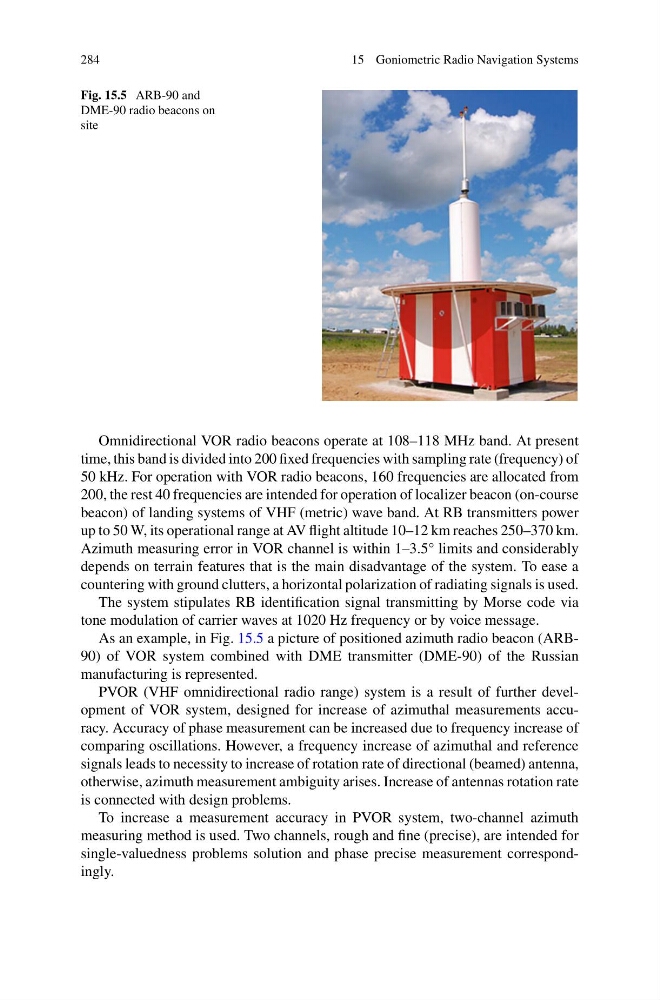
Fig. 15.5 ARB-90 and
DME-90 radio beacons on
site
Omnidirectional VOR radio beacons operate at 108–118 MHz band. At present
time, this band is divided into 200 fixed frequencies with sampling rate (frequency) of
50 kHz. For operation with VOR radio beacons, 160 frequencies are allocated from
200, the rest 40 frequencies are intended for operation of localizer beacon (on-course
beacon) of landing systems of VHF (metric) wave band. At RB transmitters power
up to 50 W, its operational range at AV flight altitude 10–12 km reaches 250–370 km.
Azimuth measuring error in VOR channel is within 1–3.5° limits and considerably
depends on terrain features that is the main disadvantage of the system. To ease a
countering with ground clutters, a horizontal polarization of radiating signals is used.
The system stipulates RB identification signal transmitting by Morse code via
tone modulation of carrier waves at 1020 Hz frequency or by voice message.
As an example, in Fig. 15.5 a picture of positioned azimuth radio beacon (ARB90) of VOR system combined with DME transmitter (DME-90) of the Russian
manufacturing is represented.
PVOR (VHF omnidirectional radio range) system is a result of further development of VOR system, designed for increase of azimuthal measurements accuracy. Accuracy of phase measurement can be increased due to frequency increase of
comparing oscillations. However, a frequency increase of azimuthal and reference
signals leads to necessity to increase of rotation rate of directional (beamed) antenna,
otherwise, azimuth measurement ambiguity arises. Increase of antennas rotation rate
is connected with design problems.
To increase a measurement accuracy in PVOR system, two-channel azimuth
measuring method is used. Two channels, rough and fine (precise), are intended for
single-valuedness problems solution and phase precise measurement correspondingly.
15 Goniometric Radio Navigation Systems
Fig. 15.5 ARB-90 and
DME-90 radio beacons on
site
Omnidirectional VOR radio beacons operate at 108–118 MHz band. At present
time, this band is divided into 200 fixed frequencies with sampling rate (frequency) of
50 kHz. For operation with VOR radio beacons, 160 frequencies are allocated from
200, the rest 40 frequencies are intended for operation of localizer beacon (on-course
beacon) of landing systems of VHF (metric) wave band. At RB transmitters power
up to 50 W, its operational range at AV flight altitude 10–12 km reaches 250–370 km.
Azimuth measuring error in VOR channel is within 1–3.5° limits and considerably
depends on terrain features that is the main disadvantage of the system. To ease a
countering with ground clutters, a horizontal polarization of radiating signals is used.
The system stipulates RB identification signal transmitting by Morse code via
tone modulation of carrier waves at 1020 Hz frequency or by voice message.
As an example, in Fig. 15.5 a picture of positioned azimuth radio beacon (ARB90) of VOR system combined with DME transmitter (DME-90) of the Russian
manufacturing is represented.
PVOR (VHF omnidirectional radio range) system is a result of further development of VOR system, designed for increase of azimuthal measurements accuracy. Accuracy of phase measurement can be increased due to frequency increase of
comparing oscillations. However, a frequency increase of azimuthal and reference
signals leads to necessity to increase of rotation rate of directional (beamed) antenna,
otherwise, azimuth measurement ambiguity arises. Increase of antennas rotation rate
is connected with design problems.
To increase a measurement accuracy in PVOR system, two-channel azimuth
measuring method is used. Two channels, rough and fine (precise), are intended for
single-valuedness problems solution and phase precise measurement correspondingly.