

12
2 Principal Physics of Radar Location and Radio-Navigation
In other words, any function can be represented in a form of sinusoid sum of
different frequencies ω with amplitude equals to |G(ω)|, and initial phase, equals
to (ω). This conclusion conditionally can be formulated as that “electromagnetic
field is a set of electromagnetic waves (radio waves) of different frequencies.”
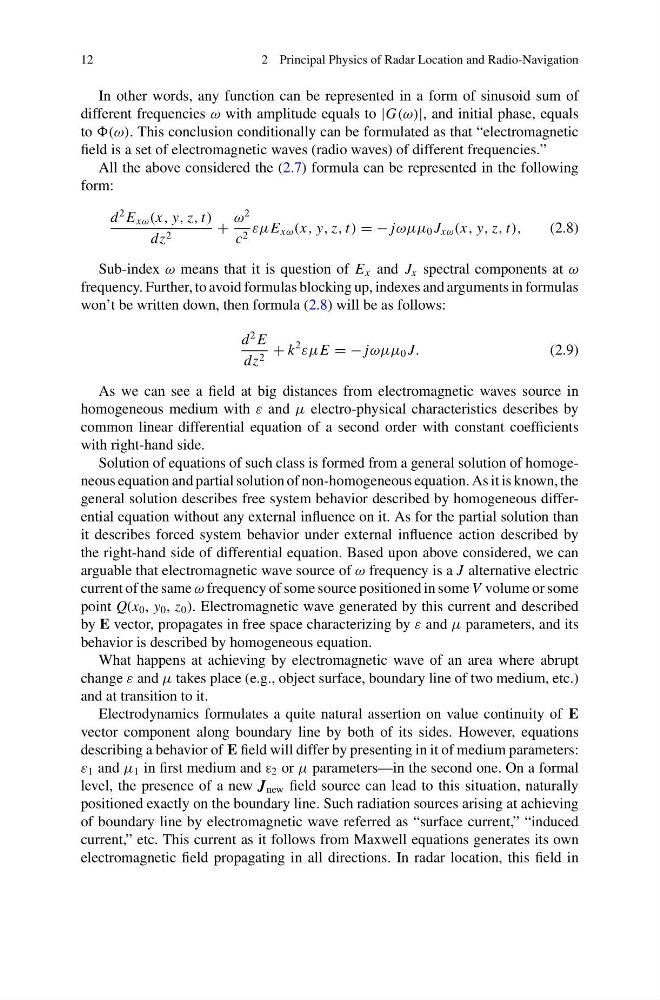
All the above considered the (2.7) formula can be represented in the following
form:
d
2 E xω (x, y, z, t)
dz 2
+
ω
2
c 2 εμE xω (x, y, z, t) = − jωμμ 0 J xω (x, y, z, t),
(2.8)
Sub-index ω means that it is question of E x and J x spectral components at ω
frequency. Further, to avoid formulas blocking up, indexes and arguments in formulas
won’t be written down, then formula (2.8) will be as follows:
d
2 E
dz 2 + k
2
εμE = − jωμμ 0 J.
(2.9)
As we can see a field at big distances from electromagnetic waves source in
homogeneous medium with ε and μ electro-physical characteristics describes by
common linear differential equation of a second order with constant coefficients
with right-hand side.
Solution of equations of such class is formed from a general solution of homogeneous equation and partial solution of non-homogeneous equation. As it is known, the
general solution describes free system behavior described by homogeneous differential equation without any external influence on it. As for the partial solution than
it describes forced system behavior under external influence action described by
the right-hand side of differential equation. Based upon above considered, we can
arguable that electromagnetic wave source of ω frequency is a J alternative electric
current of the same ω frequency of some source positioned in some V volume or some
point Q(x 0 , y 0 , z 0 ). Electromagnetic wave generated by this current and described
by E vector, propagates in free space characterizing by ε and μ parameters, and its
behavior is described by homogeneous equation.
What happens at achieving by electromagnetic wave of an area where abrupt
change ε and μ takes place (e.g., object surface, boundary line of two medium, etc.)
and at transition to it.
Electrodynamics formulates a quite natural assertion on value continuity of E
vector component along boundary line by both of its sides. However, equations
describing a behavior of E field will differ by presenting in it of medium parameters:
ε 1 and μ 1 in first medium and ε 2 or μ parameters—in the second one. On a formal
level, the presence of a new J new field source can lead to this situation, naturally
positioned exactly on the boundary line. Such radiation sources arising at achieving
of boundary line by electromagnetic wave referred as “surface current,” “induced
current,” etc. This current as it follows from Maxwell equations generates its own
electromagnetic field propagating in all directions. In radar location, this field in
2 Principal Physics of Radar Location and Radio-Navigation
In other words, any function can be represented in a form of sinusoid sum of
different frequencies ω with amplitude equals to |G(ω)|, and initial phase, equals
to (ω). This conclusion conditionally can be formulated as that “electromagnetic
field is a set of electromagnetic waves (radio waves) of different frequencies.”
All the above considered the (2.7) formula can be represented in the following
form:
d
2 E xω (x, y, z, t)
dz 2
+
ω
2
c 2 εμE xω (x, y, z, t) = − jωμμ 0 J xω (x, y, z, t),
(2.8)
Sub-index ω means that it is question of E x and J x spectral components at ω
frequency. Further, to avoid formulas blocking up, indexes and arguments in formulas
won’t be written down, then formula (2.8) will be as follows:
d
2 E
dz 2 + k
2
εμE = − jωμμ 0 J.
(2.9)
As we can see a field at big distances from electromagnetic waves source in
homogeneous medium with ε and μ electro-physical characteristics describes by
common linear differential equation of a second order with constant coefficients
with right-hand side.
Solution of equations of such class is formed from a general solution of homogeneous equation and partial solution of non-homogeneous equation. As it is known, the
general solution describes free system behavior described by homogeneous differential equation without any external influence on it. As for the partial solution than
it describes forced system behavior under external influence action described by
the right-hand side of differential equation. Based upon above considered, we can
arguable that electromagnetic wave source of ω frequency is a J alternative electric
current of the same ω frequency of some source positioned in some V volume or some
point Q(x 0 , y 0 , z 0 ). Electromagnetic wave generated by this current and described
by E vector, propagates in free space characterizing by ε and μ parameters, and its
behavior is described by homogeneous equation.
What happens at achieving by electromagnetic wave of an area where abrupt
change ε and μ takes place (e.g., object surface, boundary line of two medium, etc.)
and at transition to it.
Electrodynamics formulates a quite natural assertion on value continuity of E
vector component along boundary line by both of its sides. However, equations
describing a behavior of E field will differ by presenting in it of medium parameters:
ε 1 and μ 1 in first medium and ε 2 or μ parameters—in the second one. On a formal
level, the presence of a new J new field source can lead to this situation, naturally
positioned exactly on the boundary line. Such radiation sources arising at achieving
of boundary line by electromagnetic wave referred as “surface current,” “induced
current,” etc. This current as it follows from Maxwell equations generates its own
electromagnetic field propagating in all directions. In radar location, this field in