

2 Principal Physics of Radar Location and Radio-Navigation
11
Further we examine situation where an object of radar observation is located quite
far away from an observer (far zone). In this case as it is known from electrodynamics,
an electromagnetic field in homogeneous medium with a high degree of accuracy
can be described using only one segment of E vector, for instance, E x (further
will be denoted as E), uniquely connected with perpendicular to it magnetic vector
component H y (further will be denoted as H) using a relation. As for the third
components of E and H vectors, in this case E z = H z = 0. Then E x =
μ 0
ε 0
H y =
120π H y .
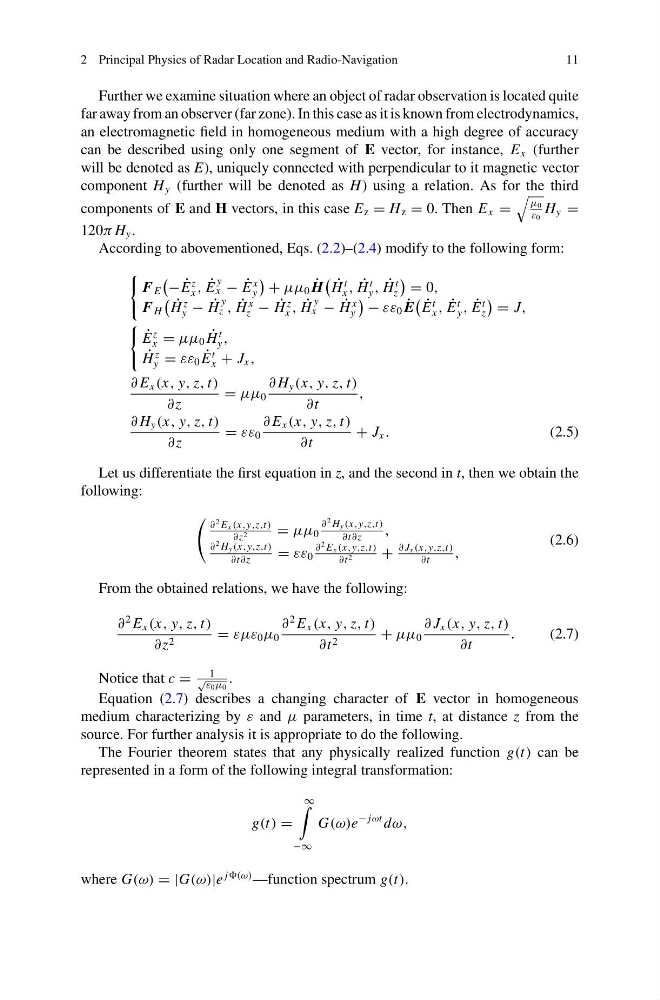
According to abovementioned, Eqs. (2.2)–(2.4) modify to the following form:
F E
− ˙
E
z
x , ˙
E
y
x − ˙
E
x
y
+ μμ 0 ˙
H
˙
H
t
x , ˙
H
t
y , ˙
H
t
z
= 0,
F H
˙
H
z
y − ˙
H
y
z , ˙
H
x
z − ˙
H
z
x , ˙
H
y
x − ˙
H
x
y
− εε 0 ˙
E
˙
E
t
x , ˙
E
t
y , ˙
E
t
z
= J,
˙
E
z
x = μμ 0 ˙
H
t
y ,
˙
H
z
y = εε 0 ˙
E
t
x + J x ,
∂ E x (x, y, z, t)
∂z
= μμ 0
∂ H y (x, y, z, t)
∂t
,
∂ H y (x, y, z, t)
∂z
= εε 0
∂ E x (x, y, z, t)
∂t
+ J x .
(2.5)
Let us differentiate the first equation in z, and the second in t, then we obtain the
following:
∂
2 E x (x,y,z,t)
∂z 2
= μμ 0
∂
2 H y (x,y,z,t)
∂t∂z
,
∂
2 H y (x,y,z,t)
∂t∂z
= εε 0
∂
2 E x (x,y,z,t)
∂t 2
+
∂ J x (x,y,z,t)
∂t
,
(2.6)
From the obtained relations, we have the following:
∂
2 E x (x, y, z, t)
∂z 2
= εμε 0 μ 0
∂
2 E x (x, y, z, t)
∂t 2
+ μμ 0
∂ J x (x, y, z, t)
∂t
.
(2.7)
Notice that c =
1
√ ε 0 μ 0
.
Equation (2.7) describes a changing character of E vector in homogeneous
medium characterizing by ε and μ parameters, in time t, at distance z from the
source. For further analysis it is appropriate to do the following.
The Fourier theorem states that any physically realized function g(t) can be
represented in a form of the following integral transformation:
g(t) =
∞
−∞
G(ω)e
− jωt dω,
where G(ω) = |G(ω)|e
j(ω) —function spectrum g(t).
11
Further we examine situation where an object of radar observation is located quite
far away from an observer (far zone). In this case as it is known from electrodynamics,
an electromagnetic field in homogeneous medium with a high degree of accuracy
can be described using only one segment of E vector, for instance, E x (further
will be denoted as E), uniquely connected with perpendicular to it magnetic vector
component H y (further will be denoted as H) using a relation. As for the third
components of E and H vectors, in this case E z = H z = 0. Then E x =
μ 0
ε 0
H y =
120π H y .
According to abovementioned, Eqs. (2.2)–(2.4) modify to the following form:
F E
− ˙
E
z
x , ˙
E
y
x − ˙
E
x
y
+ μμ 0 ˙
H
˙
H
t
x , ˙
H
t
y , ˙
H
t
z
= 0,
F H
˙
H
z
y − ˙
H
y
z , ˙
H
x
z − ˙
H
z
x , ˙
H
y
x − ˙
H
x
y
− εε 0 ˙
E
˙
E
t
x , ˙
E
t
y , ˙
E
t
z
= J,
˙
E
z
x = μμ 0 ˙
H
t
y ,
˙
H
z
y = εε 0 ˙
E
t
x + J x ,
∂ E x (x, y, z, t)
∂z
= μμ 0
∂ H y (x, y, z, t)
∂t
,
∂ H y (x, y, z, t)
∂z
= εε 0
∂ E x (x, y, z, t)
∂t
+ J x .
(2.5)
Let us differentiate the first equation in z, and the second in t, then we obtain the
following:
∂
2 E x (x,y,z,t)
∂z 2
= μμ 0
∂
2 H y (x,y,z,t)
∂t∂z
,
∂
2 H y (x,y,z,t)
∂t∂z
= εε 0
∂
2 E x (x,y,z,t)
∂t 2
+
∂ J x (x,y,z,t)
∂t
,
(2.6)
From the obtained relations, we have the following:
∂
2 E x (x, y, z, t)
∂z 2
= εμε 0 μ 0
∂
2 E x (x, y, z, t)
∂t 2
+ μμ 0
∂ J x (x, y, z, t)
∂t
.
(2.7)
Notice that c =
1
√ ε 0 μ 0
.
Equation (2.7) describes a changing character of E vector in homogeneous
medium characterizing by ε and μ parameters, in time t, at distance z from the
source. For further analysis it is appropriate to do the following.
The Fourier theorem states that any physically realized function g(t) can be
represented in a form of the following integral transformation:
g(t) =
∞
−∞
G(ω)e
− jωt dω,
where G(ω) = |G(ω)|e
j(ω) —function spectrum g(t).