

10
2 Principal Physics of Radar Location and Radio-Navigation
and radio-engineering’s, an electric model is a quite acceptable and hence a universally accepted. In quantum electrodynamics, such model of a charge unfortunately
is inappropriate anyway; thus, it has quite other approaches.
Similar discussion can be done with respect to electrical current, and within
common models, it can be examined as electrical charges movement. However, in
some cases as for instance during current passage through capacitor such a current
interpretation is not acceptable. To meet a requirement of continuity of current at
segment between capacitor coating a “bias current” (electric induction current) term
is introduced, equals to derivative of a magnetic field vector in time— ˙
H t , which
exactly turns to be numerically equal to conduction current in external circuit of
capacitor.
Being within frames of classical model of a current as a motion of charged particles we should answer the question, what turns to be a source of electromagnetic
field? An answer—“everything!” Since within the frames of admitted “electronic”
model, all atoms contain electrodes which are in continuous movement, all material objects, the temperature of which differs from absolute zero, are the source of
electromagnetic emission; i.e., each of continuously emits electromagnetic field. All
surrounding furniture, walls and floor, tables and chairs, doors and windows have
the same property. Certainly, the power of this emission is very small, but within our
discussions this is not important to the story. The most powerful natural radiation
source is a Sun. Thunderstorm lightings are powerful radiator. Finally, it is necessary
to mention the space radiation, constantly effecting on our planet. The abovementioned demonstrates natural sources of electromagnetic radiation representing by
nature continuously operating generators of electromagnetic field. From the point of
view of an earth habitant, this is so-called background radiation which always exists
at input of receiving device of any type of radar station generating a continuous noise
to radar signal.
It is clear that with distance from electromagnetic field source, the E and H vectors
length, i.e., its |E| and |H | modules, should decrease. This brings up the question
on laws of such decrease. From electrodynamics, we know that power flux density,
carrying by electromagnetic field at quite big distance from its source, is in proportion
to |E|
2 and relation |E|/|H | = 120π .
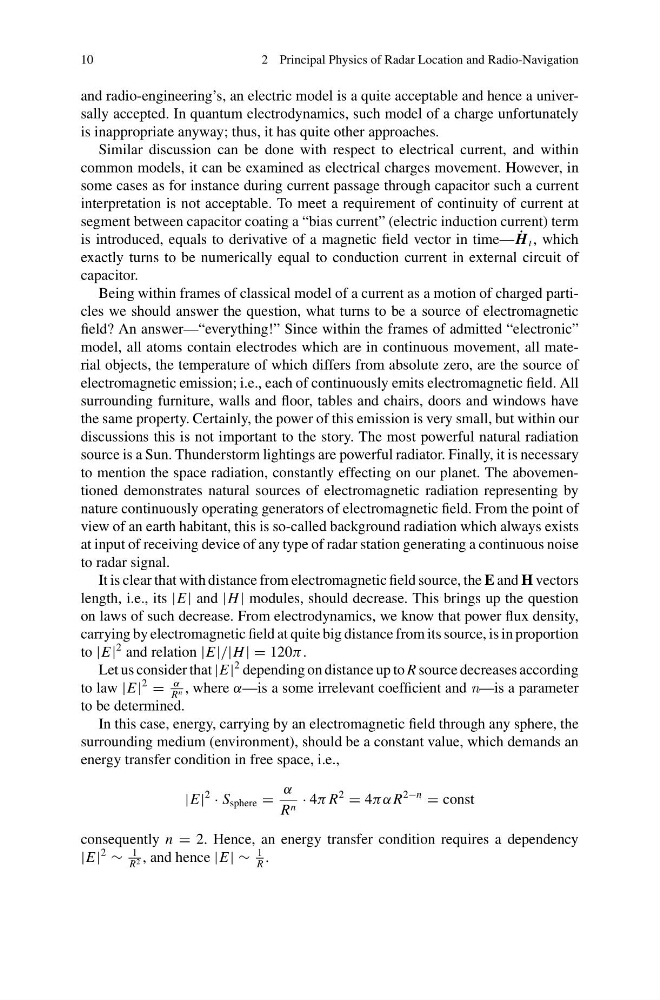
Let us consider that |E|
2 depending on distance up to R source decreases according
to law |E|
2
=
α
R n , where α—is a some irrelevant coefficient and p—is a parameter
to be determined.
In this case, energy, carrying by an electromagnetic field through any sphere, the
surrounding medium (environment), should be a constant value, which demands an
energy transfer condition in free space, i.e.,
|E|
2
· S sphere =
α
R n · 4π R
2
= 4πα R
2−n
= const
consequently n = 2. Hence, an energy transfer condition requires a dependency
|E|
2
∼
1
R 2 , and hence |E| ∼
1
R
.
2 Principal Physics of Radar Location and Radio-Navigation
and radio-engineering’s, an electric model is a quite acceptable and hence a universally accepted. In quantum electrodynamics, such model of a charge unfortunately
is inappropriate anyway; thus, it has quite other approaches.
Similar discussion can be done with respect to electrical current, and within
common models, it can be examined as electrical charges movement. However, in
some cases as for instance during current passage through capacitor such a current
interpretation is not acceptable. To meet a requirement of continuity of current at
segment between capacitor coating a “bias current” (electric induction current) term
is introduced, equals to derivative of a magnetic field vector in time— ˙
H t , which
exactly turns to be numerically equal to conduction current in external circuit of
capacitor.
Being within frames of classical model of a current as a motion of charged particles we should answer the question, what turns to be a source of electromagnetic
field? An answer—“everything!” Since within the frames of admitted “electronic”
model, all atoms contain electrodes which are in continuous movement, all material objects, the temperature of which differs from absolute zero, are the source of
electromagnetic emission; i.e., each of continuously emits electromagnetic field. All
surrounding furniture, walls and floor, tables and chairs, doors and windows have
the same property. Certainly, the power of this emission is very small, but within our
discussions this is not important to the story. The most powerful natural radiation
source is a Sun. Thunderstorm lightings are powerful radiator. Finally, it is necessary
to mention the space radiation, constantly effecting on our planet. The abovementioned demonstrates natural sources of electromagnetic radiation representing by
nature continuously operating generators of electromagnetic field. From the point of
view of an earth habitant, this is so-called background radiation which always exists
at input of receiving device of any type of radar station generating a continuous noise
to radar signal.
It is clear that with distance from electromagnetic field source, the E and H vectors
length, i.e., its |E| and |H | modules, should decrease. This brings up the question
on laws of such decrease. From electrodynamics, we know that power flux density,
carrying by electromagnetic field at quite big distance from its source, is in proportion
to |E|
2 and relation |E|/|H | = 120π .
Let us consider that |E|
2 depending on distance up to R source decreases according
to law |E|
2
=
α
R n , where α—is a some irrelevant coefficient and p—is a parameter
to be determined.
In this case, energy, carrying by an electromagnetic field through any sphere, the
surrounding medium (environment), should be a constant value, which demands an
energy transfer condition in free space, i.e.,
|E|
2
· S sphere =
α
R n · 4π R
2
= 4πα R
2−n
= const
consequently n = 2. Hence, an energy transfer condition requires a dependency
|E|
2
∼
1
R 2 , and hence |E| ∼
1
R
.