

14.4 Functional Supplement to Global Satellite Radio Navigation Systems
267
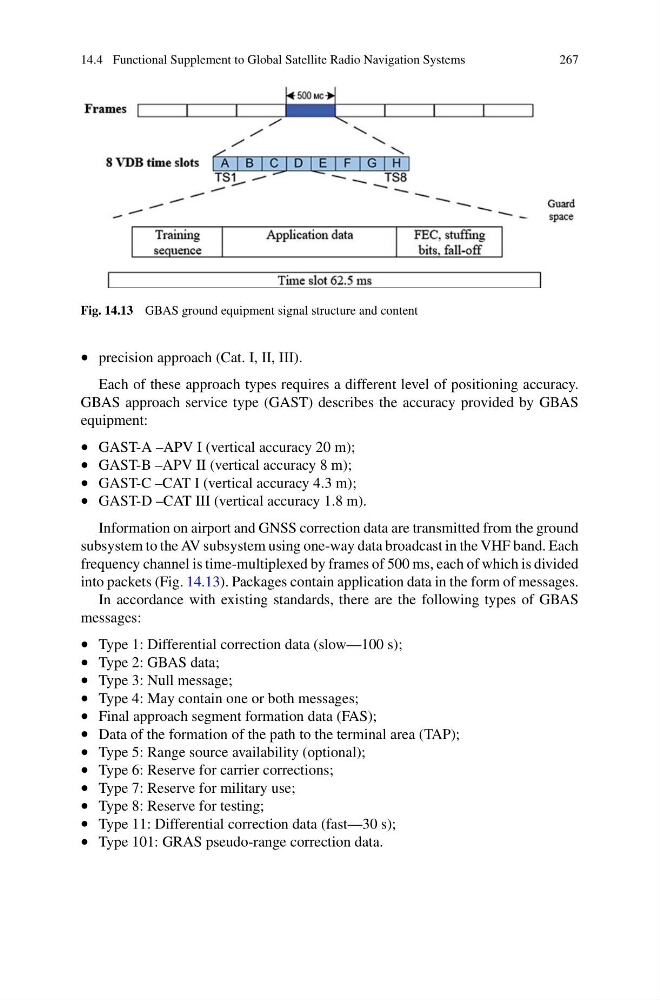
Fig. 14.13 GBAS ground equipment signal structure and content
• precision approach (Cat. I, II, III).
Each of these approach types requires a different level of positioning accuracy.
GBAS approach service type (GAST) describes the accuracy provided by GBAS
equipment:
• GAST-A –APV I (vertical accuracy 20 m);
• GAST-B –APV II (vertical accuracy 8 m);
• GAST-C –CAT I (vertical accuracy 4.3 m);
• GAST-D –CAT III (vertical accuracy 1.8 m).
Information on airport and GNSS correction data are transmitted from the ground
subsystem to the AV subsystem using one-way data broadcast in the VHF band. Each
frequency channel is time-multiplexed by frames of 500 ms, each of which is divided
into packets (Fig. 14.13). Packages contain application data in the form of messages.
In accordance with existing standards, there are the following types of GBAS
messages:
• Type 1: Differential correction data (slow—100 s);
• Type 2: GBAS data;
• Type 3: Null message;
• Type 4: May contain one or both messages;
• Final approach segment formation data (FAS);
• Data of the formation of the path to the terminal area (TAP);
• Type 5: Range source availability (optional);
• Type 6: Reserve for carrier corrections;
• Type 7: Reserve for military use;
• Type 8: Reserve for testing;
• Type 11: Differential correction data (fast—30 s);
• Type 101: GRAS pseudo-range correction data.
267
Fig. 14.13 GBAS ground equipment signal structure and content
• precision approach (Cat. I, II, III).
Each of these approach types requires a different level of positioning accuracy.
GBAS approach service type (GAST) describes the accuracy provided by GBAS
equipment:
• GAST-A –APV I (vertical accuracy 20 m);
• GAST-B –APV II (vertical accuracy 8 m);
• GAST-C –CAT I (vertical accuracy 4.3 m);
• GAST-D –CAT III (vertical accuracy 1.8 m).
Information on airport and GNSS correction data are transmitted from the ground
subsystem to the AV subsystem using one-way data broadcast in the VHF band. Each
frequency channel is time-multiplexed by frames of 500 ms, each of which is divided
into packets (Fig. 14.13). Packages contain application data in the form of messages.
In accordance with existing standards, there are the following types of GBAS
messages:
• Type 1: Differential correction data (slow—100 s);
• Type 2: GBAS data;
• Type 3: Null message;
• Type 4: May contain one or both messages;
• Final approach segment formation data (FAS);
• Data of the formation of the path to the terminal area (TAP);
• Type 5: Range source availability (optional);
• Type 6: Reserve for carrier corrections;
• Type 7: Reserve for military use;
• Type 8: Reserve for testing;
• Type 11: Differential correction data (fast—30 s);
• Type 101: GRAS pseudo-range correction data.