

266
14 Pseudo-Ranging Radio Navigation Systems
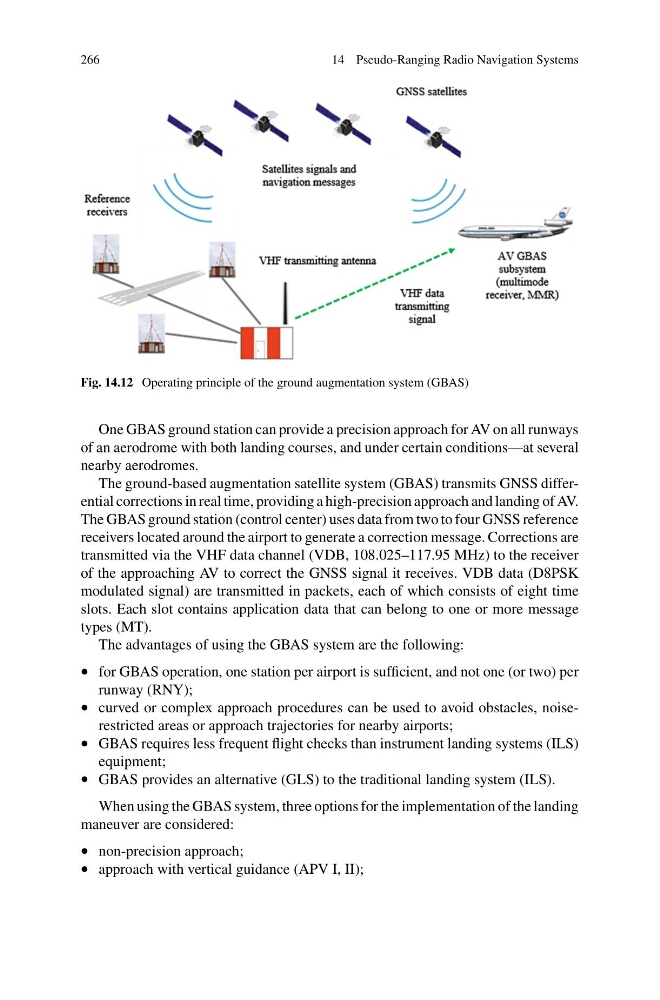
Fig. 14.12 Operating principle of the ground augmentation system (GBAS)
One GBAS ground station can provide a precision approach for AV on all runways
of an aerodrome with both landing courses, and under certain conditions—at several
nearby aerodromes.
The ground-based augmentation satellite system (GBAS) transmits GNSS differential corrections in real time, providing a high-precision approach and landing of AV.
The GBAS ground station (control center) uses data from two to four GNSS reference
receivers located around the airport to generate a correction message. Corrections are
transmitted via the VHF data channel (VDB, 108.025–117.95 MHz) to the receiver
of the approaching AV to correct the GNSS signal it receives. VDB data (D8PSK
modulated signal) are transmitted in packets, each of which consists of eight time
slots. Each slot contains application data that can belong to one or more message
types (MT).
The advantages of using the GBAS system are the following:
• for GBAS operation, one station per airport is sufficient, and not one (or two) per
runway (RNY);
• curved or complex approach procedures can be used to avoid obstacles, noiserestricted areas or approach trajectories for nearby airports;
• GBAS requires less frequent flight checks than instrument landing systems (ILS)
equipment;
• GBAS provides an alternative (GLS) to the traditional landing system (ILS).
When using the GBAS system, three options for the implementation of the landing
maneuver are considered:
• non-precision approach;
• approach with vertical guidance (APV I, II);
14 Pseudo-Ranging Radio Navigation Systems
Fig. 14.12 Operating principle of the ground augmentation system (GBAS)
One GBAS ground station can provide a precision approach for AV on all runways
of an aerodrome with both landing courses, and under certain conditions—at several
nearby aerodromes.
The ground-based augmentation satellite system (GBAS) transmits GNSS differential corrections in real time, providing a high-precision approach and landing of AV.
The GBAS ground station (control center) uses data from two to four GNSS reference
receivers located around the airport to generate a correction message. Corrections are
transmitted via the VHF data channel (VDB, 108.025–117.95 MHz) to the receiver
of the approaching AV to correct the GNSS signal it receives. VDB data (D8PSK
modulated signal) are transmitted in packets, each of which consists of eight time
slots. Each slot contains application data that can belong to one or more message
types (MT).
The advantages of using the GBAS system are the following:
• for GBAS operation, one station per airport is sufficient, and not one (or two) per
runway (RNY);
• curved or complex approach procedures can be used to avoid obstacles, noiserestricted areas or approach trajectories for nearby airports;
• GBAS requires less frequent flight checks than instrument landing systems (ILS)
equipment;
• GBAS provides an alternative (GLS) to the traditional landing system (ILS).
When using the GBAS system, three options for the implementation of the landing
maneuver are considered:
• non-precision approach;
• approach with vertical guidance (APV I, II);