

8
2 Principal Physics of Radar Location and Radio-Navigation
Here, it is appropriate to rise a question that concludes into the following. Well,
Maxwell described electromagnetic field basing on E, H, D, B vectors and its derivatives in all four (4) spatial–time coordinates. Technically, Maxwell equations represent eight (8) equations interrelated with 52 variables. Is it possible to pick out another
combination from these variables and relate them with some another equations? We
have an unambiguous answer: “Of course, it is possible.” For complete description
of electromagnetic field in some problems, it is more convenient to use another characteristics of a field such as, for instance, a vector A and ϕ scalar potentials, Hertz
vector P, which are easily converted into E, H, D, B classical vectors.
So why the preference was given to E, H, D, B vectors and what exists in nature?
Historically it happened that electromagnetic field and, more precisely, its development, was observed in a form of some force actions on electric charges for what it
was convenient to introduce electric field vector E (E vector) as a force acting on a
unit charge. As for the second part of question: “What exists in nature?”… we can
answer that in nature there are no E or A, or P. There is electromagnetic field, and
E, A and G—its model characteristics, tools of its properties description.
Further, we will base upon classical description of electromagnetic field via E, H,
D, B vectors. It is important that Maxwell equations state the fact that any medium
within electromagnetic theory is described using its all three characteristics—dielectric permittivity ε, conductivity σ and magnetic permittivity μ (the mentioned is not
spread over electric and magnetic anisotropic medium).
For isotropic medium, we can express D, B vectors in terms of the rest two E, H
vectors using equitation: D = εε 0 E i B = μμ 0 H, where ε 0 = 8.85 · 10
−12 F/m and
μ 0 = 4π · 10
−7 H/m—electric and magnetic constants correspondingly.
So, for an “observer” positioned in point Q with (x, y, z) coordinates, in t time
moment, electromagnetic field is described by E(x, y, z, t), H(x, y, z, t), D(x, y,
z, t), B(x, y, z, t) vectors and derivatives of each its vectors components in all x,
y, z, t variables. Exactly these values interrelated between each other the Maxwell
equations:
⎧
⎪ ⎪ ⎨
⎪ ⎪ ⎩
rot E = −
∂ B
∂t
,
rot H =
∂ D
∂t
+ j,
div D = ρ, div B = 0,
D = εε 0 E, B = μμ 0 H.
(2.1)
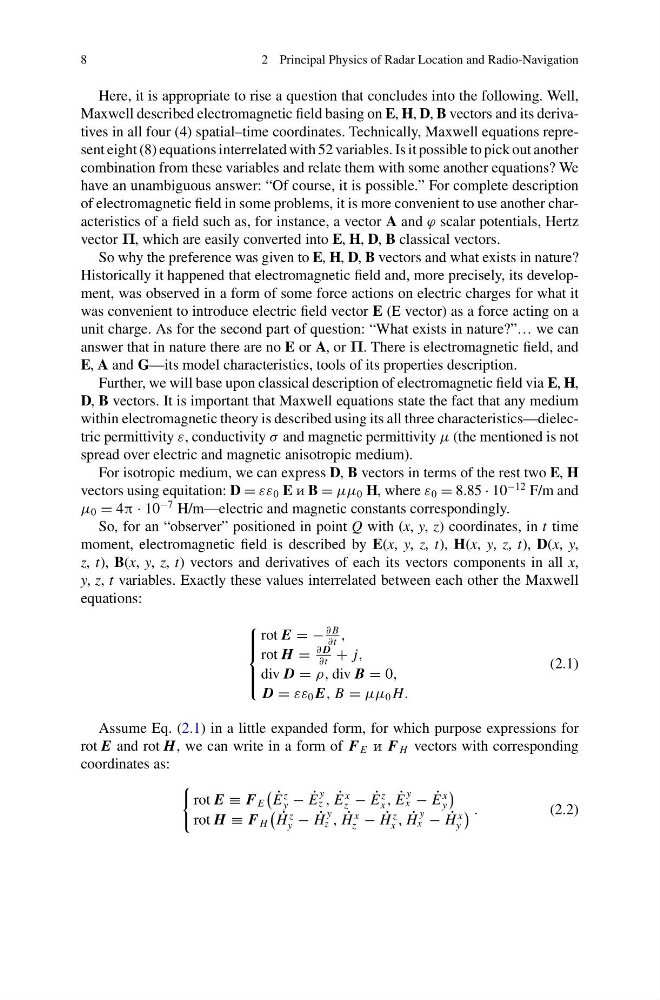
Assume Eq. (2.1) in a little expanded form, for which purpose expressions for
rot E and rot H, we can write in a form of F E i F H vectors with corresponding
coordinates as:
rot E ≡ F E
˙
E
z
y − ˙
E
y
z , ˙
E
x
z − ˙
E
z
x , ˙
E
y
x − ˙
E
x
y
rot H ≡ F H
˙
H
z
y − ˙
H
y
z , ˙
H
x
z − ˙
H
z
x , ˙
H
y
x − ˙
H
x
y
.
(2.2)
2 Principal Physics of Radar Location and Radio-Navigation
Here, it is appropriate to rise a question that concludes into the following. Well,
Maxwell described electromagnetic field basing on E, H, D, B vectors and its derivatives in all four (4) spatial–time coordinates. Technically, Maxwell equations represent eight (8) equations interrelated with 52 variables. Is it possible to pick out another
combination from these variables and relate them with some another equations? We
have an unambiguous answer: “Of course, it is possible.” For complete description
of electromagnetic field in some problems, it is more convenient to use another characteristics of a field such as, for instance, a vector A and ϕ scalar potentials, Hertz
vector P, which are easily converted into E, H, D, B classical vectors.
So why the preference was given to E, H, D, B vectors and what exists in nature?
Historically it happened that electromagnetic field and, more precisely, its development, was observed in a form of some force actions on electric charges for what it
was convenient to introduce electric field vector E (E vector) as a force acting on a
unit charge. As for the second part of question: “What exists in nature?”… we can
answer that in nature there are no E or A, or P. There is electromagnetic field, and
E, A and G—its model characteristics, tools of its properties description.
Further, we will base upon classical description of electromagnetic field via E, H,
D, B vectors. It is important that Maxwell equations state the fact that any medium
within electromagnetic theory is described using its all three characteristics—dielectric permittivity ε, conductivity σ and magnetic permittivity μ (the mentioned is not
spread over electric and magnetic anisotropic medium).
For isotropic medium, we can express D, B vectors in terms of the rest two E, H
vectors using equitation: D = εε 0 E i B = μμ 0 H, where ε 0 = 8.85 · 10
−12 F/m and
μ 0 = 4π · 10
−7 H/m—electric and magnetic constants correspondingly.
So, for an “observer” positioned in point Q with (x, y, z) coordinates, in t time
moment, electromagnetic field is described by E(x, y, z, t), H(x, y, z, t), D(x, y,
z, t), B(x, y, z, t) vectors and derivatives of each its vectors components in all x,
y, z, t variables. Exactly these values interrelated between each other the Maxwell
equations:
⎧
⎪ ⎪ ⎨
⎪ ⎪ ⎩
rot E = −
∂ B
∂t
,
rot H =
∂ D
∂t
+ j,
div D = ρ, div B = 0,
D = εε 0 E, B = μμ 0 H.
(2.1)
Assume Eq. (2.1) in a little expanded form, for which purpose expressions for
rot E and rot H, we can write in a form of F E i F H vectors with corresponding
coordinates as:
rot E ≡ F E
˙
E
z
y − ˙
E
y
z , ˙
E
x
z − ˙
E
z
x , ˙
E
y
x − ˙
E
x
y
rot H ≡ F H
˙
H
z
y − ˙
H
y
z , ˙
H
x
z − ˙
H
z
x , ˙
H
y
x − ˙
H
x
y
.
(2.2)