

228
12 Radar Systems of Maritime Transport
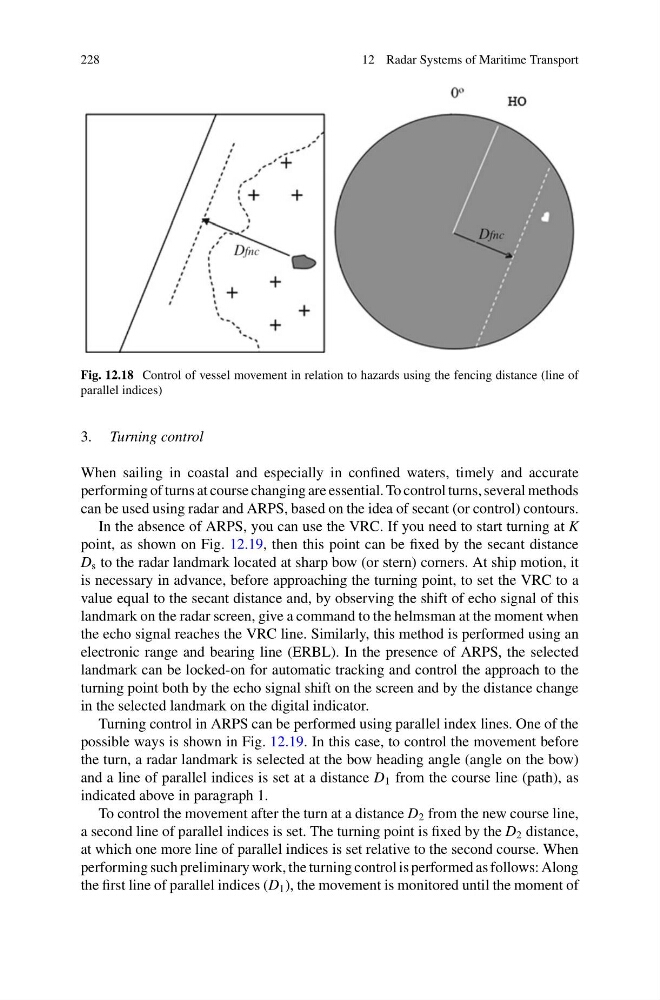
Fig. 12.18 Control of vessel movement in relation to hazards using the fencing distance (line of
parallel indices)
3. Turning control
When sailing in coastal and especially in confined waters, timely and accurate
performing of turns at course changing are essential. To control turns, several methods
can be used using radar and ARPS, based on the idea of secant (or control) contours.
In the absence of ARPS, you can use the VRC. If you need to start turning at K
point, as shown on Fig. 12.19, then this point can be fixed by the secant distance
D s to the radar landmark located at sharp bow (or stern) corners. At ship motion, it
is necessary in advance, before approaching the turning point, to set the VRC to a
value equal to the secant distance and, by observing the shift of echo signal of this
landmark on the radar screen, give a command to the helmsman at the moment when
the echo signal reaches the VRC line. Similarly, this method is performed using an
electronic range and bearing line (ERBL). In the presence of ARPS, the selected
landmark can be locked-on for automatic tracking and control the approach to the
turning point both by the echo signal shift on the screen and by the distance change
in the selected landmark on the digital indicator.
Turning control in ARPS can be performed using parallel index lines. One of the
possible ways is shown in Fig. 12.19. In this case, to control the movement before
the turn, a radar landmark is selected at the bow heading angle (angle on the bow)
and a line of parallel indices is set at a distance D 1 from the course line (path), as
indicated above in paragraph 1.
To control the movement after the turn at a distance D 2 from the new course line,
a second line of parallel indices is set. The turning point is fixed by the D 2 distance,
at which one more line of parallel indices is set relative to the second course. When
performing such preliminary work, the turning control is performed as follows: Along
the first line of parallel indices (D 1 ), the movement is monitored until the moment of
12 Radar Systems of Maritime Transport
Fig. 12.18 Control of vessel movement in relation to hazards using the fencing distance (line of
parallel indices)
3. Turning control
When sailing in coastal and especially in confined waters, timely and accurate
performing of turns at course changing are essential. To control turns, several methods
can be used using radar and ARPS, based on the idea of secant (or control) contours.
In the absence of ARPS, you can use the VRC. If you need to start turning at K
point, as shown on Fig. 12.19, then this point can be fixed by the secant distance
D s to the radar landmark located at sharp bow (or stern) corners. At ship motion, it
is necessary in advance, before approaching the turning point, to set the VRC to a
value equal to the secant distance and, by observing the shift of echo signal of this
landmark on the radar screen, give a command to the helmsman at the moment when
the echo signal reaches the VRC line. Similarly, this method is performed using an
electronic range and bearing line (ERBL). In the presence of ARPS, the selected
landmark can be locked-on for automatic tracking and control the approach to the
turning point both by the echo signal shift on the screen and by the distance change
in the selected landmark on the digital indicator.
Turning control in ARPS can be performed using parallel index lines. One of the
possible ways is shown in Fig. 12.19. In this case, to control the movement before
the turn, a radar landmark is selected at the bow heading angle (angle on the bow)
and a line of parallel indices is set at a distance D 1 from the course line (path), as
indicated above in paragraph 1.
To control the movement after the turn at a distance D 2 from the new course line,
a second line of parallel indices is set. The turning point is fixed by the D 2 distance,
at which one more line of parallel indices is set relative to the second course. When
performing such preliminary work, the turning control is performed as follows: Along
the first line of parallel indices (D 1 ), the movement is monitored until the moment of