

12 Radar Systems of Maritime Transport
229
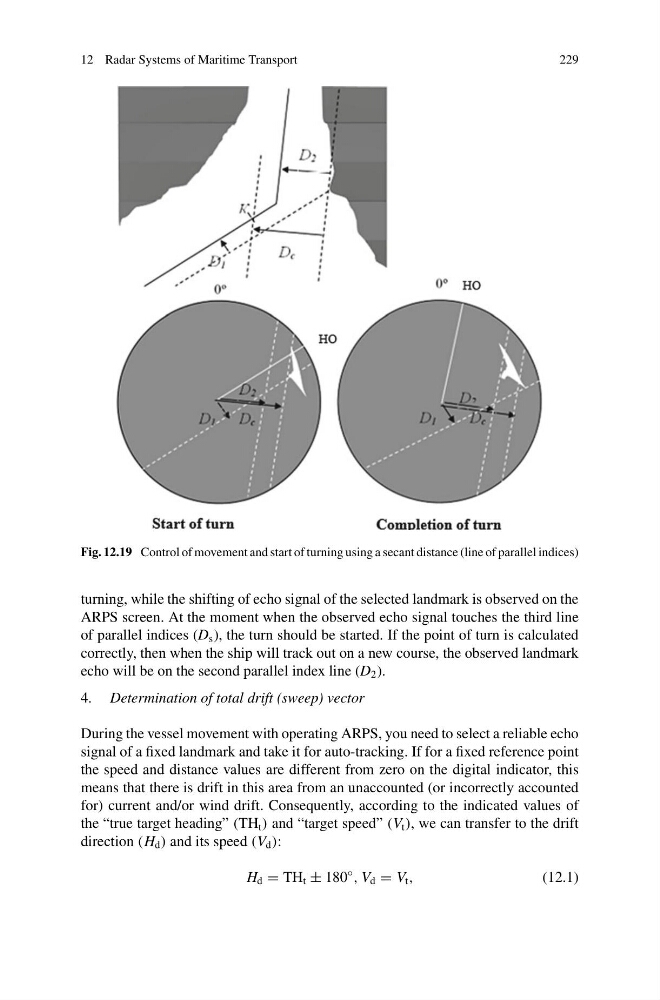
Fig. 12.19 Control of movement and start of turning using a secant distance (line of parallel indices)
turning, while the shifting of echo signal of the selected landmark is observed on the
ARPS screen. At the moment when the observed echo signal touches the third line
of parallel indices (D s ), the turn should be started. If the point of turn is calculated
correctly, then when the ship will track out on a new course, the observed landmark
echo will be on the second parallel index line (D 2 ).
4. Determination of total drift (sweep) vector
During the vessel movement with operating ARPS, you need to select a reliable echo
signal of a fixed landmark and take it for auto-tracking. If for a fixed reference point
the speed and distance values are different from zero on the digital indicator, this
means that there is drift in this area from an unaccounted (or incorrectly accounted
for) current and/or wind drift. Consequently, according to the indicated values of
the “true target heading” (TH t ) and “target speed” (V t ), we can transfer to the drift
direction (H d ) and its speed (V d ):
H d = TH t ± 180
◦
, V d = V t ,
(12.1)
229
Fig. 12.19 Control of movement and start of turning using a secant distance (line of parallel indices)
turning, while the shifting of echo signal of the selected landmark is observed on the
ARPS screen. At the moment when the observed echo signal touches the third line
of parallel indices (D s ), the turn should be started. If the point of turn is calculated
correctly, then when the ship will track out on a new course, the observed landmark
echo will be on the second parallel index line (D 2 ).
4. Determination of total drift (sweep) vector
During the vessel movement with operating ARPS, you need to select a reliable echo
signal of a fixed landmark and take it for auto-tracking. If for a fixed reference point
the speed and distance values are different from zero on the digital indicator, this
means that there is drift in this area from an unaccounted (or incorrectly accounted
for) current and/or wind drift. Consequently, according to the indicated values of
the “true target heading” (TH t ) and “target speed” (V t ), we can transfer to the drift
direction (H d ) and its speed (V d ):
H d = TH t ± 180
◦
, V d = V t ,
(12.1)