

226
12 Radar Systems of Maritime Transport
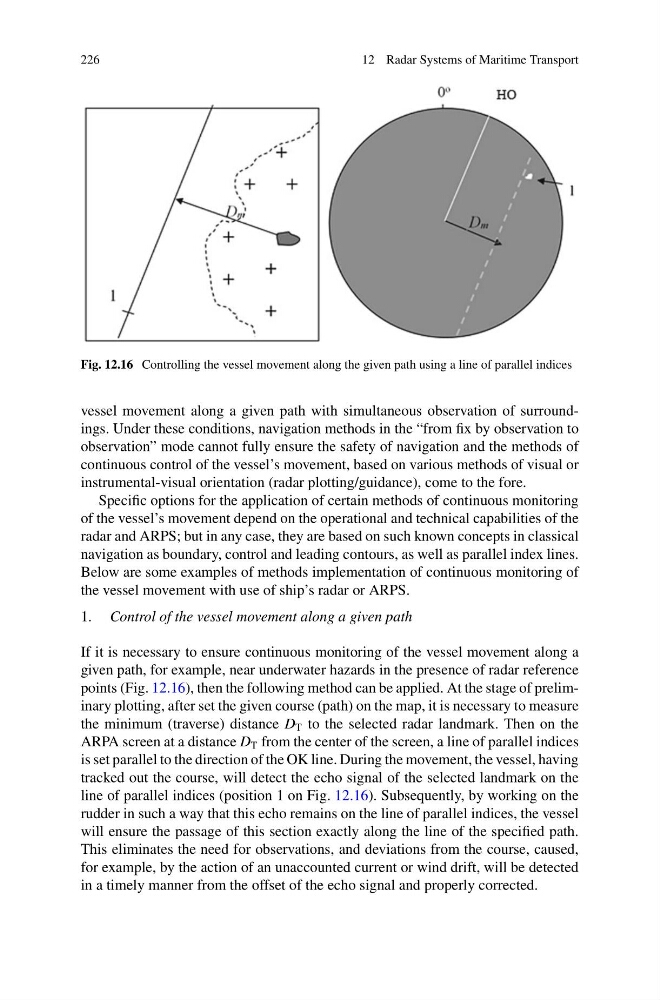
Fig. 12.16 Controlling the vessel movement along the given path using a line of parallel indices
vessel movement along a given path with simultaneous observation of surroundings. Under these conditions, navigation methods in the “from fix by observation to
observation” mode cannot fully ensure the safety of navigation and the methods of
continuous control of the vessel’s movement, based on various methods of visual or
instrumental-visual orientation (radar plotting/guidance), come to the fore.
Specific options for the application of certain methods of continuous monitoring
of the vessel’s movement depend on the operational and technical capabilities of the
radar and ARPS; but in any case, they are based on such known concepts in classical
navigation as boundary, control and leading contours, as well as parallel index lines.
Below are some examples of methods implementation of continuous monitoring of
the vessel movement with use of ship’s radar or ARPS.
1. Control of the vessel movement along a given path
If it is necessary to ensure continuous monitoring of the vessel movement along a
given path, for example, near underwater hazards in the presence of radar reference
points (Fig. 12.16), then the following method can be applied. At the stage of preliminary plotting, after set the given course (path) on the map, it is necessary to measure
the minimum (traverse) distance D T to the selected radar landmark. Then on the
ARPA screen at a distance D T from the center of the screen, a line of parallel indices
is set parallel to the direction of the OK line. During the movement, the vessel, having
tracked out the course, will detect the echo signal of the selected landmark on the
line of parallel indices (position 1 on Fig. 12.16). Subsequently, by working on the
rudder in such a way that this echo remains on the line of parallel indices, the vessel
will ensure the passage of this section exactly along the line of the specified path.
This eliminates the need for observations, and deviations from the course, caused,
for example, by the action of an unaccounted current or wind drift, will be detected
in a timely manner from the offset of the echo signal and properly corrected.
12 Radar Systems of Maritime Transport
Fig. 12.16 Controlling the vessel movement along the given path using a line of parallel indices
vessel movement along a given path with simultaneous observation of surroundings. Under these conditions, navigation methods in the “from fix by observation to
observation” mode cannot fully ensure the safety of navigation and the methods of
continuous control of the vessel’s movement, based on various methods of visual or
instrumental-visual orientation (radar plotting/guidance), come to the fore.
Specific options for the application of certain methods of continuous monitoring
of the vessel’s movement depend on the operational and technical capabilities of the
radar and ARPS; but in any case, they are based on such known concepts in classical
navigation as boundary, control and leading contours, as well as parallel index lines.
Below are some examples of methods implementation of continuous monitoring of
the vessel movement with use of ship’s radar or ARPS.
1. Control of the vessel movement along a given path
If it is necessary to ensure continuous monitoring of the vessel movement along a
given path, for example, near underwater hazards in the presence of radar reference
points (Fig. 12.16), then the following method can be applied. At the stage of preliminary plotting, after set the given course (path) on the map, it is necessary to measure
the minimum (traverse) distance D T to the selected radar landmark. Then on the
ARPA screen at a distance D T from the center of the screen, a line of parallel indices
is set parallel to the direction of the OK line. During the movement, the vessel, having
tracked out the course, will detect the echo signal of the selected landmark on the
line of parallel indices (position 1 on Fig. 12.16). Subsequently, by working on the
rudder in such a way that this echo remains on the line of parallel indices, the vessel
will ensure the passage of this section exactly along the line of the specified path.
This eliminates the need for observations, and deviations from the course, caused,
for example, by the action of an unaccounted current or wind drift, will be detected
in a timely manner from the offset of the echo signal and properly corrected.