

198
11 Radar Systems of Air Transport
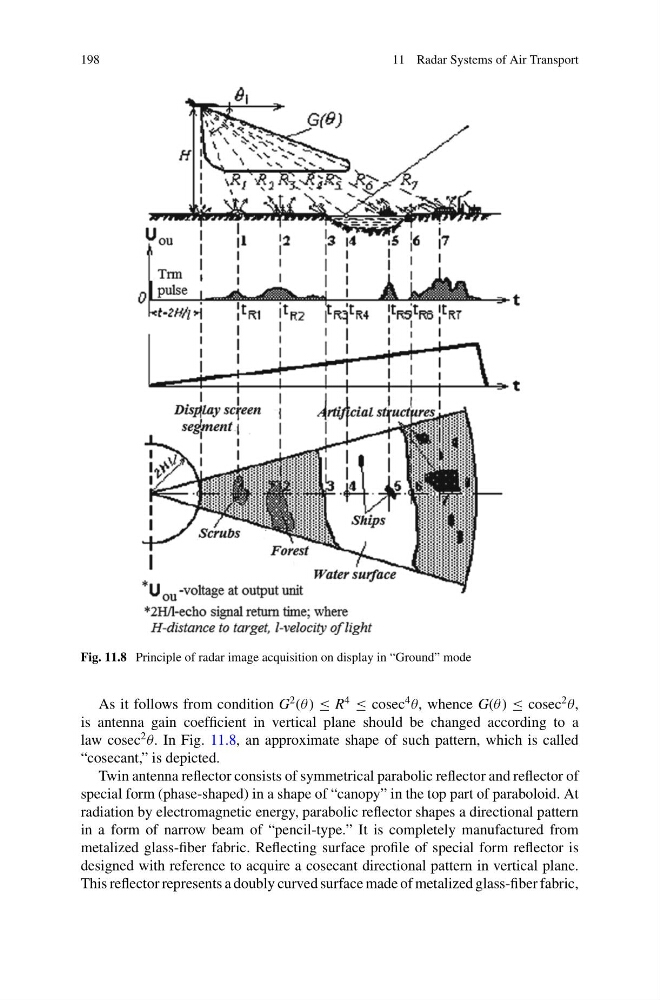
Fig. 11.8 Principle of radar image acquisition on display in “Ground” mode
As it follows from condition G
2 (θ ) ≤ R
4
≤ cosec
4
θ, whence G(θ ) ≤ cosec
2
θ,
is antenna gain coefficient in vertical plane should be changed according to a
law cosec
2
θ. In Fig. 11.8, an approximate shape of such pattern, which is called
“cosecant,” is depicted.
Twin antenna reflector consists of symmetrical parabolic reflector and reflector of
special form (phase-shaped) in a shape of “canopy” in the top part of paraboloid. At
radiation by electromagnetic energy, parabolic reflector shapes a directional pattern
in a form of narrow beam of “pencil-type.” It is completely manufactured from
metalized glass-fiber fabric. Reflecting surface profile of special form reflector is
designed with reference to acquire a cosecant directional pattern in vertical plane.
This reflector represents a doubly curved surface made of metalized glass-fiber fabric,
11 Radar Systems of Air Transport
Fig. 11.8 Principle of radar image acquisition on display in “Ground” mode
As it follows from condition G
2 (θ ) ≤ R
4
≤ cosec
4
θ, whence G(θ ) ≤ cosec
2
θ,
is antenna gain coefficient in vertical plane should be changed according to a
law cosec
2
θ. In Fig. 11.8, an approximate shape of such pattern, which is called
“cosecant,” is depicted.
Twin antenna reflector consists of symmetrical parabolic reflector and reflector of
special form (phase-shaped) in a shape of “canopy” in the top part of paraboloid. At
radiation by electromagnetic energy, parabolic reflector shapes a directional pattern
in a form of narrow beam of “pencil-type.” It is completely manufactured from
metalized glass-fiber fabric. Reflecting surface profile of special form reflector is
designed with reference to acquire a cosecant directional pattern in vertical plane.
This reflector represents a doubly curved surface made of metalized glass-fiber fabric,