

1 Basic Terms and Definitions
5
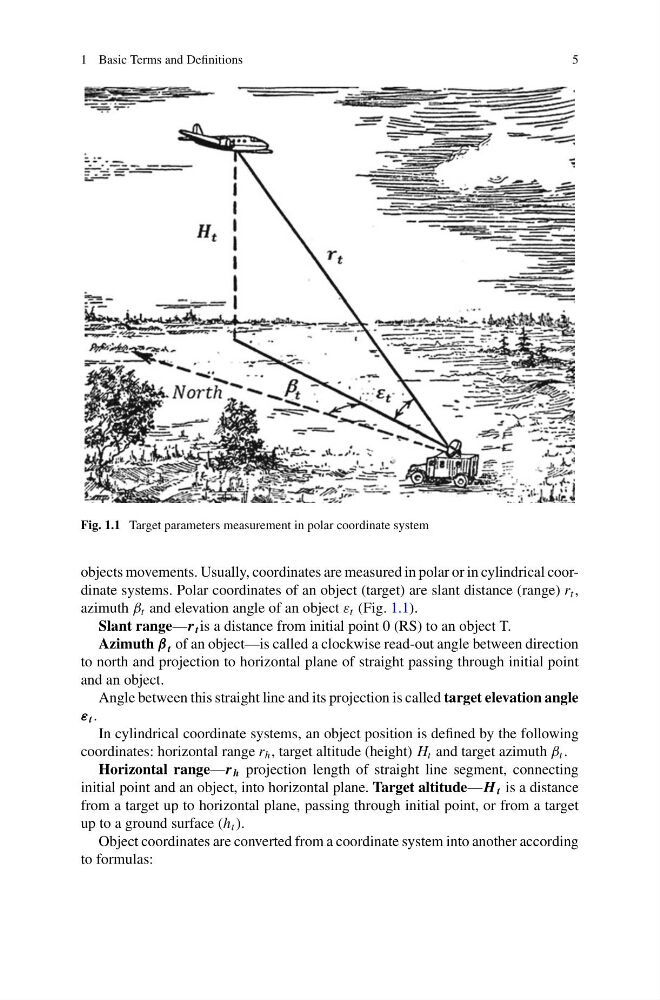
Fig. 1.1 Target parameters measurement in polar coordinate system
objects movements. Usually, coordinates are measured in polar or in cylindrical coordinate systems. Polar coordinates of an object (target) are slant distance (range) r t ,
azimuth β t and elevation angle of an object ε t (Fig. 1.1).
Slant range—r t is a distance from initial point 0 (RS) to an object T.
Azimuth β t of an object—is called a clockwise read-out angle between direction
to north and projection to horizontal plane of straight passing through initial point
and an object.
Angle between this straight line and its projection is called target elevation angle
ε t .
In cylindrical coordinate systems, an object position is defined by the following
coordinates: horizontal range r h , target altitude (height) H t and target azimuth β t .
Horizontal range—r h projection length of straight line segment, connecting
initial point and an object, into horizontal plane. Target altitude—H t is a distance
from a target up to horizontal plane, passing through initial point, or from a target
up to a ground surface (h t ).
Object coordinates are converted from a coordinate system into another according
to formulas:
5
Fig. 1.1 Target parameters measurement in polar coordinate system
objects movements. Usually, coordinates are measured in polar or in cylindrical coordinate systems. Polar coordinates of an object (target) are slant distance (range) r t ,
azimuth β t and elevation angle of an object ε t (Fig. 1.1).
Slant range—r t is a distance from initial point 0 (RS) to an object T.
Azimuth β t of an object—is called a clockwise read-out angle between direction
to north and projection to horizontal plane of straight passing through initial point
and an object.
Angle between this straight line and its projection is called target elevation angle
ε t .
In cylindrical coordinate systems, an object position is defined by the following
coordinates: horizontal range r h , target altitude (height) H t and target azimuth β t .
Horizontal range—r h projection length of straight line segment, connecting
initial point and an object, into horizontal plane. Target altitude—H t is a distance
from a target up to horizontal plane, passing through initial point, or from a target
up to a ground surface (h t ).
Object coordinates are converted from a coordinate system into another according
to formulas: